When to replace a heat pump in Owensboro, KY

A local installer who puts in heat pumps gets your project.

Find a heat pump pro

How do I know when to replace my heat pump?

Your heat pump works harder in Daviess County than it would somewhere milder. It's pulling double duty, warming the house through cold winters and wringing moisture out of long, sticky summers. At some point every unit starts costing you more in repair calls and higher bills than it would to just put in a new one. The question is whether you're at that point now, or whether one more repair will get you through another year.

Replace it once repairs get frequent or the unit is past 15 years old

A heat pump running 15 years or more has usually been through enough summers and winters here that its compressor and other parts are wearing out together, not one at a time. If you've called for a repair more than once in the past year, or the last quote came close to half what a new system costs, replacing it is usually the better move. A unit that short cycles, blows air that isn't quite warm enough in January or cool enough in July, or runs up your power bill compared to last year is telling you the same thing. Keeping an aging unit alive through one more Owensboro winter often costs more than starting fresh with one sized right for your home.

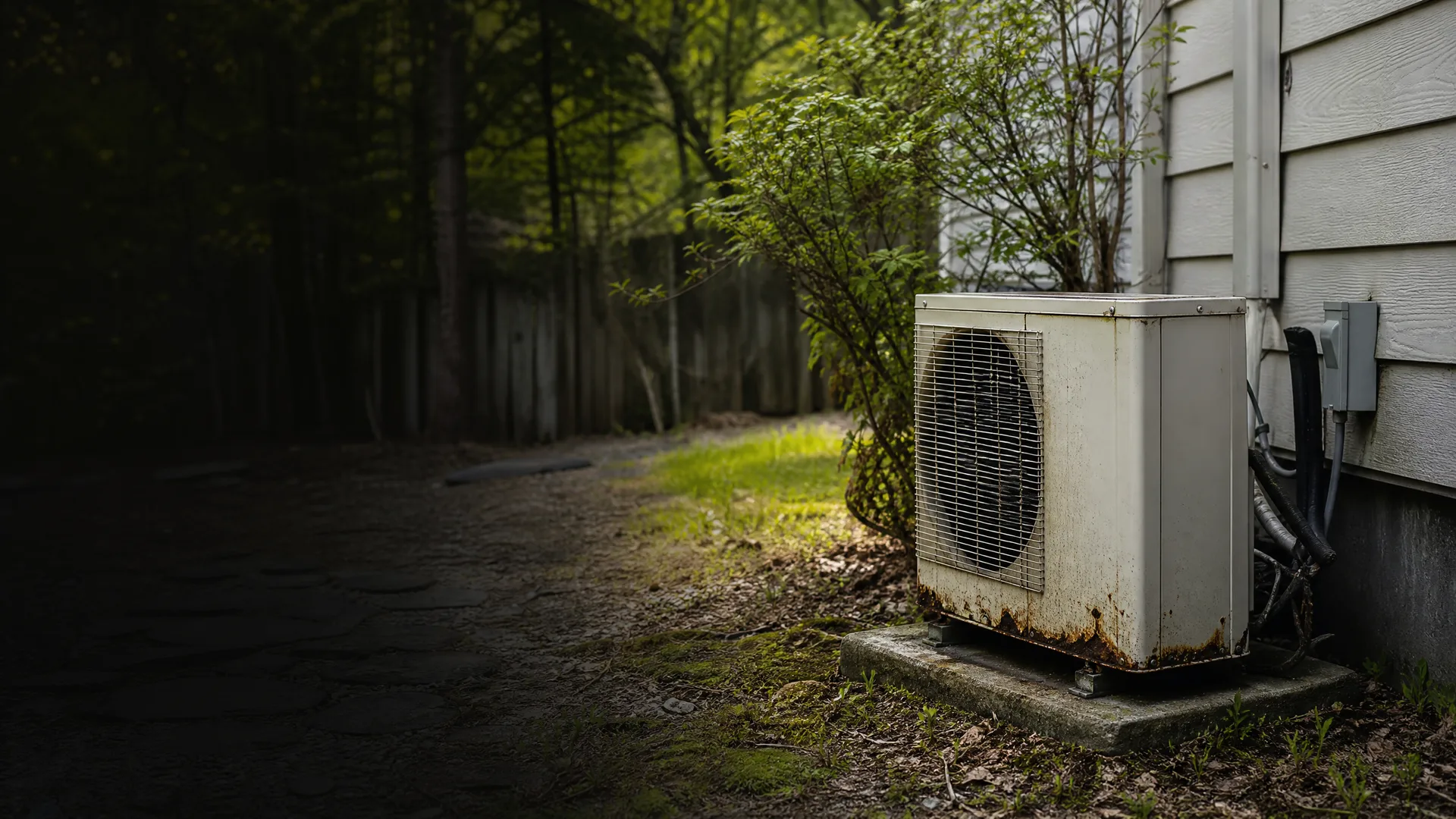
A weathered, rust-streaked outdoor heat pump unit on a concrete pad beside a house with horizontal siding, with shrubs, moss and a dim wooded yard and fence to the left.

You walk out to the side yard in March to check on the unit before summer hits. The rust is easy to spot now, orange streaks running down the base where the cabinet meets the pad. It wasn't there last spring. The fan spins when you flip the thermostat over, but it sounds rougher than you remember, a low rattle underneath the hum. You crouch down and notice the ground near the base stays damp even though it hasn't rained in two days. Daviess County winters put a lot of hours on this unit, and it's starting to show. You straighten up, wipe your hands on your jeans, and head back inside, already wondering how many more summers it has in it.

What does Daviess County weather ask of your heat pump?

  • Winter nights average 28°F

    Winter nights averaging 28°F mean the unit leans on its backup heat strips often, and those cost more to run than the compressor.

  • Heat runs October through April

    Seven months of heating puts long hours on the compressor every year, so a unit past its years has already logged a lot of cycles.

  • Cooling runs May through September

    Five months of cooling adds onto that same heating load, so this unit gets almost no real rest across the year.

NOAA nClimDiv 1991-2020

How a Heat Pump Actually Works

  • A heat pump runs in reverse to heat, pulling heat from outside air even when it's cold, down to a point.
  • Below around 35°F outdoors, the compressor gets help from backup electric strips to keep the house warm.
  • The defrost cycle melts ice off the outdoor coil by briefly reversing the system, which is normal in winter.
  • A compressor that short cycles, running a few minutes then stopping, usually points to a failing capacitor or low refrigerant.
  • The reversing valve is what switches the system between heating and cooling, and when it sticks, one mode stops working.
  • Backup strip heat draws far more power than the compressor, so a unit leaning on it often is costing you more to run.

A heat pump doesn't make heat the way a furnace does. It moves it. In winter it pulls warmth out of the outside air, even cold air, and carries it inside through the refrigerant line. That works well down to around 35°F. Past that, the compressor alone can't keep up with a Daviess County cold snap, so the system brings in backup electric strips to cover the gap. Those strips are a backstop, not the main event, and they draw a lot more power than the compressor does.

You'll also see the outdoor unit run its defrost cycle on a cold morning, the fan stopping while the coil clears itself of ice. That's the system briefly switching into cooling mode to melt the frost, then switching back. It's normal and it's quick.

The part doing the switching between heating and cooling is the reversing valve. When it sticks, the system gets stuck in one mode no matter what the thermostat calls for. And if the compressor starts cycling on and off every few minutes instead of running a normal stretch, that's usually a capacitor giving out or the refrigerant charge running low, not something that fixes itself. A technician checking any of this is really checking three things: the charge, the valve, and how much the strips are kicking in. All three tell you whether the unit is still doing its job the efficient way or working around a problem.

A woman with long gray hair in a dark green sweater sits on a cushioned window seat with textured pillows and a knit blanket, looking out a window toward trees with yellow and orange foliage.
A gray-haired woman in a cream sweater sits under a blanket in a living room, looking out a window toward sunlit yellow foliage, with a lamp, framed landscape painting, bookshelf and potted plant behind her.
A gray-haired woman in a gray knit sweater sits in an armchair by a window with autumn foliage outside, in a room with a wooden dresser, framed picture, and a potted plant.
A gray-haired woman in a cream turtleneck sweater sits in an armchair by a window, looking out toward yellow and orange autumn foliage, with a lamp, bookshelf and side table in the dim room behind her.

Find a heat pump installation pro in Daviess County

A heat pump that's struggling in Daviess County doesn't usually fail all at once. It leans harder on the backup strips, the defrost cycle runs more often, and the power bill climbs a little each winter before anyone notices why. By the time the rust has spread or the compressor hesitates on startup, you're not looking at a tune-up anymore. A heat pump installer who works this county every season has seen which units make it past ten winters here and which ones start costing more to run than to replace. That's not something you can tell from the model number or a quick look at the cabinet. Getting one local contractor out to look at your specific unit, the age of it, how it's been running, what it's costing you, tells you more in twenty minutes than guessing will. If yours is already leaning on those strips most winter nights, that's worth having someone look at now, before the next cold snap finds out for you.

Repairing it one more time

A heat pump that's six or seven years old and still under warranty on parts is usually worth fixing. A stuck reversing valve or a bad capacitor is a few hundred dollars of work on a machine that has years left in it. The repair bill is small next to the cost of a new system, and you keep the refrigerant charge and ductwork you already know work with this unit. If the compressor has been running fine and this is the first real repair call in years, there's no reason to push a replacement. Fixing it also buys time to plan a replacement on your terms instead of in the middle of a January cold snap, when Daviess County contractors are booked solid and prices aren't in your favor.

Replacing it instead

Once a heat pump is past ten or twelve years old and the compressor itself is the problem, replacing makes more sense than repairing. A new compressor alone can cost close to what a new outdoor unit runs, and an old unit paired with a new compressor is still an old unit everywhere else. If you've had two or more repair calls in the past couple of winters, or the unit is leaning hard on backup strips to keep up, a new system will hold up better through the next several Daviess County winters and summers. It also comes with a full warranty instead of a warranty on one part. A contractor who services heat pumps in this area can tell you quickly which side of that line yours falls on.

An outdoor air conditioner condenser unit on a concrete pad beside a house with beige horizontal siding, with conduit running from an electrical box on the wall.
Before you get your heat pump installation
A gray outdoor heat pump unit on a concrete pad beside a house with horizontal lap siding, connected by conduit and a flexible line to a wall-mounted disconnect box, with low shrubs and mulch nearby.
After you get your heat pump installation

The same unit cools your house in July and heats it in January because of one part, the reversing valve. It switches which way refrigerant flows through the system. When that valve sticks, you get strange results, like cold air blowing when the thermostat is calling for heat. The compressor is the part doing the real work moving that refrigerant, and it's built to last a certain number of years under normal conditions. A weak capacitor or a low charge makes it short-cycle, turning on and off more than it should, and that wears it out faster than steady runtime would. The defrost board watches a sensor on the outdoor coil and only triggers a defrost cycle when ice has actually built up, not on a timer. Backup heat strips pull a lot more power than the compressor does, so if a unit is leaning on them more than it used to, that often points to a refrigerant leak or a compressor on its way out, not just a cold snap. Refrigerant doesn't run out on its own. If the charge is low, it's leaking somewhere.

How a heat pump actually works

  • The reversing valve is what lets the same unit cool in July and heat in January by switching refrigerant flow direction.
  • A stuck reversing valve often shows up as a system blowing cold air when the thermostat calls for heat, or the reverse.
  • Compressors are rated for a design life, but short-cycling from a failing capacitor or low charge wears them down faster than normal runtime.
  • The defrost board reads a thermistor on the outdoor coil and triggers defrost only when ice actually builds up, not on a fixed timer in most newer units.
  • Backup heat strips draw far more current than the compressor, so a unit leaning on them often points to a refrigerant or compressor problem, not just cold weather.
  • Refrigerant doesn't get used up in a sealed system, so a unit that's low on charge has a leak somewhere in the lines or coil.
A woman in a cream knit sweater sits in an armchair indoors, eyes closed and smiling, beside a window showing yellow and orange autumn foliage, with a mug on a wooden side table and shelves holding vases behind her.
An older man with gray hair and a navy knit sweater sits in an armchair with his eyes closed, near a bright window with potted green plants.
A gray outdoor heat pump unit on a concrete pad beside a house with horizontal lap siding, with a conduit running to a wall-mounted disconnect box and a green shrub to the left.

Running clean

The coil is clear and the pad around it is clean, no leaves piled against the cabinet. The disconnect box is wired tight and the unit sits level. A heat pump kept like this moves heat efficiently in both directions, and the compressor isn't fighting anything extra to do its job.

An outdoor air conditioner condenser unit on a concrete pad beside a house with horizontal vinyl siding, with refrigerant lines and an electrical disconnect box on the wall and dry leaves on the ground.

Losing ground

Dirt cakes the coil fins and dead leaves have built up around the base, both blocking the airflow the unit needs to work. A heat pump running like this pulls more power to move the same heat, and the strain shows up on the bill before it shows up as a breakdown.

A man in a dark jacket and khaki pants walks through an open gate in a stone wall toward a woman standing in the open front doorway of a single-story white house with a dark shingled roof and river-rock accents.

What an aging heat pump costs you at home

You feel it first in the rooms farthest from the unit. The bedroom at the end of the hall stays five degrees cooler in January than the living room, so you run a space heater at night and tell yourself it's the ducts. It's not always the ducts. A compressor that's lost some of its capacity still runs, it just can't move enough heat to catch up on the coldest nights, and the backup strips pick up the difference at a much higher cost per hour.

Your power bill tells the rest of it. If January and February have been climbing a little more each year, even in months with similar weather, that's the unit asking for more electricity to do the same job. A local contractor who installs heat pumps in Daviess County homes all winter can look at your unit's age, its repair history, and your actual bills, and tell you plainly whether you're paying for a machine that's still worth keeping.

A living room with a cream sofa and knit throw beside a window, with a wooden coffee table in the foreground holding a round woven tray, a small bowl, and a speckled vase of green leafy branches.

Power here costs 14.33 cents per kilowatt-hour

At 14.33 cents per kilowatt-hour, every hour those backup strips kick in shows up on the bill fast, they draw far more power than the compressor alone. An old heat pump leaning on strip heat all winter costs you more each year it goes unreplaced.

EIA-861 2025

The signs to watch for are the rust at the base, the backup strips running more than they should, the rooms that never quite get warm, and a compressor getting old enough that a repair bill stops making sense. One or two of those on their own might wait. Several together mean the unit is telling you something. When you decide it's time, getting matched with a licensed contractor who works in Daviess County and handles heat pumps all year, through the long summers and the cold winters, means someone who already knows what tends to fail on units that have been through seven winters here. You'll hear from one contractor, not a handful calling at once. That's the whole decision: replace it before it fails on the coldest night of the year, or the hottest week of summer, rather than after.

A gray outdoor heat pump unit mounted on a concrete pad beside a dark horizontal-slat clad house wall, with gravel ground and shrubs nearby.

The right pro for this job

New system or replacementHeat PumpDaviess County, KY
Step 1 of 2

What ZIP code is the job in?