





Dark-painted single-story houses with gray shingle roofs behind a trimmed green hedge and mown lawn, surrounded by leafy trees under an overcast sky.

AC Repair in Versailles, KY

Tell us about the job

Takes about a minute. No obligation.

RepairCentral ACWoodford County, KY
Step 1 of 2

What ZIP code is the job in?

Summers here run May through September, with afternoon highs averaging 85 in June, July and August. That's real work for your AC, but nothing extreme as these systems go. Most repair calls in Versailles turn out to be the same handful of problems. A weak capacitor. A dirty coil. A low charge. A clogged drain line. The weather isn't too much for the unit. Something in it gave out, and the job is finding which part and replacing that one.

5 months
May through September, your air conditioner is on duty
85°F
the average summer afternoon it cools against
1 hail events
in ten years, and hail bends the fins on outdoor coils
58 wind events
in ten years, and wind drives debris into outdoor units
Isometric grayscale illustration of a cutaway house showing interior rooms, ceiling ductwork connected to an indoor air handler, and an outdoor condenser unit linked by lines along the exterior wall.
Your air conditioner works hardest from June through August.

NOAA nClimDiv, 1991–2020 normals

Cooling starts in May here, right after April.

The first warm stretch is what finds the part that was already weak.

Half the homes here were built in 1984 or later, so a lot of these systems aren't old

Half the homes here were built by 1984
Cooling runs May through September
Summer afternoons average 85°F

Woodford County gets its share of weather. Damaging wind has hit 58 times in the last ten years, plus a tornado and a dozen winter storms. None of that is what wears out your AC. Wind and ice go after power lines and roofs, not the capacitor in your condenser. Power here does go out sometimes, and about a quarter of Kentucky households lost power for a full day or more last year. If your AC won't start after an outage, check the breaker before you call anyone. Most of the time it's not storm damage. It's a part that wore out on its own and picked a hot day to quit.

A newer system is usually worth repairing

If your system came with the house, there's a decent chance it still has years in it. That makes repair the right first move, not replacement. Get the part that failed fixed and keep the system running.

Find a contractor
A man in a cap, dark T-shirt and work pants seen from behind, carrying a canvas tool bag as he climbs porch steps toward a dark green front door.
A gray cylindrical air conditioning condenser unit mounted on a concrete pad next to a light-colored vinyl-sided house exterior.

What to check before you call

Before you call, go outside and look at the condenser. If the fan isn't spinning but you hear a hum, that's usually the capacitor, not something you can fix yourself, but it tells you what to say when you call. Check the breaker and any switch near the indoor unit, including the one that looks like a light switch on the furnace or air handler. Pull the filter and hold it up to a light. If you can't see light through it, that's restricting airflow and can make the whole system work harder than it should. Look at the outdoor unit for ice on the lines or the coil. Ice means something is wrong with airflow or refrigerant, and running it more will not clear it. Check the drain line near the indoor unit for standing water or a musty smell, which points to a clog. None of this fixes the problem, but it tells the contractor what they're walking into.

Capacitors wear down, they don't just break

A run capacitor holds a charge that keeps the compressor and fan motor going. Heat and time wear it down slowly, so the system struggles more each season before it finally won't start at all. By the time the fan won't spin, that capacitor was already weak for a while.

Low refrigerant means a leak, not usage

A system doesn't use up refrigerant the way a car uses gas. If the charge is low, it's low because it's leaking out somewhere, through a coil, a fitting, or a line. Adding refrigerant without finding the leak just means another call later for the same problem.

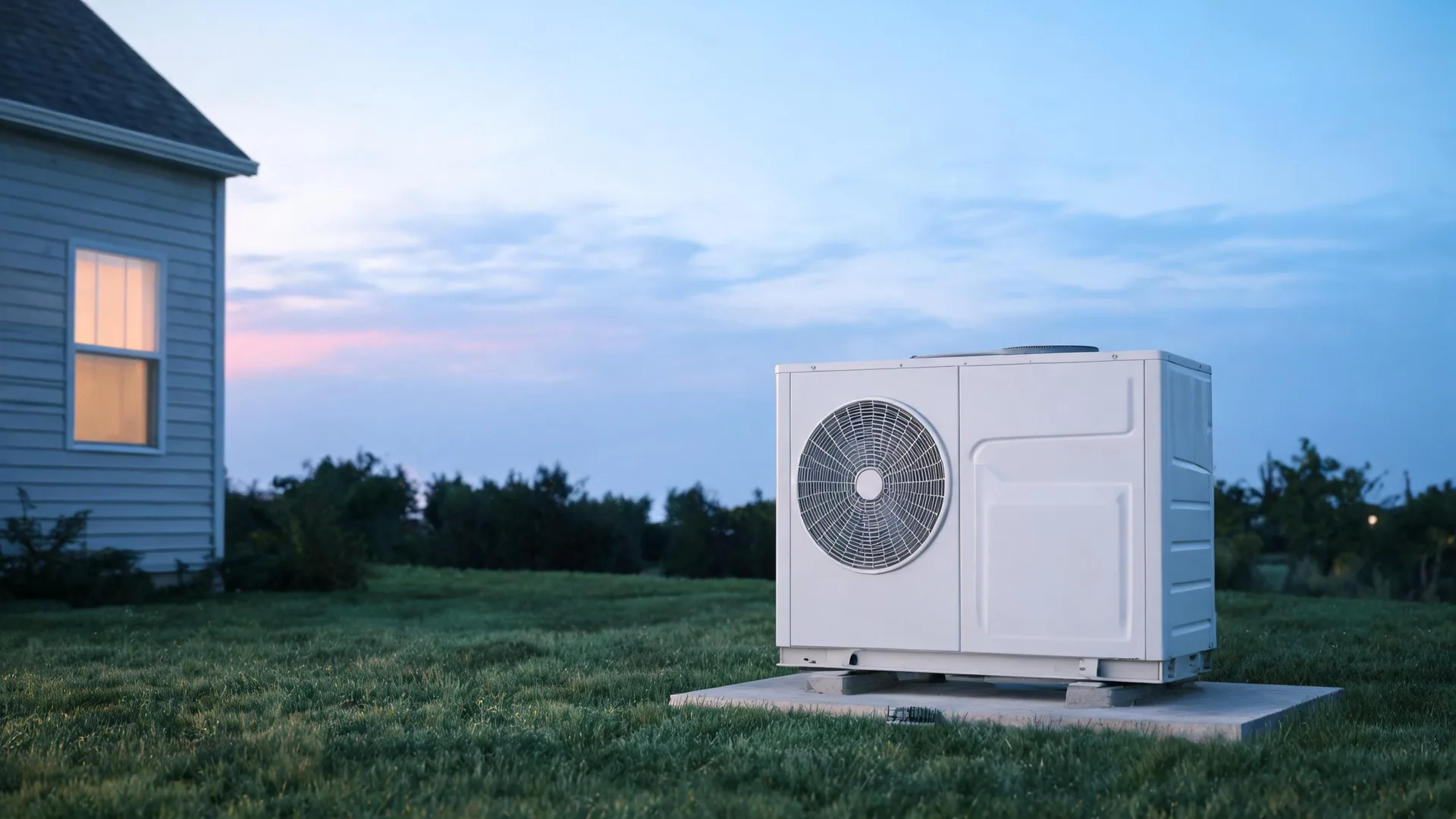
An outdoor air conditioning condenser unit positioned beside a blue-sided house at sunset.

A new air conditioner would cut about $40 a year off cooling for a typical Woodford County home.

  • A new one at the federal minimum, 14.3 SEER2$240 a year
  • An older air conditioner$280 a year

Estimates for a typical Woodford County home, compared with an older unit built to the previous federal minimum, from EIA household energy data, Kentucky fuel prices and NOAA climate normals. Your home will differ.

Repair makes sense when a part like a capacitor or contactor has failed.

Replacement makes sense when the compressor has failed or the system uses R-22 refrigerant, which is no longer made.

A diagnostic starts outside at the condenser, not inside with a thermostat. The tech checks for voltage at the unit, then tests the capacitor and contactor before touching anything else, since those cause most no-start calls. Gauges go on next to check refrigerant pressure, which tells them whether the charge is right or whether there's a leak to find. Inside, they'll check the air handler or furnace for a clogged filter or a frozen coil, since restricted airflow shows up on the gauges as something that looks electrical or refrigerant-related but isn't. If the system runs but doesn't cool well, they'll check the temperature of the air going back in against the air coming out, which tells them whether the system is actually moving heat the way it should. None of this takes guesswork. Each reading points toward or away from a specific part, and that's what narrows down the actual repair.