






A quiet suburban street at twilight featuring two-story brick homes with illuminated windows and large trees lining the sidewalk.

AC Repair in Pikeville, KY

Tell us about the job

Takes about a minute. No obligation.

RepairCentral ACPike County, KY
Step 1 of 2

What ZIP code is the job in?

Pike County saw 164 severe weather events between 2015 and 2024, and most of those were damaging wind. An outdoor AC unit sits outside through all of it. Hail dents the fins, wind throws branches and grit into the coil. A unit can take a hit like that and still start up and blow cold air, so it still seeming to work is not proof it came through fine. If yours took a direct hit from a storm this year, it is worth having someone look at the coil and the fan blade before you trust it through the next one.

4 months
June through September, your air conditioner is on duty
85°F
the average summer afternoon it cools against
25 hail events
in ten years, and hail bends the fins on outdoor coils
125 wind events
in ten years, and wind drives debris into outdoor units
Isometric cutaway illustration of a house interior showing ducted air handling equipment, ceiling ducts, furniture in two rooms, and an outdoor condenser unit connected by lines outside the wall.
Your air conditioner works hardest from June through August.

NOAA nClimDiv, 1991–2020 normals

Half the homes in Pike County were built in 1985 or earlier, half later.

Your AC's age doesn't come from your house's age. Most of the time a dead AC is a failed capacitor or a low charge, same as anywhere else.

Four months of real heat, same AC problems as anywhere

Cooling runs June through September
Summer afternoons average 85°F
125 damaging wind events from 2015 to 2024

A diagnostic starts outside at the unit itself, not with a clipboard of guesses. A tech will cut power, pull the panel, and check the capacitor first since it's the most common failure and the quickest to test. From there it's gauges on the line set to see what the charge is actually doing, not just what the thermostat says. Electrical connections get checked for anything scorched or loose, since a loose wire can mimic a bad part that's actually fine. Airflow gets checked too, across the coil and through the ducts, because a system can have a perfectly good compressor and still run poorly if air isn't moving through it right. The point of the visit is to find the actual failure, not the first thing that looks suspicious.

If your AC took a hit this year, don't wait for it to fail

Pike County gets hit with damaging wind and hail most years. If a storm has come through since you last had the unit checked, get the coil and fan blade looked at now, before summer puts a real load on it.

Find a contractor
A man in a cap, dark jacket and tan work pants, seen from behind, carries a canvas tool bag up concrete steps toward a dark green front door of a gray clapboard house with a potted shrub beside it.
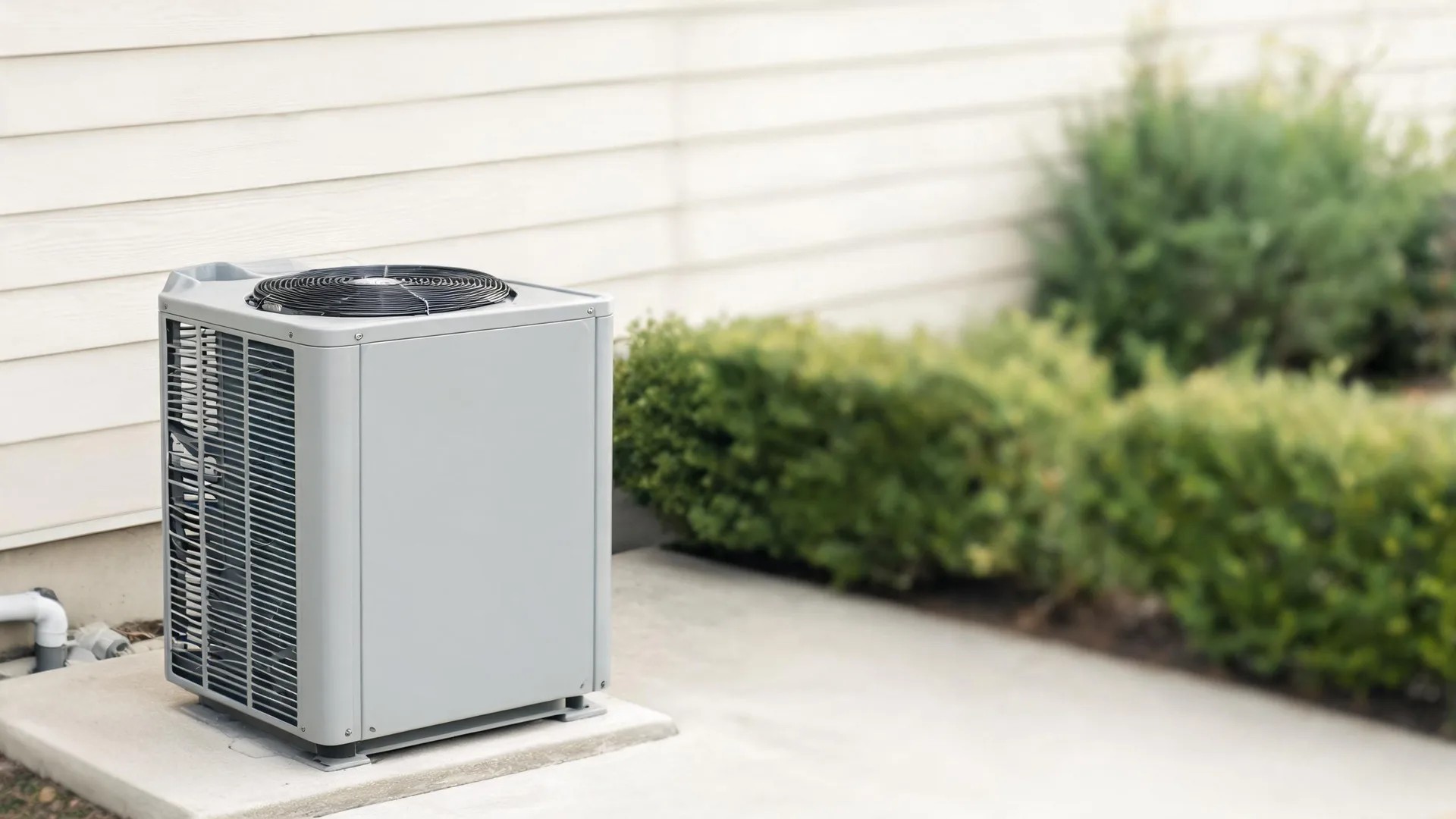
A gray cylindrical air conditioning condenser unit mounted on a concrete pad next to a light-colored vinyl-sided house exterior.

What to check before you call

Before you call anyone, go outside and look at the unit. The fan on top should be spinning free and level, not wobbling or scraping the housing. Pull the breaker if you're going to touch anything near it. Check the disconnect box mounted near the unit, the gray box with a pull-out block, and make sure it's seated in all the way. Look at the line set, the copper pipes running to the house, and feel for ice on either one. Ice means something is wrong with the charge or the airflow, and running it more will only make that worse. Inside, check the thermostat is actually set to cool and the batteries aren't dead, and check the filter. A filter clogged with dust chokes the airflow across the coil and can bring on that same ice. Check the breaker panel too. A breaker that's tripped once will often trip again right away if you reset it and the problem is still there, and that's worth knowing before a tech even shows up.

Warm air instead of cold

Air coming out of the vents that feels like room temperature usually means a low charge or a compressor that has quit, not a thermostat problem. Running the unit longer doesn't fix either one. A struggling compressor that keeps trying can burn itself out the rest of the way.

Short cycling or running nonstop

A unit that shuts off after a couple minutes and restarts right away usually has an electrical problem, often the capacitor, sometimes a sensor reading wrong. A unit that runs nonstop and never catches up is usually fighting a low charge or a coil too dirty to move heat. Both wear the compressor down faster than normal cycling would.

Overhead view of a gray residential air conditioning condenser unit mounted on a concrete pad beside a house with asphalt shingle roofing.

A new air conditioner would cut about $30 a year off cooling for a typical Pike County home.

  • A new one at the federal minimum, 14.3 SEER2$230 a year
  • An older air conditioner$260 a year

Estimates for a typical Pike County home, compared with an older unit built to the previous federal minimum, from EIA household energy data, Kentucky fuel prices and NOAA climate normals. Your home will differ.

Repair makes sense when a part like a capacitor or contactor has failed.

Replacement makes sense when the compressor has failed or the system uses R-22 refrigerant, which is no longer made.

A compressor is the part that makes replacement worth talking about. It's the most expensive part in the unit, and when it's failing outright, most of the time it doesn't make sense to put that money into a system that's still aging around it. A capacitor, a contactor, a fan motor, even a coil, those get replaced on their own all the time and the unit goes on running like normal. The question a tech is really answering isn't just what broke, it's what else in there is close behind it. A unit that's needed a few different repairs over a few different years is telling you something a single breakdown doesn't. One bad part on a system that's otherwise been left alone is usually just one bad part.