Overhead view of a gray outdoor AC condenser unit on a concrete pad beside a mulched garden bed and a house with vinyl siding.

AC Repair in Danville, KY

Tell us about the job

Takes about a minute. No obligation.

RepairCentral ACBoyle County, KY
Step 1 of 2

What ZIP code is the job in?

Four months of real work

AC in Danville runs June through September, with afternoon highs averaging 85 degrees across the summer. That's a normal stretch of use, not an extreme one. A system sized and maintained right should handle it without strain.


So look for the usual cause

When a unit struggles here, it's rarely the weather doing something unusual. It's a weak capacitor, a low refrigerant charge, a dirty coil, or a clogged filter choking airflow. Finding which one it is matters more than guessing at the heat.

4 months
June through September, your air conditioner is on duty
85°F
the average summer afternoon it cools against
9 hail events
in ten years, and hail bends the fins on outdoor coils
32 wind events
in ten years, and wind drives debris into outdoor units
Isometric cutaway illustration of a small home interior with furniture and ducting, showing an indoor air handler connected by lines to an outdoor condenser unit on a pad.
Your air conditioner works hardest from June through August.

NOAA nClimDiv, 1991–2020 normals

A capacitor weakens slowly, then the compressor just won't start one day.

A unit that ran fine Monday can be dead Tuesday, with no warning before it quits.

June is when a weak AC finally gets found out

Cooling runs June through September
Climate zone 4A
Power costs 12.79 cents a kWh statewide

Get the usual fix

Nothing about this area is especially hard on it. It's most likely the usual problem with the usual fix.

Find a contractor
A man in a dark long-sleeve shirt and tan work pants climbs porch steps toward a dark green front door, carrying a worn canvas and leather tool bag, with a potted conical shrub beside the entry.
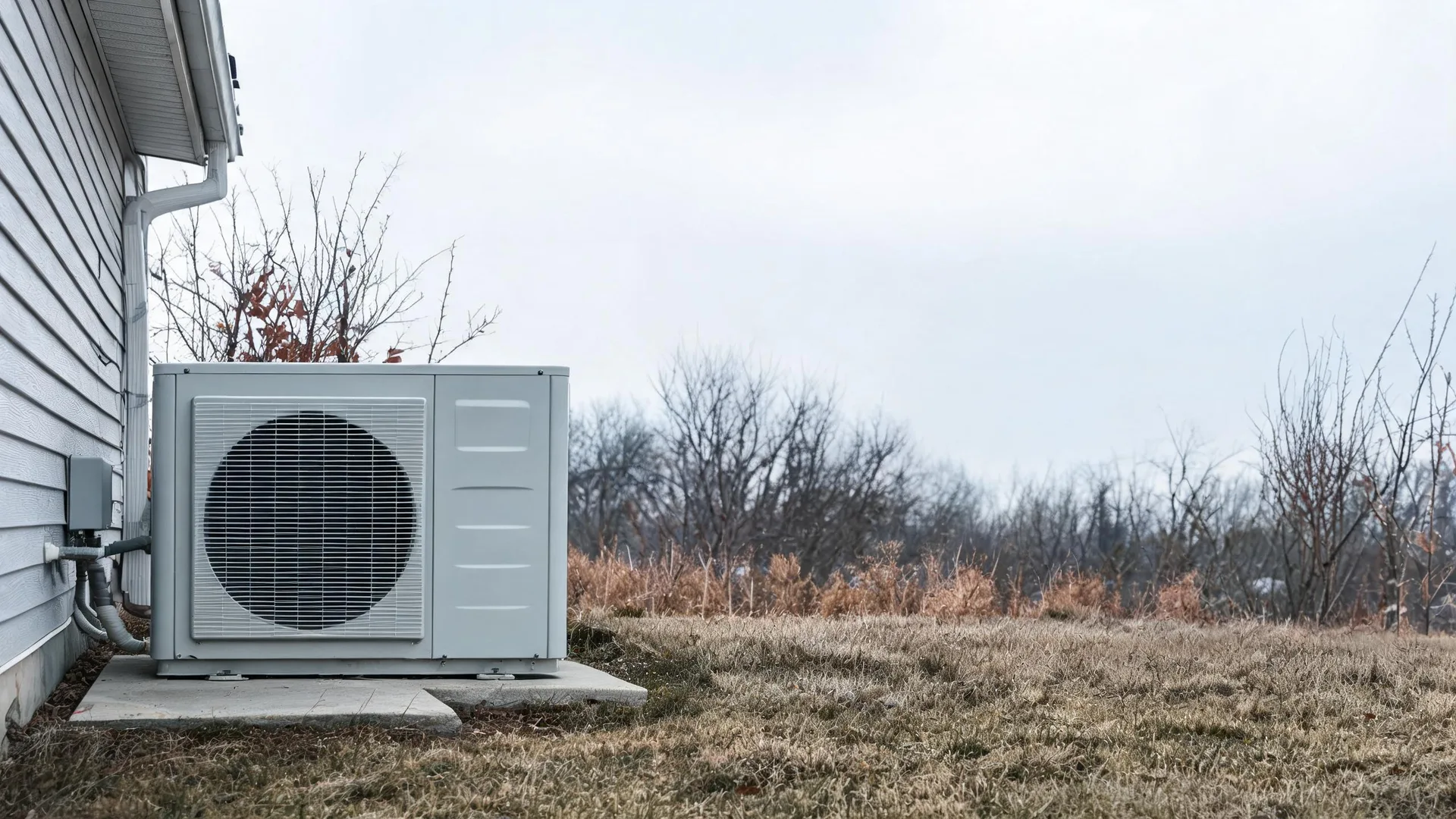
A gray metal air conditioning condenser unit mounted on a concrete pad in a flat grassy field under a partly cloudy sky.

What the AC is telling you before it quits

A system that's struggling makes noise about it before it quits. Short cycling is one of the first things an owner notices, the unit kicking on, running a few minutes, then shutting off before the house cools. That's hard on the compressor every time it happens. Warm air coming out of the vents while the unit runs means it's working without doing its job, which points to the refrigerant charge or the compressor itself. Ice on the coil or the line outside is never a good sign, even though people sometimes see it and think the system is working hard rather than failing. A weak capacitor is different. It can fail quietly, so the unit that ran fine yesterday just won't start today. Short cycling, warm air, and ice are worth calling in before they lead to a unit that won't start at all.

What you can check yourself

Look at the filter first. Pull it out and hold it to the light. If you can't see through it, that's choking the airflow and the coil can freeze because of it. Check the outdoor unit too. Leaves, grass clippings and dirt pressed against the fins block the airflow it needs to dump heat. Clear them away by hand and make sure nothing is stacked against the cabinet. Then check the thermostat. Swap the batteries if it uses them, and make sure it's set to cool and set below the room temperature, not just sitting at the same number.

What to leave alone

Don't open the outdoor unit's cabinet or touch anything inside it. The capacitor in there holds a charge even with the power off and can shock you. Don't pour anything on the coil to clean it or try to straighten bent fins yourself, that's easy to make worse. And if you see ice anywhere on the coil or the line, shut the system off and let it thaw completely before anyone looks at it. Running it iced up pushes liquid refrigerant back toward the compressor, and that's the part you don't want to damage.

An outdoor air conditioning condenser unit mounted on a concrete pad next to a blue-sided residential house at sunset.

A new air conditioner would cut about $40 a year off cooling for a typical Boyle County home.

  • A new one at the federal minimum, 14.3 SEER2$230 a year
  • An older air conditioner$270 a year

Estimates for a typical Boyle County home, compared with an older unit built to the previous federal minimum, from EIA household energy data, Kentucky fuel prices and NOAA climate normals. Your home will differ.

Repair makes sense when a part like a capacitor or contactor has failed.

Replacement makes sense when the compressor has failed or the system uses R-22 refrigerant, which is no longer made.

A diagnostic visit starts outside, at the condenser, before anyone touches a wire. A tech checks the capacitor with a meter, since a weak one often tests low long before it fails outright. Refrigerant pressure gets checked next, with gauges on the lines, because a low charge points to a leak somewhere in the system rather than a part that simply wore out. Airflow gets checked at the coil and the return, since restricted airflow can look like a refrigerant problem when it isn't one. Electrical connections get checked too, since a loose or corroded connection can mimic a failing part. The goal is to find the one thing actually causing the symptom, not to replace parts until something works.