A illuminated two-story red brick house on a quiet residential street at dusk, flanked by mature trees under a deep blue evening sky.

AC Repair in Corbin, KY

Tell us about the job

Takes about a minute. No obligation.

RepairCentral ACWhitley County, KY
Step 1 of 2

What ZIP code is the job in?

Warm air from the vents means the system isn't cooling, not just struggling

When the air coming out feels room temperature or close to it, the unit usually isn't low on airflow, it's failed to cool at all. That points to the compressor, the refrigerant charge, or an electrical problem, not something a dirty filter would cause.


A noise that wasn't there before is worth a call now, not later

Grinding, squealing, or a hard clicking that repeats usually means a motor bearing, a failing contactor, or a fan blade hitting something it shouldn't. These parts don't fix themselves, and running the system while they fail can turn a simple repair into a replaced motor.

4 months
June through September, your air conditioner is on duty
84°F
the average summer afternoon it cools against
12 hail events
in ten years, and hail bends the fins on outdoor coils
84 wind events
in ten years, and wind drives debris into outdoor units
Isometric grayscale illustration of a cutaway house interior showing a furnace with ductwork, interior rooms with furniture, and an outdoor condenser unit connected by lines at the exterior wall.
Your air conditioner works hardest from June through August.

NOAA nClimDiv, 1991–2020 normals

A system that keeps breaking down isn't due for a break, it's telling you the compressor or coil has worn past the point of holding up.

If the unit is old enough that parts are hard to find, a repair now can just be money spent before a replacement anyway.

Four months of real heat and 84 power-disrupting storms a year, nothing more than that

Cooling runs June through September
Summer afternoons average 84°F
84 damaging wind events from 2015 to 2024
Corbin AC RepairHalf the homes here were built in 1987 or earlier, and almost a quarter are mobile homes.

Whitley County saw 108 severe weather events between 2015 and 2024, and most of those were damaging wind. That's a lot of chances for a tree limb or flying debris to hit an outdoor unit. Hail showed up too, enough to bend the fins on a condenser coil without cracking the cabinet or stopping the fan. A unit can keep running after that kind of hit, just worse than before, pulling more power to do less cooling. If your AC took a beating in the last storm and still turns on, that's not the same as it being fine. Worth having someone look at the coil and the fan blade before the next one rolls through.

Get the usual fix

Nothing about this area is especially hard on it. It's most likely the usual problem with the usual fix.

Find a contractor
A man in a cap, gray work shirt and brown pants, seen from behind, steps up porch stairs toward a dark green front door while carrying a canvas tool bag, with a potted shrub beside the entry.
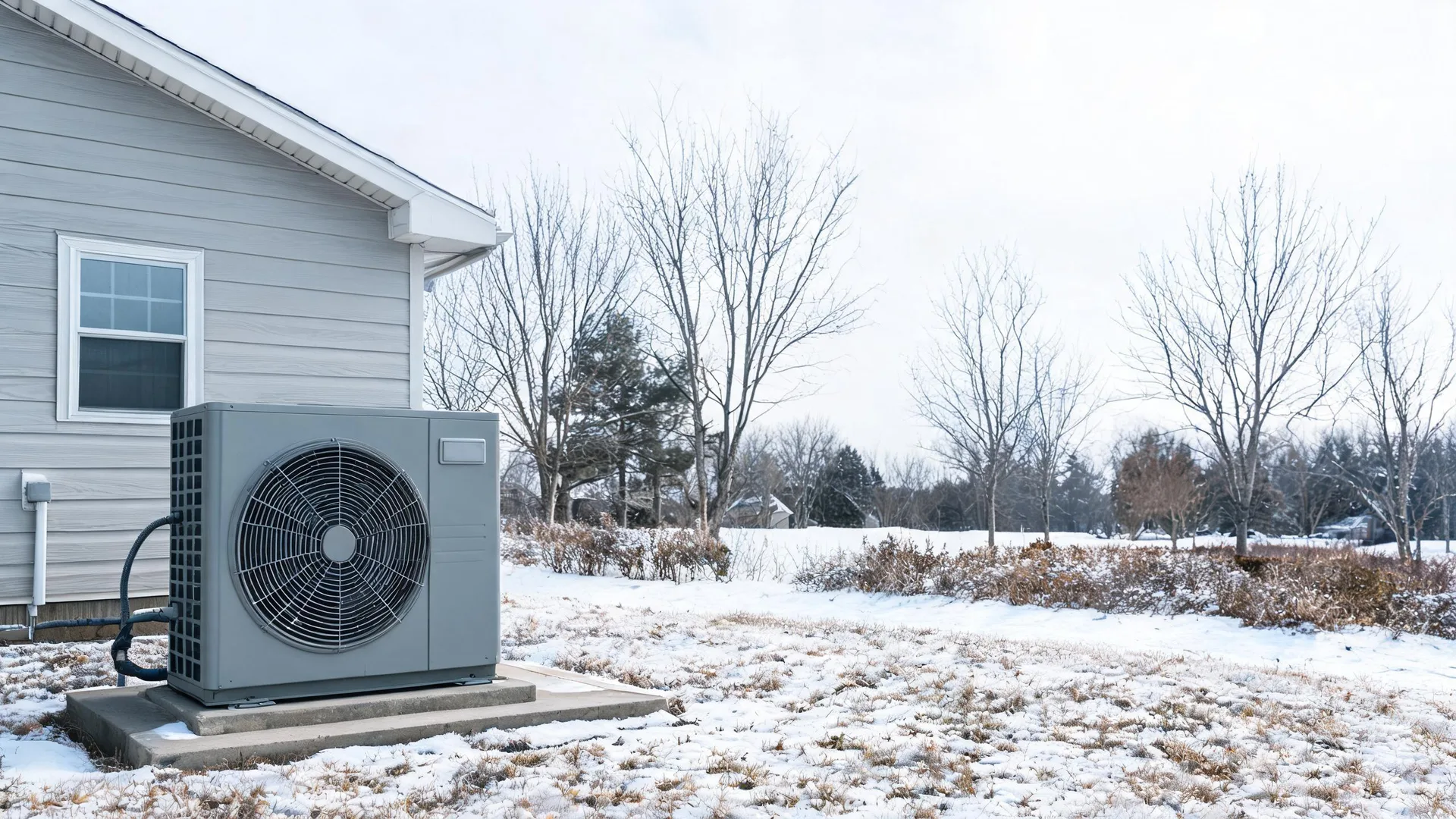
A gray residential air conditioner condenser unit mounted on a concrete pad in an open grass field.

What actually wears out

Most AC failures come down to the same few parts giving out. The capacitor pushes the compressor and fan motors to start and keeps them running smooth once they do, and it loses a little strength every time the system cycles on. After enough cycles it can't deliver a full charge, and the system either won't start or shuts off partway through a run. The contactor wears out the same way. It's the switch that sends power to the outdoor unit each time the thermostat calls for cooling, and its contacts pit and burn a little more with every cycle until they stop closing reliably. The condenser coil fails for a different reason. It has to shed heat into the outside air, and anything that blocks that, dirt, grass clippings, bent fins, makes the compressor work harder to move the same amount of heat. A compressor that runs hot and strained for long enough wears out well before it should. None of this comes from one bad day. It's what happens to a system that turns on and off thousands of times over its life.

A weak capacitor turns into a dead compressor

A capacitor that's losing strength makes the compressor strain to start each cycle. Keep running it that way and the heat from that strain breaks down the compressor windings for good. One is a part swap. The other means a new outdoor unit.

A little refrigerant leak gets worse under pressure

A system low on refrigerant still runs, just colder on the coil than it should. Ice builds up, blocks airflow, and the compressor ends up pulling in liquid refrigerant instead of gas. That's the one thing a compressor can't handle and won't recover from.

An outdoor air conditioning condenser unit installed beside the exterior wall of a blue vinyl-sided house at sunset.

A new air conditioner would cut about $30 a year off cooling for a typical Whitley County home.

  • A new one at the federal minimum, 14.3 SEER2$220 a year
  • An older air conditioner$250 a year

Estimates for a typical Whitley County home, compared with an older unit built to the previous federal minimum, from EIA household energy data, Kentucky fuel prices and NOAA climate normals. Your home will differ.

Repair makes sense when a part like a capacitor or contactor has failed.

Replacement makes sense when the compressor has failed or the system uses R-22 refrigerant, which is no longer made.

A diagnostic starts with the thermostat and the breaker, not the outdoor unit, because a system that won't start at all points somewhere different than one that starts and fails to cool. From there it's gauges on the refrigerant lines to check the charge, a clamp meter on the compressor and fan motor to see what they're actually drawing, and a look at the capacitor and contactor since those fail more than anything else out there. Airflow gets checked too, the filter, the coil, the blower, because low airflow across the coil can mimic a refrigerant problem and send a repair in the wrong direction if it's missed. Most of this doesn't require taking anything apart. It's testing one part at a time until the readings point to the one that's actually failing, then confirming it before anything gets replaced.