





A dark two-story house with a covered front porch and shrubs, framed by large leafy trees, photographed from ground level across a mown green lawn with blurred grass in the foreground.

AC Maintenance in Murray, KY

Tell us about the job

Takes about a minute. No obligation.

Tune-up, service, or cleaningCentral ACCalloway County, KY
Step 1 of 2

What ZIP code is the job in?

Skip maintenance long enough and the first sign is usually weak cooling, not a dead system. Dust builds up on the coil and it can't pull heat out of the air like it should, so the unit runs longer to hit the same temperature. That longer runtime wears on the compressor, which is the part you really don't want to fail. A dirty filter adds to the problem by cutting airflow across that same coil, and in bad cases the coil can ice over. None of this happens right away. It builds slowly, a little worse each time the system runs, until the strain shows up somewhere you notice.

5 months
May through September, your air conditioner is on duty
87°F
the average summer afternoon it cools against
31 hail events
in ten years, and hail bends the fins on outdoor coils
102 wind events
in ten years, and wind drives debris into outdoor units
Isometric line illustration of a cutaway house showing an indoor air handler with branching ducts in the attic space, connected by a line set to an outdoor condenser unit beside the building, with simple furniture in two rooms.
Your air conditioner works hardest from June through August.

NOAA nClimDiv, 1991–2020 normals

Half the homes in Calloway County were built in 1983 or later.

A system that age still has years ahead of it, and a yearly check is what gets it there.

Cooling starts in May here. Get it checked in April.

Cooling runs May through September
Summer afternoons average 87°F
102 damaging wind events from 2015 to 2024
Once a year is enoughKentucky homes paid 12.79 cents per kilowatt-hour in 2024

Cooling runs May through September here, about five months out of the year. One visit before that stretch starts is enough to cover it. The afternoon high averages 87 in June, July and August, so once the system is running it doesn't get a break, but that's steady work, not the kind that calls for extra visits. What a yearly check catches is the slow stuff, a coil getting dirty, a capacitor getting weak, before five months of heat turns it into a breakdown. There's no reason to do it more than once.

Keep it in good shape

If your system is fairly new, a yearly check keeps it in good shape for longer.

Find a contractor
A gray cylindrical air conditioning condenser unit mounted on a concrete pad next to a light-colored vinyl-sided house exterior.

Not every tune-up looks under the same hood

A quick visit covers what you can see. Check the refrigerant pressure, look at the filter, maybe hose off the condenser coil. A thorough one covers what you can't. That means pulling the capacitor and testing it under load, not just eyeballing it for a bulge. It means checking the contactor for pitting, since that's a part that arcs a little every time the system cycles on. It means measuring the temperature drop across the evaporator coil to see if the system is actually moving heat the way it should, not just running. It means checking refrigerant by superheat and subcooling instead of just topping off the charge. A capacitor that's starting to weaken will still let the system run fine for months before it fails outright, usually on the hottest day it has to work. That's the kind of thing a quick check walks right past and a thorough one catches with time to spare.

Keep the filter clean

A dirty filter is the one thing worth checking without waiting for a visit. Pull it out, hold it up to the light, and if you can't see through it, swap it or wash it if it's the reusable kind. A clogged filter starves the coil of airflow, and that's the same strain that leads to icing and a struggling compressor.

Leave the rest alone

Don't pull panels off the outdoor unit or touch the capacitor or contactor yourself. Those parts hold a charge or carry voltage that doesn't go away just because the system is off. Clearing leaves, grass clippings or anything piled against the outdoor unit is safe and worth doing. Anything past that is a job for the yearly check.

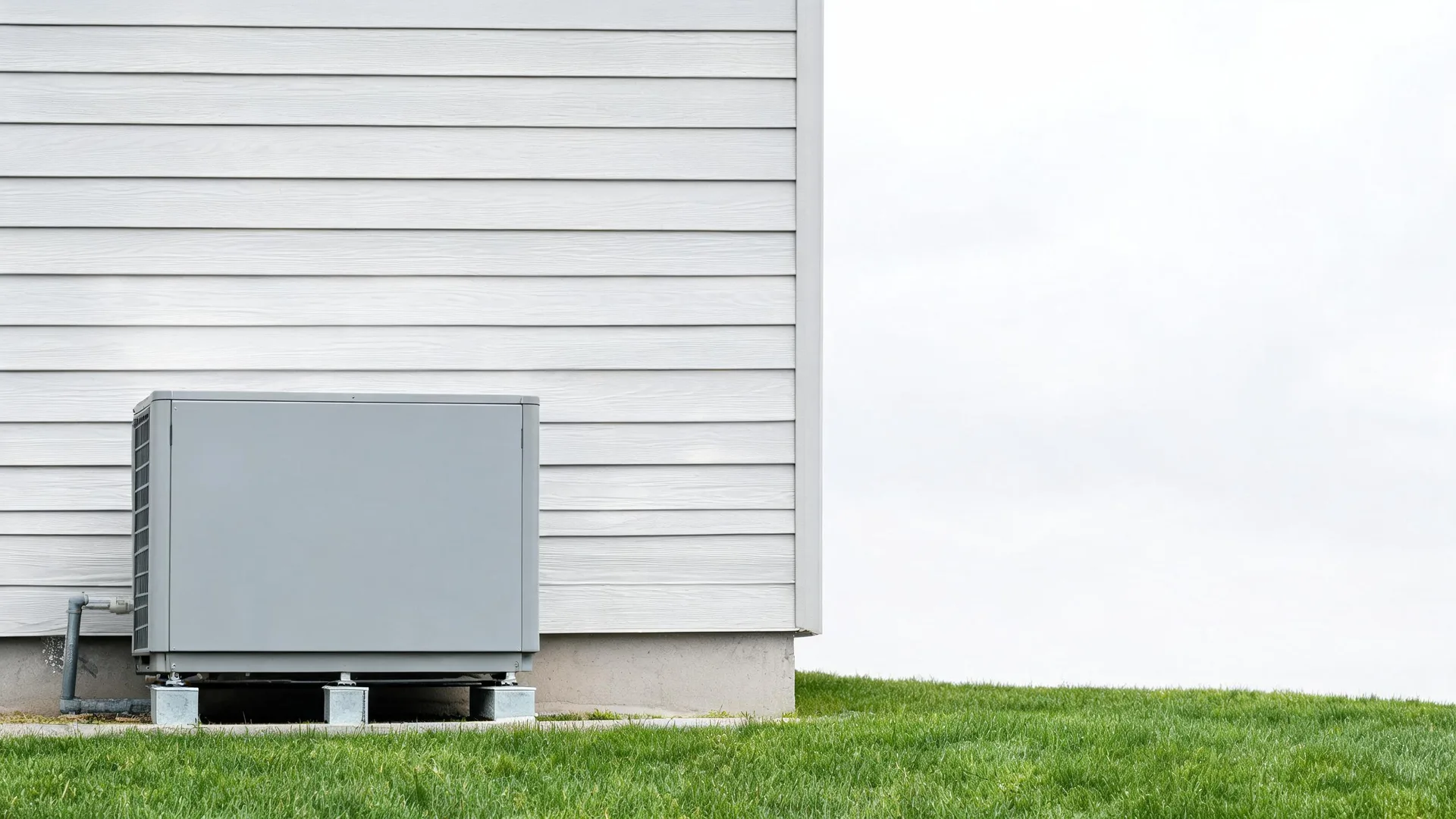
An overhead view of a residential air conditioning condenser unit mounted on a concrete pad next to a house with vinyl siding.

Book your AC tune-up in April, before homes here start needing cooling in May.

  1. Jan
  2. Feb
  3. Mar
  4. Apr
  5. May
  6. Jun
  7. Jul
  8. Aug
  9. Sep
  10. Oct
  11. Nov
  12. Dec

A tune-up checks the refrigerant charge, cleans the coils, tests the capacitor and tightens the electrical connections.

A tune-up worth paying for ends with the system put back together and run through a full cycle, not just inspected. The technician checks the condensate drain, since a clogged one backs up and can shut the system down or leak into the house. The blower wheel gets looked at too. It collects dust the same way the coil does, and a dirty wheel moves less air no matter how clean everything else is. Electrical connections at the disconnect and the air handler get tightened, because a loose connection heats up under load and that heat damages whatever it touches. The refrigerant lines get checked for the right insulation, since a bare suction line loses cooling capacity before the air ever reaches a vent. None of this takes the place of a repair once something's actually failed, but it's what keeps that failure from happening in the first place.