







A lit brick residential street at dusk showing a row of two-story homes with covered porches and mature trees.

AC Maintenance in Hopkinsville, KY

Tell us about the job

Takes about a minute. No obligation.

Tune-up, service, or cleaningCentral ACChristian County, KY
Step 1 of 2

What ZIP code is the job in?

Christian County saw 169 severe weather events between 2015 and 2024, and damaging wind caused most of them. Wind drives debris into the condenser coil and the fan outside your house. Hail dents the housing and bends the fins that let it shed heat. A unit can look fine from the porch and still be running on a bent coil or a fan that's been knocked out of balance. Before the heat sets in is the time to find out.

5 months
May through September, your air conditioner is on duty
87°F
the average summer afternoon it cools against
26 hail events
in ten years, and hail bends the fins on outdoor coils
106 wind events
in ten years, and wind drives debris into outdoor units
Isometric grayscale illustration of a cutaway house with the roof lifted, showing interior rooms, ductwork, an indoor air handler, and an outdoor condenser unit beside the building.
Your air conditioner works hardest from June through August.

NOAA nClimDiv, 1991–2020 normals

A clean filter and a clear space around the condenser are jobs for the homeowner.

The coil, the fan motor and the refrigerant charge need a trained eye at every visit.

Half the AC units in Hopkinsville are younger than the houses by 1983

Half the homes here were built by 1983
Cooling runs May through September
Summer afternoons average 87°F
May is when it starts workingCooling in Christian County runs May through September. Have it checked in April.

A maintenance visit before summer is the chance to catch what last year's storms left behind. A technician can check the fins for the dents hail leaves and see whether the fan still spins true after a season of wind. None of that shows up as a comfort problem until the first hot week, when the unit is working hardest and least able to spare a bent fan or a clogged coil. Getting it looked at now means finding out before the heat does.

Keep a newer system newer

If your AC is one of the newer units here, a yearly check is what keeps it that way. A technician looking at it every year catches a bent fin or a worn part while it's still small, instead of letting it run a full season unnoticed.

Find a contractor
A man in a cap, dark long-sleeved shirt and brown work pants climbs porch steps toward a dark green front door, carrying a canvas tool bag filled with hand tools.
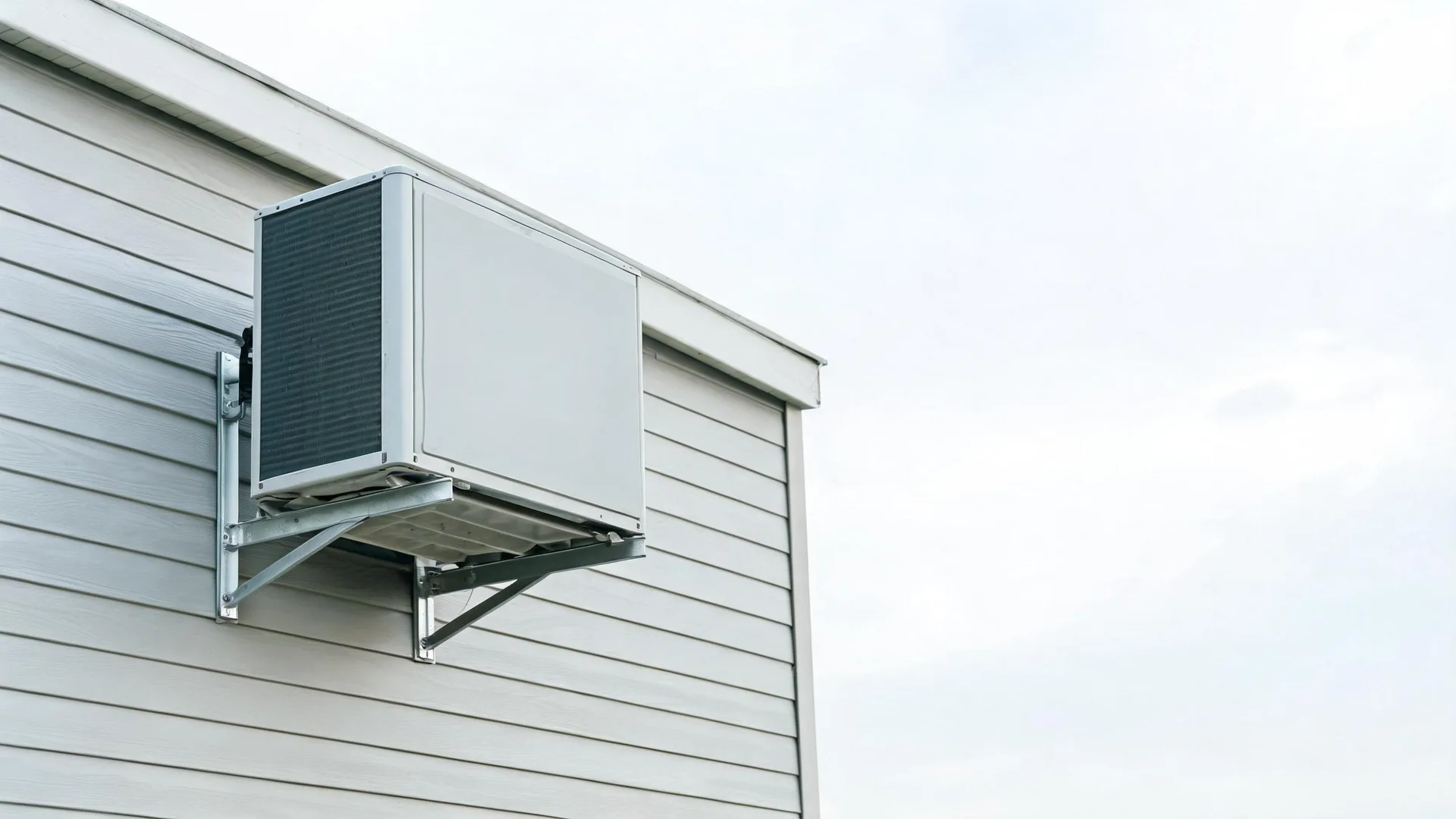
An outdoor residential air conditioning condenser unit mounted on a concrete pad, surrounded by gravel with a blue sky in the background.

A slow part, a clogged line, a system that can't keep up

The filter is the only part of this system you see, and it protects the part you don't. Once it loads up with dust, air stops moving through it, and the evaporator coil inside the house gets cold enough to ice over instead of pulling heat out of the air. The system runs longer to do less. Outside, the condenser coil has to shed that heat into the air, and if it's coated in cottonwood seed or grass clippings or just caked with dirt, it can't let go of heat the way it should. A dirty coil, inside or out, makes the compressor work harder for the same result, and the compressor is not a part you want to wear out early. The drain line has nothing to do with cooling the air, but it carries away the water the evaporator coil pulls out of the house. When that line clogs with algae, the pan behind it fills and backs up. None of these ever fail all at once. They lose a little capacity at a time, until the week the system has to work hardest turns out to be the week it can't.

What a quick visit covers

A fast tune-up checks refrigerant pressure, swaps or checks the filter, and makes sure the unit powers on and blows cold. That tells you the system runs today. It does not tell you how it will hold up once the heat sets in and stays.

What a thorough one adds

A full visit pulls the panel off the condenser and checks the capacitor's output against its rating. Electrical connections work loose from vibration over a season, and a thorough tech tightens them before they arc or fail. The drain line gets flushed before the pan backs up, not after. A tech checks the coil fins for the bends that choke airflow and measures the temperature drop across the evaporator coil instead of just confirming cold air is moving.

Overhead view of an air conditioning condenser unit on a concrete pad next to a house with asphalt shingle roofing and vinyl siding.

Book your AC tune-up in April, before homes here start needing cooling in May.

  1. Jan
  2. Feb
  3. Mar
  4. Apr
  5. May
  6. Jun
  7. Jul
  8. Aug
  9. Sep
  10. Oct
  11. Nov
  12. Dec

A tune-up checks the refrigerant charge, cleans the coils, tests the capacitor and tightens the electrical connections.

A proper tune-up starts with the condenser fan motor. A tech checks that the bearings are quiet and the blade spins without wobbling, since a motor running rough now is one that seizes later. The capacitor gets tested under load, not just glanced at, because a weak one lets the compressor struggle to start every time it cycles. Refrigerant charge gets checked against what the system calls for, not topped off by guess, since too much or too little both make the compressor work harder than it should. The tech also checks the contactor, the relay that switches the compressor and fan on and off, for pitting from years of arcing. Left alone, a pitted contactor can stick closed or fail to close at all.