
Before you get your mini split repair
You're calling around Bowling Green trying to find someone who works on mini splits, explaining the cold-air problem over and over, waiting on callbacks that don't come.
 Let a pro reach out
After you send the request, you're done searching.
Cold air coming out of the heads when you need heat means the mini split isn't switching over right, or something in the outdoor unit has quit. Either way, it's not warming your house, and Bowling Green winters don't leave much room for a system that's down.
Most homes in Warren County run on electric heat, and a mini split that won't heat is one of the main ways people here stay warm. When it stops working, there's no backup furnace kicking in down the hall. You're stuck with space heaters or a cold house until it's fixed.
A problem like this usually comes down to the reversing valve, a frozen outdoor coil, a refrigerant leak, or a control board that's lost track of what the system should be doing. Some of these a homeowner can rule out by looking. Most of them need someone who works on these systems to open it up and test it.
That's the part that eats a weekend: finding someone who actually knows mini splits, not just central air, who's free before next week and willing to drive out to Bowling Green or wherever you are in the county. Calling three companies, repeating the same description of the problem three times, waiting on callbacks that don't come.
Send the form on this page and that search is done. You're not the one calling around anymore. Someone who works on these systems gets your information and takes it from there.
A mini split that won't heat is usually one of a few things. The reversing valve, which flips the system from cooling to heating, can stick and leave it stuck blowing cold. The outdoor unit can ice over in cold weather and if its defrost cycle isn't kicking in, the ice stays and the heat stops. A low refrigerant charge will also leave it running without putting out real heat, even with the fan going. Sometimes the fix is a simple reset, but if the valve or the defrost control has failed, that's a repair job, not a settings problem. With Warren County winters getting genuinely cold, a mini split down for even a few days means space heaters and cold mornings. Worth having someone look at it before the next cold snap, not after.


The indoor head doesn't make heat on its own. It reads the room and sends a call through a control wire to the outdoor unit, which is where the actual heating happens. That signal tells the reversing valve which way to send refrigerant. When that valve sticks halfway, the system keeps running but can't settle into heat mode, so you get power with no warmth. Cold weather adds another step. Frost forms on the outdoor coil below freezing, and the system is built to handle that with a defrost cycle, where the compressor briefly reverses to melt it off. That's normal. What's not normal is the unit staying in defrost, which usually means a sensor or control board misread the frost and never switched back. A low refrigerant charge makes the coil run colder than it should, so ice builds faster and heating time drops. And the outdoor fan has to keep pulling air across that coil the whole time. If the motor is seized or slow, the coil can't shed heat properly, and the whole cycle falls apart from there.




A mini split works hardest when it's cold outside, and that's exactly when a weak system shows its problems. Below a certain outdoor temperature, the unit has to run its defrost cycle more often just to keep the outdoor coil clear of ice. If that cycle isn't timed right, or if the unit is already low on refrigerant, it spends more time defrosting than heating. On a mild January evening in Warren County you might not notice. On a night in the teens, the same system can fall behind and never catch up to your thermostat setting.
Ice across the outdoor coil isn't normal, even in winter. A little frost that clears during the defrost cycle is expected. A coil that stays iced over, or has ice building on the fan or housing, means the defrost cycle isn't completing or the system is low on charge. Running a frozen unit for heat doesn't fix itself, and it puts more strain on the compressor each hour it keeps trying. A contractor checking this will look at the defrost control and the refrigerant charge before anything else, since either one can cause the same ice.
Cooling runs May through September
Cooling runs May through September here, so the mini split gets a break from heat duty before the next cold stretch starts.
Heat runs October through April
Heat runs October through April here, almost seven months, so a stuck reversing valve or iced-over outdoor unit leaves you cold for a long stretch.
Power here costs 12.48 cents per kilowatt-hour
Power here costs 12.48 cents per kilowatt-hour, and a mini split running to make up for weak heat output burns through more of it than it should.
NOAA nClimDiv 1991-2020 · EIA-861 2025


Describe your mini split job once, to one pro.
You only hire the pro if you want to.
With most homes here heating on electricity, a mini split that's stuck blowing cold doesn't just leave you cold. It runs the outdoor unit and any backup strip heat while delivering nothing warm to the room.
That's power going out the meter for a system doing no work for you, through a Warren County winter that runs cold enough to notice right away.


You're calling around Bowling Green trying to find someone who works on mini splits, explaining the cold-air problem over and over, waiting on callbacks that don't come.
You send one form and the search is off your plate. Someone qualified takes it from there, and you're not the one chasing it down anymore.
You can hear the outdoor unit humming along and the indoor head blowing air, so it seems like the system is trying. But the room stays cold anyway. That gap between the unit clearly running and the room never warming up is what sends people looking for an answer, because it doesn't match what a working heater is supposed to do.
A mini split can run its compressor and fan and still put out air that's barely warm, or just room temperature. That happens when the system has the refrigerant charge to run but not enough of it to actually carry heat, or when the outdoor coil is iced over and the unit can't pull heat from the outside air at all. The compressor spins, the fan moves air, every light on the indoor head looks normal, and none of it adds up to warmth in the room. In Bowling Green, this shows up most on the coldest mornings, when the outdoor unit is working its hardest and has the least margin for a problem like a low charge or a coil that won't clear itself.

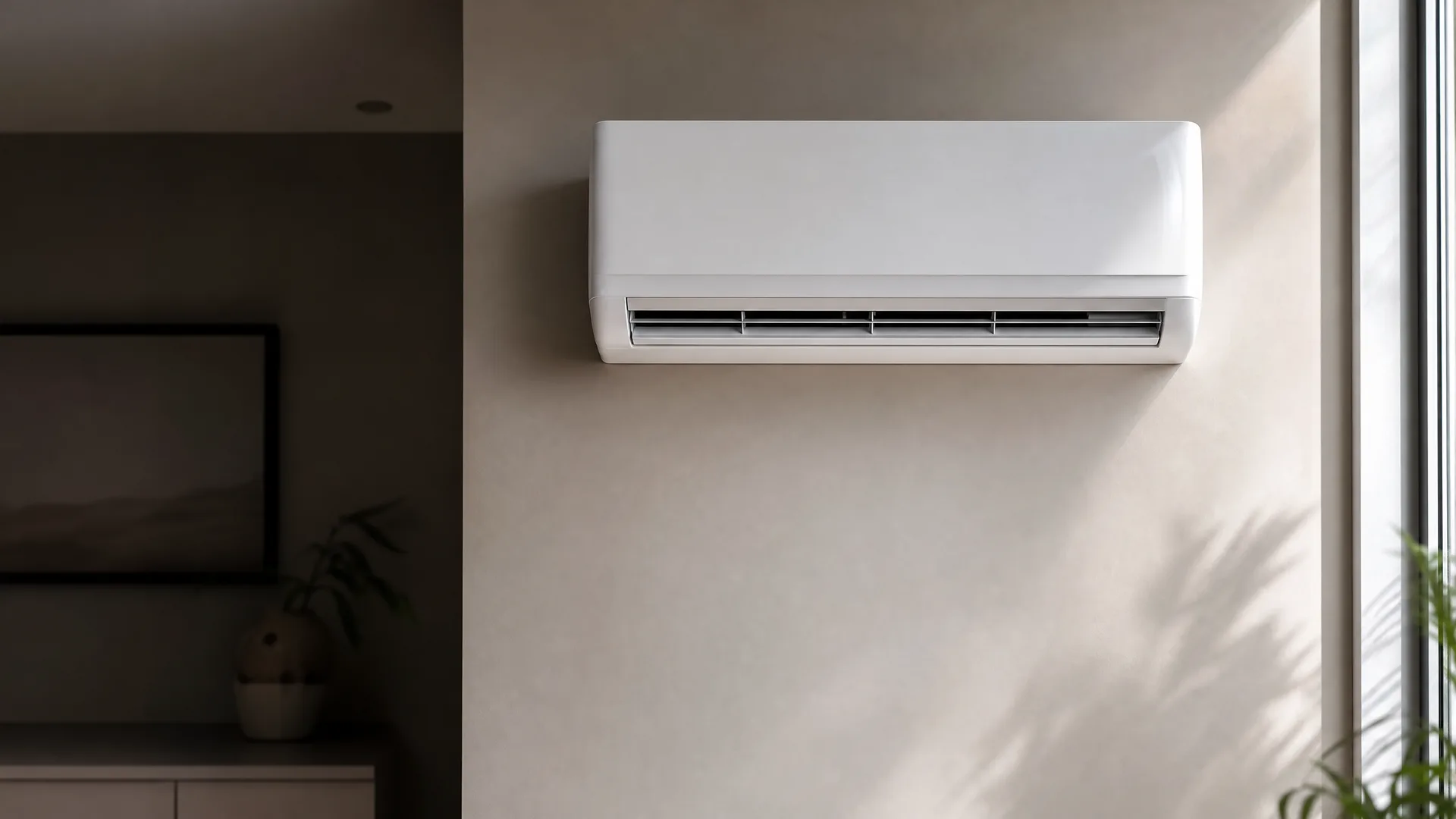
This is what heat delivery looks like: the head mounted clean near the ceiling, casing white, vents clear. Air moving out warm, no buildup dragging on the airflow. Nothing about the unit itself is slowing down what the outdoor system sends it.

Yellowed casing, dust settled into the louvers, years showing on a unit that's been running hard. A mini split in this shape is more likely to have a reversing valve or defrost cycle that's starting to fail along with everything else you can see.
Five months of cooling means your mini split spends the other seven on heat, which is most of the year. That's a long stretch for a reversing valve or defrost cycle to hold up without a check.
NOAA nClimDiv 1991-2020

This is what a mini split should look like. The casing is white and unmarked, the wall around it clean, nothing blocking the vents. Warm air moves out freely because nothing inside is fighting the airflow.

Dust has built up across the casing and into the vents, and the filter sits exposed behind an open panel. Buildup like this blocks airflow before the system ever gets to the reversing valve or defrost cycle, so even a unit that's otherwise fine struggles to heat the room.

A mini split that won't switch over to heat is telling you something specific: a reversing valve that's stuck, an outdoor coil icing over without clearing, or a control signal that isn't reaching the outdoor unit. None of that fixes itself, and running it stuck only burns power without warming the room. With heat season stretching from October into April here, that's not a small stretch to sit on a broken system.
Finding someone who actually works on mini splits in Bowling Green, explaining the cold-air problem to each one, and waiting to see who calls back is its own kind of work. Send the form and that part is done. You're not sorting through names or repeating yourself to the next person who picks up. Someone qualified gets the details and takes it from there, and you get your heat back without having done the legwork of finding them.

Send one request and you're done looking