













Can a mini split cool a whole house in Louisville, KY

Your new mini split project goes to an installer who works in Jefferson County.

Request a pro

Can a mini split cool my whole house in Louisville?

You want central air comfort without central air ductwork, or your ducts can't reach a new addition. A single mini split head handles one room well, but you're wondering if it can carry the whole house through a Louisville summer, when the heat and humidity settle in for months and a system that falls short will show it fast.

Only if you install more than one unit, sized and placed for every room

One indoor head cools the room it's in and maybe the space right next to it, not a whole house. A multi-zone system, with an outdoor compressor running several indoor heads, can cover a full house, but each zone needs its own head and its own sizing. Skip a bedroom and that bedroom stays warm in July. Louisville summers run long and humid, so undersized zones struggle more here than they would somewhere drier. Getting whole-house coverage out of a mini split means a contractor working out how many zones your house needs, where each head goes, and how much capacity each room calls for before anything gets mounted.

A white wall-mounted mini-split air conditioner installed high on a light gray interior wall below a white crown molding and ceiling with a recessed light.
One head, sized and placed right, keeps a single room or an open living area at the temperature you set, even in a Jefferson County August.
A dusty, discolored white wall-mounted mini-split air conditioner unit installed on a plain beige interior wall below a molding strip.
A unit asked to cool rooms down the hall loses the fight once the house warms up, and the far bedrooms run hot by afternoon.

What will it cost you to run a mini split here?

  • Cooling runs May through September

    You're asking it to work May through September, five months straight, longer than a single-zone unit is usually sized for.

  • Heat runs October through April

    Heat runs October through April here. If your mini split is a heat pump model, it's working most of the year, not just summer.

  • Power here costs 12.34 cents per kilowatt-hour

    At 12.34 cents per kilowatt-hour, running an undersized unit hard all summer to cool rooms it wasn't built for adds up fast.

NOAA nClimDiv 1991-2020 · EIA-861 2025

How a multi-zone system works

  • A whole house setup is a multi-zone system: one outdoor compressor feeding several indoor heads through separate refrigerant lines.
  • Each indoor head has its own thermostat, so the bedroom can run cooler than the kitchen without fighting over one setting.
  • The outdoor unit modulates its speed to match the combined load of every head running at once, not just the biggest room.
  • Line sets run through small wall penetrations to each head, so there's no ductwork tying the rooms together.
  • A single outdoor unit can usually support somewhere between two and eight indoor heads, depending on its capacity.
  • Sizing has to account for every room at once, since an outdoor unit matched to one zone will fall short once three or four heads call for cooling in the same August afternoon.

A whole house mini split setup isn't one indoor head working harder. It's a different kind of system, built around one outdoor compressor that branches out to several indoor heads, each one running its own line set and its own thermostat. The living room can sit at 72 while the bedroom runs 68, because each head calls for cooling on its own, independent of the others. That's the opposite of how a single-zone unit behaves, where one thermostat decides for the whole space it's installed in.

The outdoor compressor is the part doing the real work of matching supply to demand. It modulates its speed up and down depending on how many heads are calling at once, so on a mild April afternoon it might run at a fraction of its capacity, and on a sticky August day with every zone calling, it ramps up to cover all of them together. That's why sizing a multi-zone system means adding up every room's load at the same time, not just picking the biggest one. An outdoor unit sized for a single large room will come up short once three or four zones are asking for cooling in the same afternoon.

Line sets run through small wall penetrations to reach each head, which is why there's no ductwork connecting the rooms. Air isn't moved between them. Each head conditions the space it's mounted in, and a single outdoor unit can typically support somewhere between two and eight of them, depending on its size.

An older woman with gray hair in a gray knit sweater sits on a sofa under a knitted blanket beside a large window, looking out toward yellow autumn foliage, with a living room, fireplace and patterned rug behind her.
An older woman with gray hair in a cowl-neck sweater sits on a sofa under a blanket, looking out a large window toward trees with yellow autumn foliage.
A gray-haired woman in a light knit sweater sits in an armchair by a window, looking out at trees with yellow autumn leaves, with a dark ceramic mug on the sill and a plant in the foreground.
A gray-haired woman in a cream knit sweater sits in a chair by a large window, looking out at rolling hills covered in autumn-colored trees.

Put one indoor head in the living room and expect it to carry the whole house, and the strain shows up in the rooms farthest from it first. The compressor runs long hours trying to push cool air somewhere it was never sized to reach, and July and August in Jefferson County don't let up long enough for it to catch up. Upstairs bedrooms stay warm, the air in them stays heavy, and you end up adding a fan or a window unit just to sleep. None of that is free. A compressor working past its load wears faster than one sized to the house, and if the gap never closes, you're looking at a second system on top of the first. A multi-zone setup, with a head in each room that needs one, skips all of this. Every room gets its own cold air and its own thermostat, and no room is left waiting on what's left over from another.

What a single head costs you

  • A single head trying to cool the whole house will run long hours through July and August without ever catching up in the far rooms.
  • Rooms past the one with the indoor head stay several degrees warmer, so you end up running fans or window units to cover the gap.
  • A mini split sized for one zone but pushed to cool the whole house wears out its compressor faster than one matched to the load.
  • If the upstairs bedrooms never cool down, you may end up paying for a second system on top of the one you already installed.
  • Humidity sits heavier in the rooms the mini split can't reach, so August nights there feel damp even with the unit running.
  • A whole house setup avoids this by giving every room its own head, so no part of the house is left to the leftover air from another.
A woman in a cream knit sweater sits in an armchair with her eyes closed and head tilted back, beside a window showing orange autumn foliage and a wooden side table with a mug.
A gray-haired man in a blue quarter-zip sweater sits in an armchair with his eyes closed, beside a large window with bare trees outside and a potted plant and lamp nearby.
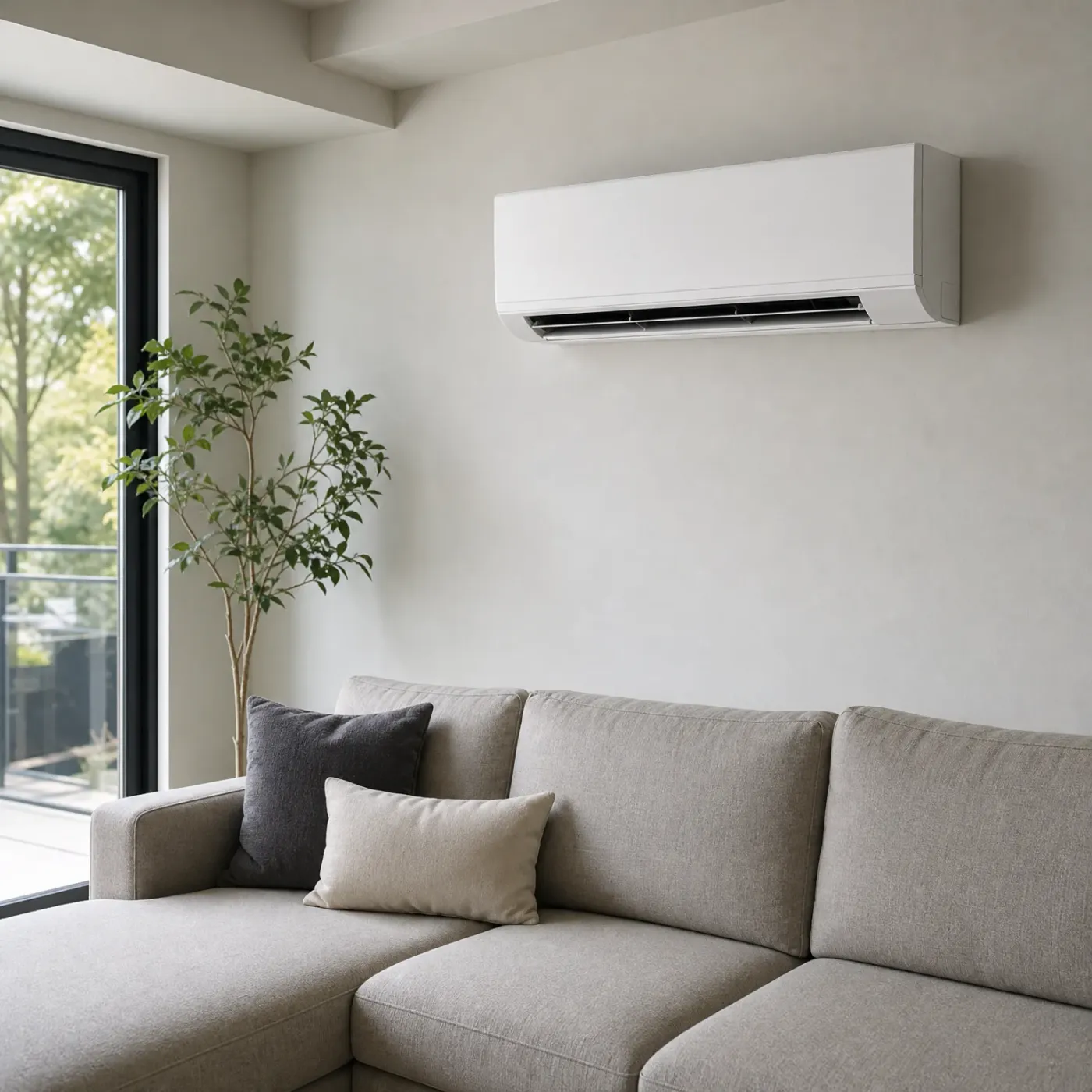
A white wall-mounted mini-split indoor unit on a pale interior wall above a gray sectional sofa with cushions, next to a potted leafy tree and a floor-to-ceiling window showing green trees outside.

A mini split pro near you

A licensed installer who works in Jefferson County gets your project.

Get in touch with a local installer about a new mini split.

Reach a local pro

No charge to send it. You decide if you hire them.

A woman stands in the open black front door of a white-sided house with a dark shingled roof while a man in a navy jacket approaches along the walkway, with lantern wall lights, a potted shrub, and flowering garden beds nearby.

What a single head costs you by August

If your house is running on one indoor head, you already know which rooms stay comfortable and which ones don't. The room with the head gets cold air right where you want it. The rooms down the hall get whatever leaks past the doorway, and in a Jefferson County summer that's not enough. You end up shutting doors to keep the cold air in one place, which only makes the rest of the house feel worse.

A contractor who installs mini splits around Louisville every summer has seen this exact layout before, the one head trying to do a house's job, and knows which rooms usually get left out and why. Getting matched with someone local who works on this kind of system regularly means you're not explaining your house from scratch. One contractor looks at where your rooms sit, where the current head is, and what it would take to add the zones that are missing, instead of guessing from a phone estimate.

A dark ceramic mug on a round wooden table beside a light grey sofa with a woven cushion and knit throw, with a window, potted plant, floor lamp and wooden cabinet blurred in the background.
A white wall-mounted mini-split air conditioner unit near the ceiling on a plain light-colored interior wall with open space to the right.

How the lines actually run

A multi-zone system splits refrigerant from one outdoor unit into separate lines, each feeding its own indoor head. The lines run through a wall or up through an attic, not through ductwork, so a room with no duct run near it, like a finished basement or a converted garage, can still get its own head. That's why additions and older Jefferson County homes without duct access are often where a multi-zone setup earns its keep, room by room.

A white wall-mounted mini-split air conditioner unit installed near the ceiling on a plain beige interior wall, with a light curtain at the right edge.

What sizing on paper misses

A contractor sizing a multi-zone system adds up the square footage and the heat load of each room, including how many windows face west and catch that Louisville afternoon sun. A single head sized for the whole house skips that step and gets picked by total square footage alone. That's the difference between a system that holds 72 degrees in every room through an August afternoon and one that only holds it near the head.

What you're probably noticing right now

The room with the indoor head feels fine. Walk down the hall and it's warmer, maybe noticeably so by afternoon. A back bedroom or a finished bonus room stays sticky no matter where you set the thermostat, and you've probably propped a door open or run a box fan trying to even things out. If this has been going on for a while, check the walls and trim near that far room for any softness or staining. A house that runs warm and humid for months gives mold something to work with, especially in rooms that don't get much air movement.

A white wall-mounted mini-split air conditioner on a beige interior wall, with a cream curtain and window at left, a potted plant on a ledge at right, and a wood floor below.

A head that's keeping up

This is what a mini split looks like when it's sized right for the space it covers. Air moves freely across the coil and out into the room, and the filter behind that front panel isn't fighting years of dust. It cools the room it's in without straining.


A dusty, discolored white wall-mounted mini-split air conditioner unit installed high on a plain interior wall below a white ceiling molding.

A head carrying too much

Dust like this builds up when a unit runs long hours, season after season, often because it's being asked to cover more square footage than one head can handle. A dirty coil cools less for the same effort, so a head already stretched thin falls further behind.

A dusty beige wall-mounted mini-split air conditioner indoor unit installed high on a plain light-colored wall below the ceiling.
Before you get your mini split installation
A white wall-mounted mini-split air conditioner near the ceiling of a room with light gray walls, white crown molding, and a beige curtain at the left edge.
After you get your mini split installation

Cooling runs May through September

Five months of cooling is a long stretch to ask one indoor head to cover a house it was never sized for. That's May through September here, and every one of those months is a chance for the rooms without a head to fall further behind.

NOAA nClimDiv 1991-2020

  1. A contractor measures each room's size, windows, and exposure

  2. Those numbers set how many indoor heads the house needs

  3. The outdoor compressor gets sized to run all heads at once

  4. Refrigerant lines route from the compressor to each room

One mini split head can cool the room it's in, but it can't cool a whole house in Jefferson County on its own. The rooms without a head will run warm through the summer no matter how you set the thermostat, because the air has nowhere to travel once it leaves that one room. A whole house setup means sizing an outdoor compressor to carry several indoor heads, one for every room that needs its own line, and that's a load calculation specific to your house, not a guess. A contractor who installs these year-round in Louisville has seen which rooms usually get left out, the additions, the bonus rooms over the garage, the far end of the hall, and sizes around that. Getting matched with one licensed local contractor means one visit, one set of eyes on your house, and one person who answers when you call back instead of a handful of companies competing for the job.

A white wall-mounted mini-split air conditioner on a dark gray interior wall, with a flat screen at lower left and a green leafy plant at lower right.

Get matched with a mini split pro in Jefferson County

New system or replacementMini-splitJefferson County, KY
Step 1 of 2

What ZIP code is the job in?