




A dark modern bedroom with grey bedding, a wall-mounted air conditioning unit, and a cat resting on the bed.

Mini Split Installation in Winchester, KY

Tell us about the job

Takes about a minute. No obligation.

New system or replacementMini-splitClark County, KY
Step 1 of 2

What ZIP code is the job in?

Most homes in Clark County heat with electricity, close to six in ten. Gas service reaches about a third of homes, with a small slice on bottled or LP gas. A mini split is an electric system through and through, so it fits naturally where electricity already does the job. If your home is one of the electric majority, you're not changing how the house gets its heat, just how it delivers it. That makes the install itself the main decision. Where the outdoor unit sits, how many indoor heads you need, and which rooms they cover.

7 months
October through April, your system heats
4 months
June through September, it cools
27°F
the average winter night it heats against
85°F
the average summer afternoon it cools against
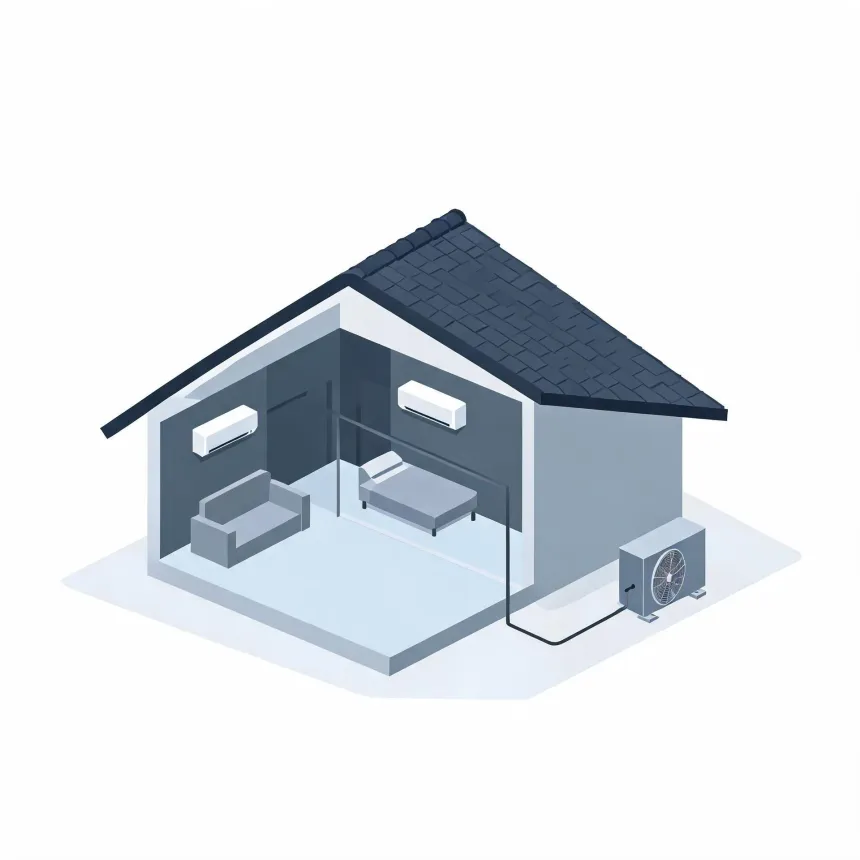
Isometric illustration of a cutaway house showing two wall-mounted indoor air conditioning units connected by a line to an outdoor condenser unit beside the building, with a sofa and bed inside.
Your system heats October through April and cools June through September.

NOAA nClimDiv, 1991–2020 normals

Cooling in Clark County starts in June and runs through September.

Get the mini split in during May, before the first hot week puts you on a waiting list.

Electricity here runs 12.79 cents a kilowatt-hour, cheaper than most states, so the payback on a high-SEER system stretches out

Power costs 12.79 cents a kWh statewide
Cooling runs June through September
Summer afternoons average 85°F

Clark County gets its share of rough weather, damaging wind more often than hail or tornadoes, plus the occasional winter storm. None of that calls for anything special from a mini split. A standard size and a mid-range efficiency rating will heat and cool a room just as well here as anywhere else. What matters more after a storm is the power itself. Close to a quarter of Kentucky households lost power for a full day or more in 2024. A mini split won't run without it, same as a furnace blower or a central AC compressor. If backup power matters to you, that's a conversation about the outage, not about the unit.

A standard mini split handles Clark County summers

Four months of cooling a year, with afternoon highs around 85°F, doesn't call for an oversized or high-end unit. A standard size and a mid-range efficiency rating will keep up here just fine. That's one less thing to weigh while you compare quotes.

Find a contractor
A man in a cap, dark jacket and tan work pants, seen from behind, carries a canvas tool bag up concrete steps toward a dark green front door of a gray clapboard house with a potted shrub beside it.
A beige split-system air conditioner outdoor condenser unit mounted on metal wall brackets atop a stucco wall.

What happens to the old system

If a mini split is replacing a furnace and central AC, the old equipment either comes out or gets shut down and left in place. A furnace that's disconnected but still sitting there needs its gas line capped and its flue dealt with, not just the power cut. If it shared a chimney with a water heater, pulling the furnace off that flue can change how the water heater drafts, so that part isn't a job to skip or guess at. Central AC is simpler to abandon since the refrigerant lines just get capped, but the outdoor condenser takes up space and most homeowners have it hauled off. Window units and electric baseboard are the easy case. Unplug it, patch the wall or cap the line, and there's nothing left to think about. Whoever installs the mini split should be able to tell straight off which of these applies and handle the parts that aren't a DIY job, like the gas line or the flue.

SEER2 measures a season, not a moment

The rating on the label comes from running the system through a full range of conditions, not a single hot afternoon. A mini split with a higher number uses less electricity to produce the same cooling over the course of a summer. It says nothing about how cold the room gets or how fast, only what it costs in electricity to get there and stay there.
A higher number costs more up front

Mini splits with higher SEER2 ratings use variable-speed compressors and better coils, and that hardware costs more to build and install. The unit pays that difference back slowly, through lower electric bills, one season at a time. Whether that trade is worth it depends on how many months a year the system runs and what electricity costs where you live, not on the rating by itself.

Sizing a mini split means matching its output to the room, not the square footage alone. A room with tall ceilings, a lot of west-facing glass, or a run of exterior wall loses or gains heat faster than its floor space suggests. Rooms that look about the same size on paper can end up needing different sized heads. Go too big and the unit cools the air fast, shuts off, then kicks on again a few minutes later. The room never sits at a steady temperature, and the compressor wears out doing short bursts of work instead of one steady run. Go too small and it runs flat out all day and still can't hold the line on the hottest afternoons. A contractor works this out room by room, checking wall and window area, insulation, and which way the room faces. For a multi-head system, each indoor unit gets sized to its own room, and the outdoor condenser gets sized to the whole job, not just tallied up from the heads. That's worth asking about when you compare quotes. Did they size each room, or did they guess at the whole house.

Install day starts outside, with the condenser. It needs a spot on a pad or wall bracket, close enough to reach each indoor head without the line set running all over the siding, and far enough from the house that it can pull in air and throw its noise somewhere other than a bedroom window. Then it's a hole through the wall, one for each indoor head, for the refrigerant lines, the power wire, and the condensate drain to pass through. The lines get connected, then pulled down into a vacuum to clear out air and moisture before any refrigerant moves through them. Skip that step or rush it and the system can develop a leak or lose efficiency within the first year, long before anything else would've gone wrong. Each indoor head mounts to a bracket on the wall or ceiling, gets leveled, and ties into its own line running back to the condenser. Once everything's connected, the installer checks refrigerant charge, tests each head for heating and cooling, and walks the line set and wall penetrations for anything that needs sealing against weather. A multi-head job takes longer than a single room, simply because there's more of all of this to do, not because any one step changes.