A row of dark-sided single-story houses with gabled shingle roofs behind a long trimmed hedge, with mown lawn in the foreground and large leafy trees overhead under an overcast sky.

Mini Split Installation in Somerset, KY

Tell us about the job

Takes about a minute. No obligation.

New system or replacementMini-splitPulaski County, KY
Step 1 of 2

What ZIP code is the job in?

Ask what size each room needs

A mini split has to be sized to the room it serves, not guessed at. An installer should walk each space and figure the load from window size, ceiling height and what's on the other side of the walls, then size the indoor head to match. One too big will cool the room fast and shut off before it pulls the damp out of the air, leaving it cold and clammy. One too small will run constantly and still not keep up.

Ask where the line set and condensate will run

The indoor head connects to the outdoor unit through a line set, and the condensate from cooling has to drain somewhere. Both have to pass through a wall or run along the outside of the house, and the path matters. A longer line set run or a lot of bends can affect how the system performs, and the condensate line needs a real slope to drain on its own instead of backing up into the unit.

7 months
October through April, your system heats
4 months
June through September, it cools
28°F
the average winter night it heats against
84°F
the average summer afternoon it cools against
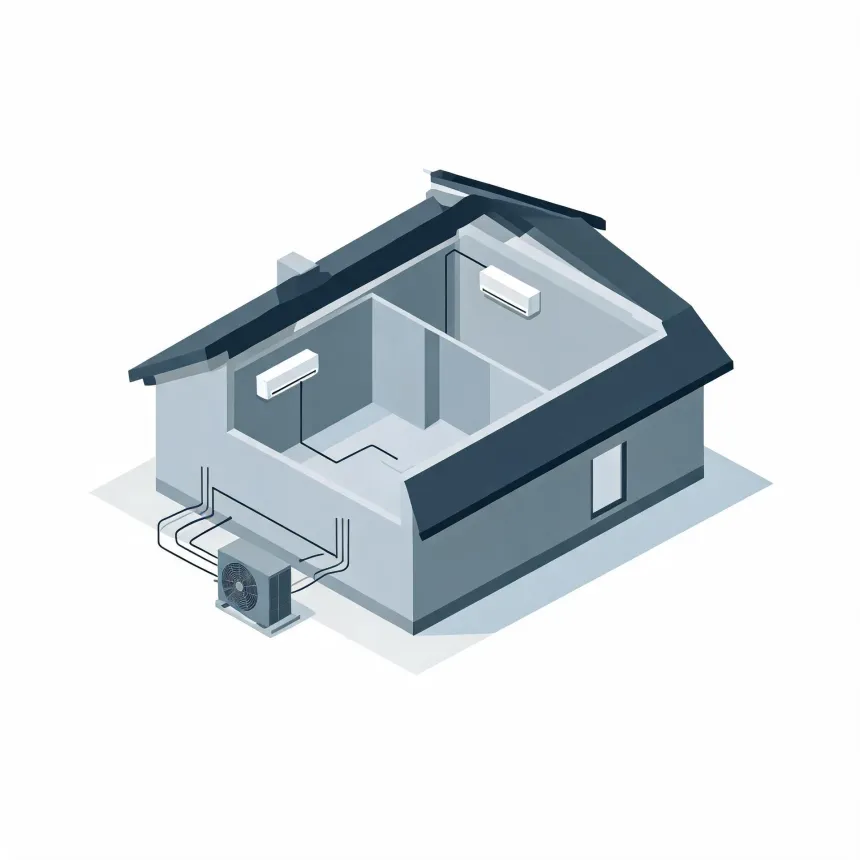
Isometric illustration of a cutaway house showing two wall-mounted indoor air conditioning units connected by line sets to an outdoor condenser unit on the ground outside.
Your system heats October through April and cools June through September.

NOAA nClimDiv, 1991–2020 normals

Summer here runs June through September, with afternoon highs averaging 84.

A mini split sized for that is a standard unit, nothing oversized or special-order.

Cooling starts in June here, so May is the month to get a mini split installed

Cooling runs June through September
Summer afternoons average 84°F
167 damaging wind events from 2015 to 2024

Kentucky electricity runs about 12.79 cents per kilowatt-hour, cheaper than most of the country. That changes the math on which mini split to install. A higher-efficiency model costs more up front and takes longer to earn that back when power is already cheap here. It still makes sense to ask about efficiency ratings, but they shouldn't be the deciding factor. What matters more is whether the unit is sized right for the room and holds up through the summer without breaking down.

Most homes here already run on electricity, and so does a mini split

Electricity heats 82.1% of homes in Pulaski County, far more than gas, propane or oil combined. A mini split fits into that picture without any rewiring for a new fuel source, since it runs on electricity like the rest of the house. That's one less thing for an installer to work around when you're ready to move forward.

Find a contractor
A white mini-split air conditioner outdoor condenser unit mounted on metal brackets against a beige stucco exterior wall, with a blue sky and scattered clouds in the background.

The rating on the box only means something once the unit is running

The number on the label is a ratio, not a grade. It compares the cooling or heating a unit puts out against the power it takes to run it over a season, so a higher number means more output for the same electricity. That ratio matters most on the days the system runs longest. A mini split left to cycle on and off for a few hours a day barely gets a chance to show what the rating promises. One running most of the afternoon and evening, day after day, is where the difference between a mid-range unit and a high-efficiency one actually shows up on the meter. The rating also assumes the unit is sized and installed right. An oversized head that short-cycles never runs long enough to hit its rated efficiency, and a line set with too many bends makes the compressor work harder than the label accounts for.

Single zone or multiple heads changes the job

One outdoor unit can run one indoor head or several, with each room getting its own thermostat and its own blower. More heads means more line set, more wall penetrations, and an outdoor unit sized to cover all of them together, not just the biggest room. A single zone system is a simpler install than one feeding a house full of rooms at once.

Where the outdoor unit sits affects the install

The outdoor unit needs a pad or mount, clearance on all sides for airflow, and a path back to each indoor head that doesn't fight gravity or run through finished space. A wall mount close to the indoor heads is a shorter job than a ground pad on the far side of the house. Electrical work to reach the unit, whether a new circuit or an extension of one already there, is its own piece of the job separate from the mounting and the line set.

Sizing a mini split is a calculation, not a guess based on square footage alone. An installer figures the heat gain for the room. That means how much sun the windows get, how high the ceiling runs, whether the wall backs up to an attic or to another conditioned room. Rooms that look the same size on paper can need different heads because of that. Get it wrong on the high side and the unit blasts cold air, hits the thermostat setting, and shuts off before it has pulled the humidity down. The room ends up cold and damp at the same time. Get it wrong on the low side and the head runs nonstop trying to catch up and never quite does. The only way to land on the right size is to work the room itself, not guess at it from across the house.

If this install is replacing a window unit or an older ducted system, that equipment doesn't just vanish. A window unit comes out and gets hauled off, usually by whoever's doing the mini split work, since it's small enough to handle on a job like this. A central system is a bigger piece of work. The outdoor condenser has refrigerant in it, and that has to be recovered by someone licensed to handle it before the unit can be cut loose and scrapped. The indoor coil and the old line set come out too, though the ductwork usually stays in place even if nothing runs through it anymore. Ask the installer up front whether removal and haul-away are part of the quote, because that's a separate piece of labor from mounting the new heads.