A quiet residential street at dusk lined with illuminated two-story brick houses and mature trees.

Mini Split Installation in Shelbyville, KY

Tell us about the job

Takes about a minute. No obligation.

New system or replacementMini-splitShelby County, KY
Step 1 of 2

What ZIP code is the job in?

Electric heat is the norm here

Just under half of homes in Shelby County heat with electricity, more than any other fuel, and gas is second at 37 percent. A mini split fits right into a home that's already wired for electric heat, with no gas line to work around.

What that means for your install

If your home already runs on electric heat, a contractor is mainly sizing the system and finding the right spot for the outdoor unit and line set. If you're on gas or propane, a mini split can still work as the main system or as backup for a room or two, it just means planning for a system that doesn't touch your existing gas line at all.

7 months
October through April, your system heats
5 months
May through September, it cools
26°F
the average winter night it heats against
85°F
the average summer afternoon it cools against
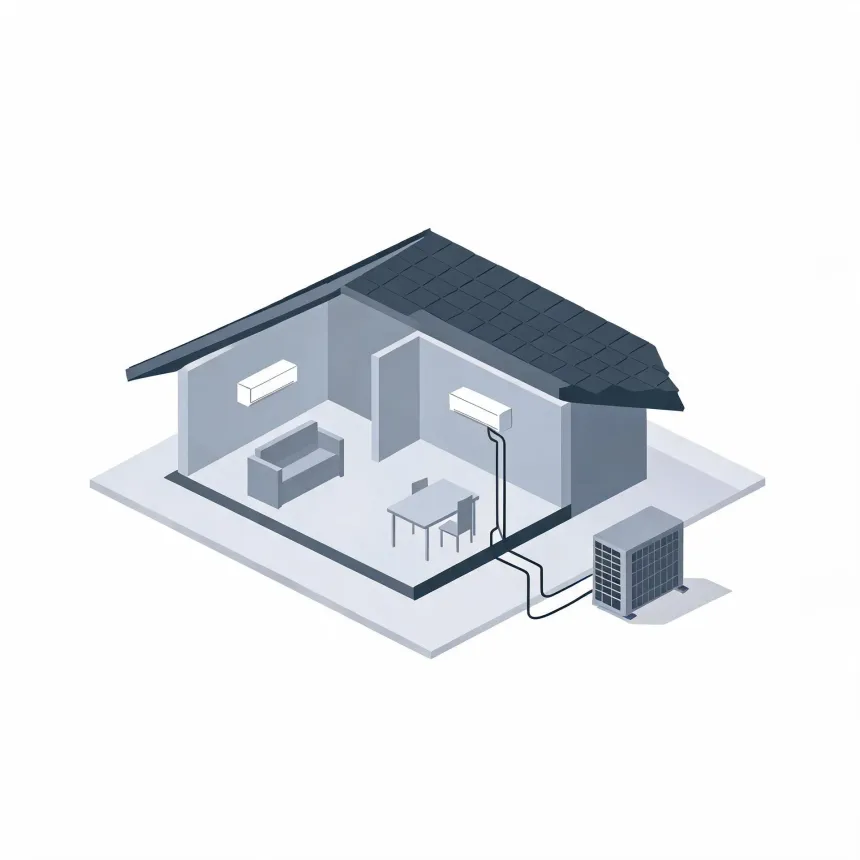
Isometric illustration of a cutaway house interior with sofa, table and chair, two wall-mounted indoor air conditioning units connected by lines to an outdoor condenser unit beside the building.
Your system heats October through April and cools May through September.

NOAA nClimDiv, 1991–2020 normals

Shelby County sees its share of damaging wind and hail, with storms rolling through most years between 2015 and 2024.

None of that changes what the install needs. A securely mounted outdoor unit and a standard size for the space is what the job calls for.

Cheap power here means payback is slow, so pick the mini split that fits the room, not the one with the best efficiency number

Power costs 12.79 cents a kWh statewide
Cooling runs May through September
Summer afternoons average 85°F
Sized for a normal summerCooling runs May through September here, with afternoon highs around 85°F. A standard mini split handles it.

Shelby County is in zone 4A, which asks for real work from both heating and cooling. Any mini split installed here has to meet the federal minimum for that. That's 14.3 SEER2 for cooling and 7.5 HSPF2 for heating. The standard treats a ductless system the same as any other split system, it names no separate class for ductless. That minimum applies to units made from January 2023 on, so older stock a contractor has on hand may carry different numbers. There's also a federal tax credit for heat pumps that meet certain efficiency levels, worth asking about once you know which system fits your home.

Get it installed before May, not during it

Cooling starts up in May here. Get the mini split installed in April and it's ready before the first warm day, not after it. Wait until the heat is already on and you're scheduling around whatever slot a contractor has open, not around what works for you.

Find a contractor
A man in a cap, dark jacket and work pants carries a worn canvas tool bag up stone steps toward a dark green front door, with a shrub in a green planter beside the entry.
A beige split-system air conditioner outdoor condenser unit mounted on metal wall brackets atop a stucco wall.

It runs long hours, so the install has to hold up

A mini split runs most of the year once it's in, cooling through the warm months and often carrying some or all of the heating load the rest of the time. That kind of runtime puts real hours on the outdoor unit's compressor and on the indoor unit's fan motor, so the install work matters more than it would on a system that only ran a season. A line set that's kinked or run too long makes the compressor work harder every time it cycles on. A wall mount that's slightly off level drains condensate wrong for as long as the system's in place. None of that shows up on install day. It shows up later, as a system that's noisier than it used to be, or one that's pulling more power to do the same job. The parts of the job that take real skill, the line set run, the mounting, getting the refrigerant charge right, are exactly the parts nobody checks on again once the cover panels are on.

The old system has to go somewhere

Taking out a furnace, a central air unit or window units means disconnecting whatever lines, wiring or refrigerant they used and hauling the equipment out. A central air unit has refrigerant in its lines that has to be recovered, not vented, before anything gets disconnected. That's a step a contractor plans for as part of the swap, not an afterthought.

What stays depends on what the old system shared

If the old system used ductwork, that ductwork can often stay in place even after it's gone, since a mini split doesn't use it. Electrical wiring run for the old equipment sometimes gets reused for the new outdoor unit, sometimes not, depending on what it was rated to carry. A contractor looks at what's already there before deciding what gets pulled and what gets left.

Sizing a mini split isn't about matching the old system's number or picking the biggest unit that fits the wall. A contractor works out the heat loss and heat gain for the room or the home, looking at square footage, ceiling height, window area and how many walls face outside. Too big and the unit short cycles, reaching the set temperature fast, shutting off, then starting again a few minutes later. That cycling is hard on the compressor, and it leaves the room cold in spots because the system never runs long enough to mix the air evenly. Too small and it runs flat out on the hottest and coldest days without ever catching up. The right size is specific to the space it's heating and cooling, which is why a unit that works well next door can be the wrong choice for a room that looks about the same but faces a different direction or has more glass.

Install day starts with mounting the indoor head and setting the outdoor unit on its pad or bracket. Most of the time goes into the line set between them. A contractor runs the refrigerant lines, the wiring and the condensate drain through a small hole in the wall, then connects them to both units. That connection gets pressure tested before any refrigerant moves. The test checks for leaks at the flare fittings, and it has to hold before the job goes any further. Once it holds, the line set gets vacuumed down to pull out moisture and air. Either one left behind damages the compressor over time. Only after that does the system get its refrigerant charge, weighed in to the amount the manufacturer specs for that line length. The last part looks simple but takes real time. The system runs through a full cycle, the temperature split at the vent gets checked, and the indoor head gets leveled so condensate drains the way it's supposed to.