A row of dark-sided single-story houses with brown shingled roofs behind a tall trimmed hedge, surrounded by large leafy trees and mown grass under an overcast sky.

Mini Split Installation in Richmond, KY

Tell us about the job

Takes about a minute. No obligation.

New system or replacementMini-splitMadison County, KY
Step 1 of 2

What ZIP code is the job in?

Weather here is hard on outdoor equipment

Madison County logged 125 severe weather events between 2015 and 2024, including damaging wind, hail and a handful of tornadoes. A mini split's outdoor unit sits outside year round, so wind-blown debris and hail are worth planning for when picking where it mounts.

Power cuts affect heat and hot water too

Nearly a quarter of Kentucky households went at least a day without power in 2024. A mini split needs electricity to run, so an outage takes out both heating and cooling until the power comes back. Worth asking about backup options if that's happened to your home before.

7 months
October through April, your system heats
5 months
May through September, it cools
27°F
the average winter night it heats against
85°F
the average summer afternoon it cools against
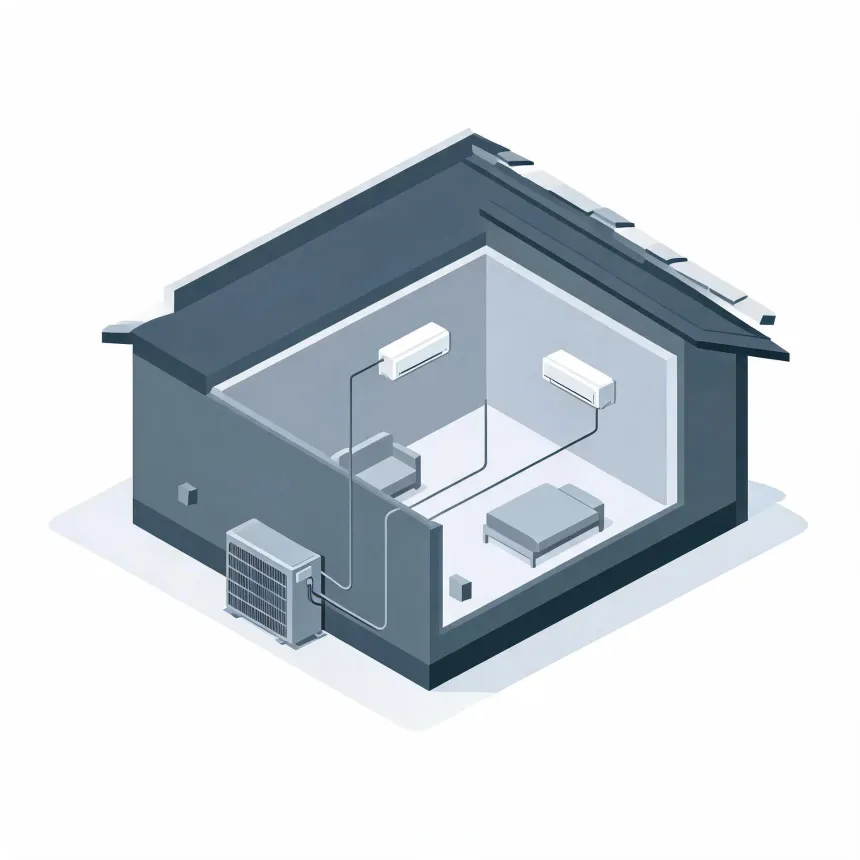
Isometric illustration of a cutaway house interior showing two wall-mounted indoor air conditioning units connected by line sets to an outdoor condenser unit beside the exterior wall.
Your system heats October through April and cools May through September.

NOAA nClimDiv, 1991–2020 normals

Kentucky electricity ran 12.79 cents per kilowatt-hour in 2024, cheaper than most states.

A mini split still has to earn its keep through Richmond winters and summers, not just a low power bill.

April is the month to get it done, before May's heat and storms arrive

Cooling runs May through September
Summer afternoons average 85°F
87 damaging wind events from 2015 to 2024

Richmond summers run about five months, May through September, with afternoon highs near 85 in June, July and August. That's enough cooling load to size for, but nothing unusual. Madison County sits in zone 4A, a mixed climate that asks real work of both the heating and cooling side, which a mini split handles either way with its heat pump. None of this calls for oversizing the unit or stepping up to a higher-tier system. A properly sized mini split, matched to the square footage and insulation of the space it's serving, covers what this climate asks of it.

A new mini split here has to clear a set efficiency floor, and a federal credit can offset it

Any mini split installed in Madison County has to meet the zone 4A minimum. That means 14.3 SEER2 for cooling and 7.5 HSPF2 for heating, no matter which unit or brand you're comparing. A federal tax credit is available on top of that for systems that qualify, worth factoring into what you're comparing now.

Find a contractor
A beige split-system air conditioner outdoor condenser unit mounted on metal wall brackets atop a stucco wall.

Sized for the room, not guessed at

Sizing a mini split comes down to matching its output to the heat the room gains in summer and loses in winter, not the square footage alone. A contractor works through a load calculation that factors in wall and ceiling insulation, window size and direction, how many people use the room, and what else gives off heat in there. Skip that and size by guesswork, and the unit ends up wrong in a way that shows up fast. Oversized, it blasts the room down to temperature, shuts off, then kicks on again a few minutes later. That short cycling never gives it time to pull moisture out of the air, so the room feels cool but damp. Undersized, it runs flat out and still falls behind when the temperature swings hard, which wears on the compressor without ever catching up. Sized right, it runs long, steady stretches at partial output, and that's where a heat pump works most efficiently and easiest on its own parts. The outdoor unit and the indoor head need to be matched to each other too, not just to the room, since pairing them wrong throws off how the system manages refrigerant flow.

How many zones it covers

A single outdoor unit can run one indoor head or several, and that number has to match what you actually need conditioned. Ask whether the system is single zone or multi zone, and whether it has room to add a head later if you close off another part of the house. A multi zone unit split across too many heads loses capacity at each one, so more isn't automatically better.

What happens if a part fails later

Ask what's covered under warranty, parts versus labor, and for how long. Also ask whether the compressor and the indoor heads are sold as a matched set or whether components can be swapped between brands. Some manufacturers void the warranty if the line set is serviced by someone other than who installed it, which matters if you ever switch contractors.

If this is replacing a furnace and central AC, the ductwork usually stays put even though the mini split doesn't use it. That's fine unless those ducts were the only thing moving air to rooms with no other vent, which is worth a look before the old system comes out. The furnace and condenser get hauled off by whoever installs the new system, along with the old refrigerant line set and any line hidden in the wall. A gas furnace means capping the gas line properly once it's disconnected, not just leaving it. If the old condenser sat on a pad outside, ask whether that pad gets reused or removed, since the new outdoor unit may not sit in the same spot once wind and drainage are factored in.

SEER2 tells you how much cooling a unit delivers per unit of power over a season, and HSPF2 does the same for heat. A higher number on either one means the unit is pulling more comfort out of the same amount of electricity. It's a seasonal average, not a reading of what the unit does on the hottest afternoon or the coldest night, so it won't tell you what the power bill looks like in the roughest stretch of weather. Units with the same rating can still behave differently once they're running, because the rating comes from lab conditions and doesn't account for how the system was sized or installed. A unit sized wrong for the room can underperform its own rating no matter how high that number is. The rating is a starting point for comparing equipment, not a promise about how it runs once it's on your wall.