





A gray tabby cat sleeps curled up on a dark gray bed in a dimly lit modern bedroom with warm ceiling cove lighting and a wall-mounted air conditioning unit.

Mini Split Installation in Prestonsburg, KY

Tell us about the job

Takes about a minute. No obligation.

New system or replacementMini-splitFloyd County, KY
Step 1 of 2

What ZIP code is the job in?

Floyd County has logged 133 severe weather events over the past decade, and damaging wind caused most of them. A mini split's outdoor unit sits right in the open for whatever comes through, wind-blown branches, hail, ice. Where a contractor mounts that unit, and what shields it, is worth settling before installation day. Power is the other piece. A mini split won't heat or cool your home during an outage unless something else is backing it up, and outages here aren't rare.

7 months
October through April, your system heats
4 months
June through September, it cools
28°F
the average winter night it heats against
86°F
the average summer afternoon it cools against
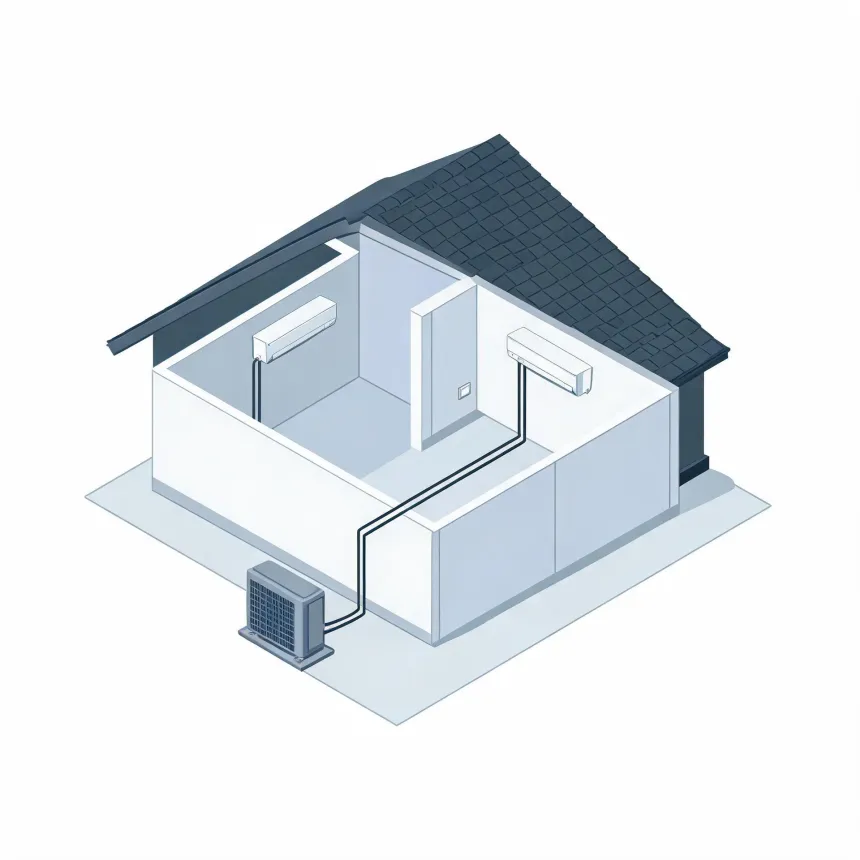
Isometric cutaway illustration of a small house with a dark shingled roof, showing two wall-mounted indoor air conditioning units in separate rooms connected by lines to an outdoor condenser unit on the ground outside.
Your system heats October through April and cools June through September.

NOAA nClimDiv, 1991–2020 normals

Half the homes in Floyd County were built in 1982 or earlier, half later.

Either way, a mini split sized the normal way fits the job.

Power here is cheap, so the payback on the priciest, most efficient unit is slower

Power costs 12.79 cents a kWh statewide
Cooling runs June through September
Summer afternoons average 86°F
Four months of cooling, nothing unusual about itSummers run June through September, with afternoon highs averaging 86°F

Electricity heats 62.8% of occupied homes in Floyd County, more than any other fuel. Utility gas comes in well behind at 29.8%. A mini split runs on electricity, so in most homes here it's working with the setup already in place rather than against it. That makes it a straightforward swap for anyone already heating electric. If your home runs on gas, a mini split can still make sense, but it's worth asking the contractor how it will work alongside what's already there.

Have it in before June

Cooling here runs June through September. May is the last month before that starts, and the best time to get a mini split installed. Do it then and the work happens on your schedule, not during the first hot week of summer.

Find a contractor
A man in a dark long-sleeve shirt, cap, and tan work pants walks up wooden steps toward a dark green front door, carrying a canvas tool bag with hand tools, beside a potted shrub.
A beige split-system air conditioner outdoor condenser unit mounted on metal wall brackets atop a stucco wall.

The label tells you a ratio, not a bill

The number on the label is a ratio, what the system puts out against what it draws to run. A higher number means less electricity for the same amount of heating or cooling. That number gets tested once, under set conditions, but your mini split doesn't run under set conditions. It cycles on and off for years, in heat, in cold, with whatever maintenance it gets or doesn't. A dirty filter or a blocked outdoor coil makes the unit work harder to move the same air, so the real efficiency you get drifts from the number on the label. Rinsing the outdoor coil and keeping the indoor filter clean are what keep the unit closer to that original rating over its life. The label tells you what the equipment is capable of. What you actually pay to run it depends on how it's sized for the space, how it's installed, and how it's kept up after that.

The old system doesn't have to go anywhere yet

A mini split can run alongside a furnace, a boiler, or window units instead of replacing them outright. Some homeowners keep the old system in place as backup and let the mini split handle the bulk of the heating and cooling. Others phase the old equipment out room by room as the new units go in. Either way, the installer doesn't need to pull the old system before the new one goes in.
If it does come out, that's separate work

Removing a furnace, baseboard units, or old ductwork is its own job, not part of hanging a mini split. Refrigerant in an old central system has to be recovered by someone certified to handle it, not vented or dumped. If the old unit ran on gas, the gas line needs to be capped off properly, not just disconnected. Ask the contractor upfront whether removal and disposal are part of the quote or billed separately.

What drives the price on a mini split job is mostly the number of zones and how far the lineset has to run. One indoor head talking to one outdoor unit is the simplest case. Add a second or third zone, each with its own indoor head, and you're adding line sets, more mounting work, and a bigger outdoor unit to drive all of them. Distance matters too. Running refrigerant line from the outdoor unit up through an exterior wall and across to a head on the far side of the house takes more time and material than mounting everything within a few feet. Where the outdoor unit sits plays in as well, a straightforward spot near the electrical panel costs less to wire than one tucked around back. Electrical work can be its own factor, since some homes need a new dedicated circuit run to the panel before the system can even be powered up.

Installation starts with the walk-through, confirming where each indoor head goes and where the outdoor unit will sit before anyone drills anything. The crew mounts the indoor head to a wall bracket, then cores a small hole through the wall for the lineset, the drain line, and the electrical whip to pass through together. That lineset gets run to the outdoor unit, connected, then the system is pressure tested to make sure there are no leaks in the joints before any refrigerant moves through it. Once it holds pressure, the line gets evacuated to pull out moisture and air, then the refrigerant valve opens and charges the system. The last steps are powering it up, confirming the indoor head is actually heating and cooling, and setting the condensate drain so it runs where it should instead of pooling against the house.