Three lit brick homes on a tree-lined residential street photographed at dusk.

Mini Split Installation in Pikeville, KY

Tell us about the job

Takes about a minute. No obligation.

New system or replacementMini-splitPike County, KY
Step 1 of 2

What ZIP code is the job in?

Wind and hail are the regular threat

Pike County saw 125 damaging wind events and 25 hail events in the past decade. An outdoor condenser sitting in the open takes that weather directly, so where it goes on the property matters as much as the unit itself.

Power cuts last longer here than a breaker reset

Nearly a quarter of Kentucky households went at least 24 hours without power in 2024. A mini split won't run without electricity, so if it's your only source of heat, it's worth talking through backup power before installation, not after an outage.

7 months
October through April, your system heats
4 months
June through September, it cools
28°F
the average winter night it heats against
85°F
the average summer afternoon it cools against
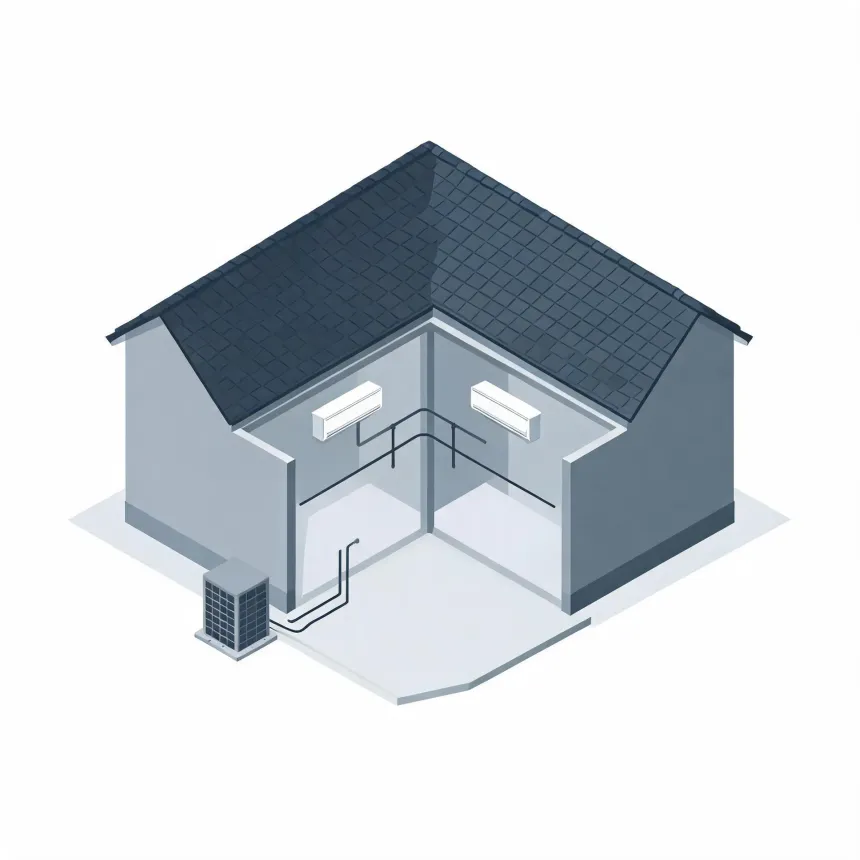
Isometric illustration of a cutaway gray house with a dark shingled roof, showing two wall-mounted indoor air conditioning units connected by piping to an outdoor condenser unit on the ground outside.
Your system heats October through April and cools June through September.

NOAA nClimDiv, 1991–2020 normals

Electricity in Kentucky runs 12.79 cents per kilowatt-hour, lower than most of the country.

A high-efficiency mini split still costs more up front, and here it takes longer to earn that back, so pick the unit that will hold up and heat the room, not just the one with the best efficiency number.

Most of Pikeville already heats with electricity, so a mini split fits right in

78.6% of homes heat with electricity
Cooling runs June through September
Summer afternoons average 85°F
Get it in before JuneCooling runs June through September here, so May is the month to get it installed.

Pike County sits in climate zone 4A, which asks real work of both heating and cooling. Any mini split installed new here has to clear the federal minimum for split-system heat pumps. That means 14.3 SEER2 for cooling and 7.5 HSPF2 for heating. The rule covers the unit itself, not how it's sized or where it's mounted, so clearing it is the floor, not the whole decision. A unit that qualifies may also put the purchase in range of the federal tax credit, worth checking against the specific model before you buy.

A standard mini split is the right call for Pikeville

Cooling here runs about four months a year, with afternoon highs near 85°F through June, July and August. That's a normal summer load, not a heavy one, and the same goes for winter. A standard-size, standard-efficiency mini split handles this just fine. Where the money matters more is the installation itself, given what the weather here can do to an outdoor unit left in a bad spot.

Find a contractor
A man in a dark long-sleeve shirt and tan work pants climbs porch steps toward a dark green front door, carrying a worn canvas and leather tool bag, with a potted conical shrub beside the entry.
A white outdoor air conditioner condenser unit mounted on metal wall brackets against gray horizontal siding, with a blue sky and white clouds behind it.

Half the homes here were built in 1985 or earlier

Half the homes in Pike County were built in 1985 or earlier. Age doesn't change what a mini split needs to do. A unit sized to the room heats and cools that room the same whether the house is new or decades old. What does matter here is that mobile homes make up 34.9% of the housing stock, and a mini split suits that kind of home well since it doesn't rely on existing ductwork. Either way, the sizing stays standard. What changes is where the outdoor unit gets mounted and how it's protected from the weather.

The rating is a seasonal average, not a promise

SEER2 and HSPF2 numbers come from lab testing across a range of conditions, not the hottest afternoon or the coldest night you'll actually see. A unit can carry a high rating and still draw more power than expected during a stretch of extreme weather. The number tells you how the system performs on average over a full season, not what it will do on any single day.

A higher number only pays off if the unit is sized right

The efficiency rating describes the equipment, not the installation. An oversized mini split cycles on and off too fast to run efficiently no matter what the label says, and an undersized one runs constantly trying to keep up. Getting the rating you're paying for depends on the contractor matching the unit to the room first.

Equipment is only part of the bill. The line set running between the indoor head and the outdoor condenser has to be cut to length, and a longer run or one that climbs through a wall or up a floor takes more refrigerant and more time than a short, straight shot. Every penetration through an exterior wall needs to be sealed properly, or you end up with drafts and water finding its way in later. The electrical side matters too. Some units run on a standard household circuit, others need a dedicated circuit run from the panel, and that's a different job depending on how far the panel sits and what's already in the wall. Mounting brackets have to be anchored into something solid, not just drywall, and the condenser pad outside has to hold the unit level and steady. None of this shows up on the unit's price tag, but all of it decides how well the system runs once it's in.

Installation starts with the walk-through. The contractor looks at where the indoor head will mount, where the line set will run, and where the condenser will sit outside, then marks the path before any tool comes out. Once work starts, the indoor unit goes up first, anchored into a stud or solid backing, never just drywall. The crew drills through the wall for the line set, the drain line, and the electrical, then seals that opening from both sides. Outside, the condenser gets set on a pad, leveled, and connected. After everything is joined, the line set gets pulled down to a vacuum to clear out moisture and air before the refrigerant is released into it. That step gets skipped by nobody who wants the system to last. Once it's running, the contractor checks the temperature split between the air going in and the air coming out, confirms the thermostat or remote talks to the head correctly, and walks the condenser pad one more time to make sure it sits level and clear of anything that would block airflow.