A row of dark-sided single-story cottages with brown shingled gable roofs behind trimmed hedges, mown lawn and a light-colored path, surrounded by large deciduous trees under an overcast sky.

Mini Split Installation in Paducah, KY

Tell us about the job

Takes about a minute. No obligation.

New system or replacementMini-splitMcCracken County, KY
Step 1 of 2

What ZIP code is the job in?

A standard mini split is the right call here

Nothing about Paducah homes calls for an oversized unit or a higher tier of equipment. A properly sized system for the square footage and layout will heat and cool the space without extra cost built in for a problem that doesn't exist here.

Sizing still has to match the room

A contractor will size the unit to the space being conditioned, not round up for margin. Kentucky electricity ran 12.79 cents per kilowatt-hour in 2024, so an oversized unit cycling more than it needs to shows up on the bill without making the room any more comfortable.

7 months
October through April, your system heats
5 months
May through September, it cools
29°F
the average winter night it heats against
88°F
the average summer afternoon it cools against
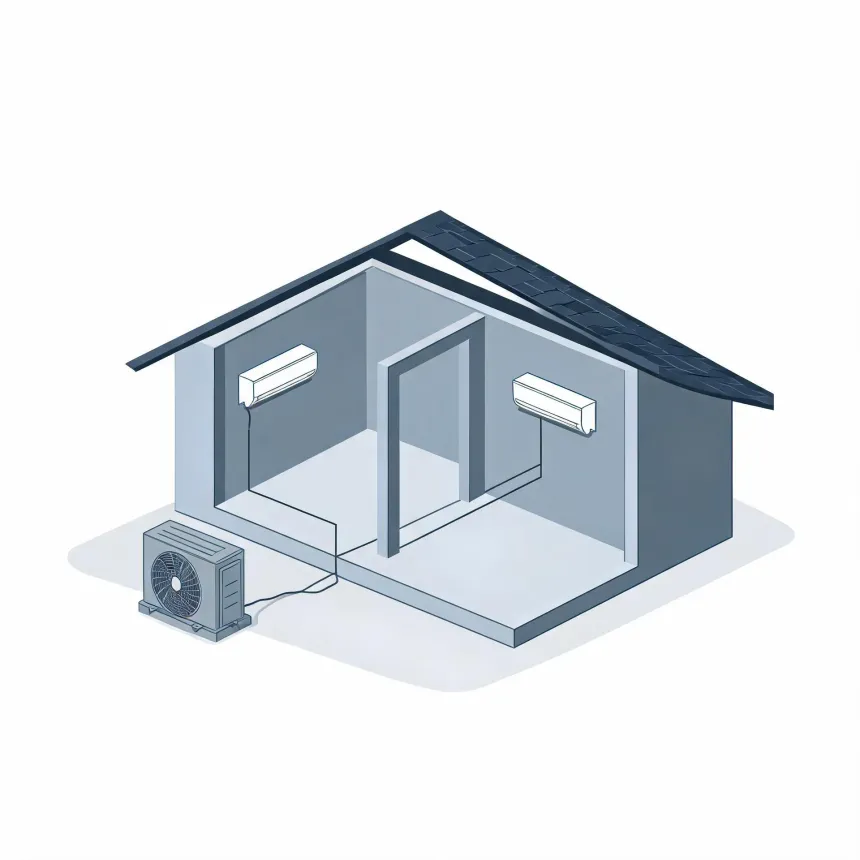
Isometric illustration of a cutaway house showing two wall-mounted indoor air conditioning units connected by lines to a single outdoor condenser unit on the ground outside.
Your system heats October through April and cools May through September.

NOAA nClimDiv, 1991–2020 normals

Afternoon highs average 88°F through June, July and August in McCracken County.

A mini split here runs its compressor hard all summer, so sizing it to the room matters more, not less.

Get it in before May, not during the first 88 degree week

Cooling runs May through September
Summer afternoons average 88°F
96 damaging wind events from 2015 to 2024
No local reason to size upHalf the homes in McCracken County were built in 1978 or earlier, half in 1978 or later. Either age fits a standard-size system.

Utility gas heats half the homes in McCracken County, more than any other fuel. Electricity comes in at 41.7%, and most of those homes are already set up to run a mini split since the system needs a power source, not a gas line. A mini split works alongside either setup. In a gas-heated home it can take over cooling and the shoulder-season months, leaving the furnace for the coldest stretch. In an electric-heated home it can replace baseboard heat or an aging electric furnace outright. Either way, nothing about the fuel mix here points toward a different kind of equipment, just a system sized to the room it's going in.

Any new system here has to clear zone 4A

McCracken County falls in climate zone 4A, which asks real work of both heating and cooling. A mini split installed here has to meet the federal minimum for a split-system heat pump, 14.3 SEER2 for cooling and 7.5 HSPF2 for heating. That standard also opens up a federal tax credit on qualifying equipment. Worth getting the sizing and the paperwork right from the start.

Find a contractor
A man in a cap, gray long-sleeve shirt and tan pants climbs concrete steps toward a dark green front door, carrying a worn canvas tool bag.
A white mini-split air conditioner outdoor condenser unit mounted on metal brackets against a beige stucco exterior wall, with a blue sky and scattered clouds in the background.

Five months of real load on the compressor

Five months of cooling here, June through August averaging 88 in the afternoon. The compressor is running most days it's out, not cycling on for a few minutes and shutting back off. That kind of steady load is exactly why the sizing question matters before the unit goes in, not after. A unit matched to the room reaches its set point and holds it. One that's too big short cycles, and the stop-start wears on the compressor faster than a long steady run would.

The line set and where the units sit

Every mini split needs a line set run between the outdoor unit and each indoor head, carrying refrigerant through the wall. A short, simple run costs less to install than one that has to go up a floor, around corners, or through a wall that isn't a straight shot. Where the outdoor unit can sit, and how far it is from the indoor head, changes how much labor the job takes before anyone talks about the equipment itself.

One head or several changes the job

A single zone cooling or heating one room is a different installation than a multi-zone system feeding several heads off one outdoor unit. Each additional indoor head means another line set run, another mounting location, and another spot for a contractor to set airflow correctly. The equipment for a multi-zone system costs more than a single head, and so does the labor to put in each additional one.

If this is a replacement, the old system still has to come out before anyone mounts the new line set. An outdoor condenser gets disconnected and hauled off. Any old indoor units, whether that's a window unit, a through-wall sleeve, or baseboard heaters, get pulled so the new head has a clean wall to mount on. A contractor handling the install should be handling the removal too, including recovering any refrigerant left in the old lines rather than venting it. If the home is coming off window units or electric baseboard, there's no ductwork to tie into or seal up, which is part of what makes the switch to mini split straightforward. Old electrical runs for baseboard heat sometimes get reused for the new system's power, and sometimes they don't match what the new unit needs, so that's worth asking about before the day of install.

Install day starts with the outdoor unit going on its pad or wall bracket, then the line set run between that and each indoor head. The indoor head goes up on a wall bracket, and a small hole gets drilled through to the outside for the refrigerant lines, the drain line, and the electrical connection to pass through. Once everything's connected, the line is pressure tested and then pulled down to a vacuum to clear out any moisture and air before refrigerant goes in. Skipping that step is how a system ends up with a slow leak or a compressor problem down the road, so it isn't a step worth rushing. After that, the system gets charged, powered on, and checked for proper airflow and temperature at each head. A single zone can wrap up in well under a day. A multi-zone system with several indoor heads and longer line runs takes longer, since each head needs its own mounting, its own line set, and its own check before the job is done.