April is before the rush
Cooling starts in May here, so April is when a mini split gets installed without anyone racing weather or a dead system to get it done.
Takes about a minute. No obligation.
Cooling starts in May here, so April is when a mini split gets installed without anyone racing weather or a dead system to get it done.
A unit put in before a power cut or a heat spell leaves time to size it right and set it up properly, instead of taking whatever can go in fast once the old system quits.
NOAA nClimDiv, 1991–2020 normals
Electricity heats close to half the homes in Hopkins County, just ahead of utility gas.
A mini split runs on electricity already, so it fits into a Madisonville home without adding a second fuel to the house.



Cooling here runs May through September, with afternoon highs around 87°F in June, July and August. That's a normal load for a mini split to carry, nothing that calls for extra capacity. A unit sized to the room, not oversized for the summer heat, is what holds up May through September without straining. There's no reason to pay more here for a bigger or higher-efficiency model than the space needs.
Hopkins County falls under zone 4A, so a mini split put in now has to clear 14.3 SEER2 for cooling and 7.5 HSPF2 for heating, the same floor as any split-system heat pump. That rules out older, less efficient models. A federal tax credit is available for qualifying equipment, which helps offset a unit built to meet it.
Find a contractor
The old system doesn't get traded in. It gets disconnected and hauled out, and what that takes depends on what it is. A window unit or a through-wall sleeve comes out in minutes. A central system is more work. The indoor coil, the outdoor condenser and the line set all have to come out. If a gas furnace was paired with that coil, the furnace either stays or goes depending on whether the mini split is replacing the whole system or just the cooling side. Refrigerant in the old lines has to be recovered, not vented, so a tech pulls it into a tank before anything gets disconnected. Sometimes the old line set can be reused if it runs through the same wall, but more often the new lines go in fresh since the sizing and routing rarely match. Whatever gets hauled out, the spot it leaves behind, a pad outside, a chase in the wall, a thermostat location, is usually where the new work picks up.
A mini split carries a SEER2 number for cooling and an HSPF2 number for heating, because it works both sides of the year. A higher number on either means less electricity to move the same amount of heat into or out of the room. Neither number says how fast the unit cools or how big a space it can handle, that comes from sizing, not the rating.
The rating comes from how the compressor and coil are built, and it holds for the life of the unit if the unit is looked after. A dirty coil or a filter choked with dust makes the system work harder for the same result, which is a drop in real performance, not a change in the rating on the label. Clean and charged right, it keeps performing the way it did on day one.
Sizing a mini split comes down to a load calculation, not a measurement of the room. A tech works out how much heat the space gains in summer and loses in winter, based on the walls, the windows, the ceiling, and which way the room faces, then matches that load to a unit's output. Too big and the unit cools the air fast but shuts off before it pulls the moisture out, so the room feels cold and damp. Too small and it runs flat out on the hottest and coldest days without ever catching up. The right size cycles on and off at a steady pace, holding the room steady instead of swinging between blasts of air and long pauses. That calculation is what the installer should walk through before anything goes on the wall, not a guess based on square footage alone.
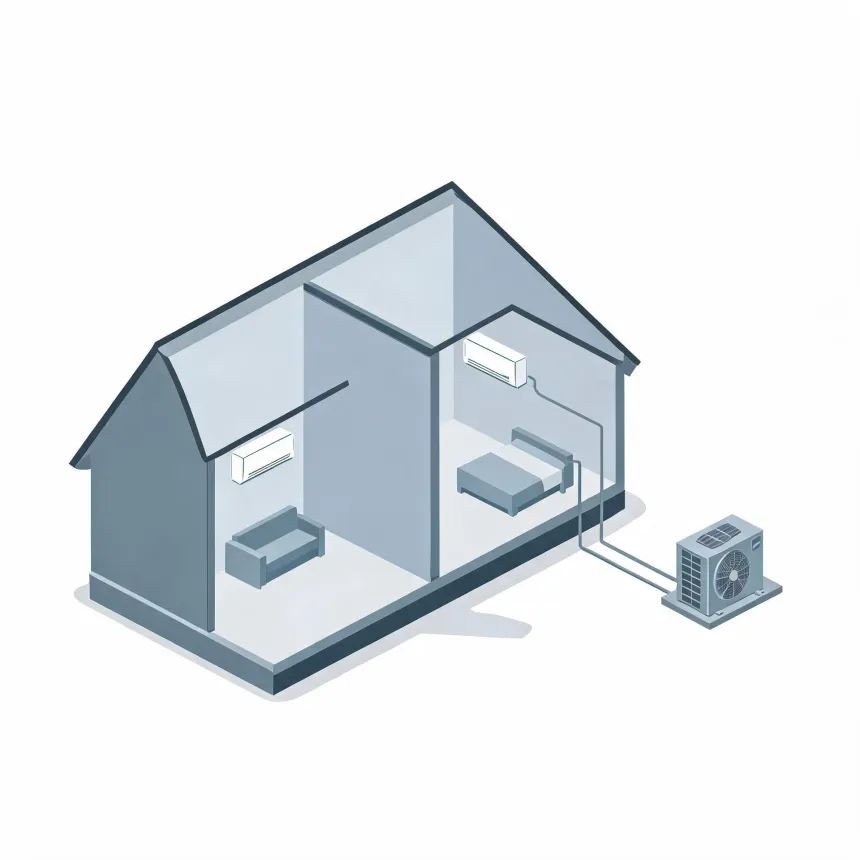
Install day starts outside with the outdoor unit. It needs clear airflow on all sides and a level pad underneath, not just the nearest wall to the room being conditioned. Running the line set is the part that takes the time. Refrigerant lines, a drain line and electrical all pass through a hole drilled in the wall, then get routed to the indoor head without kinks or long detours. Once the lines are connected, the installer pulls a vacuum on the system to clear out air and moisture before refrigerant ever moves through it. Skip that step and moisture sits in the lines, and it shows up later as a coil that won't hold pressure right. The last part is commissioning. The installer checks the refrigerant charge, confirms the indoor and outdoor units are talking to each other, and runs the system through a full cycle before calling the job done.