A illuminated two-story red brick house on a quiet residential street at dusk, flanked by mature trees under a deep blue evening sky.

Mini Split Installation in Louisville, KY

Tell us about the job

Takes about a minute. No obligation.

New system or replacementMini-splitJefferson County, KY
Step 1 of 2

What ZIP code is the job in?

Half the homes here were built in 1972 or earlier

Jefferson County's housing stock splits at that year. A house that old was built for window units or radiators, not a mini split, so the walls and room layout were never planned around a line set or a condenser pad.

An older house decides where the unit can go

Wall thickness, window placement and room layout all affect where the lines can run and where the condenser sits outside. A walkthrough settles that. The age of the house only tells you to expect it.

7 months
October through April, your system heats
5 months
May through September, it cools
27°F
the average winter night it heats against
86°F
the average summer afternoon it cools against
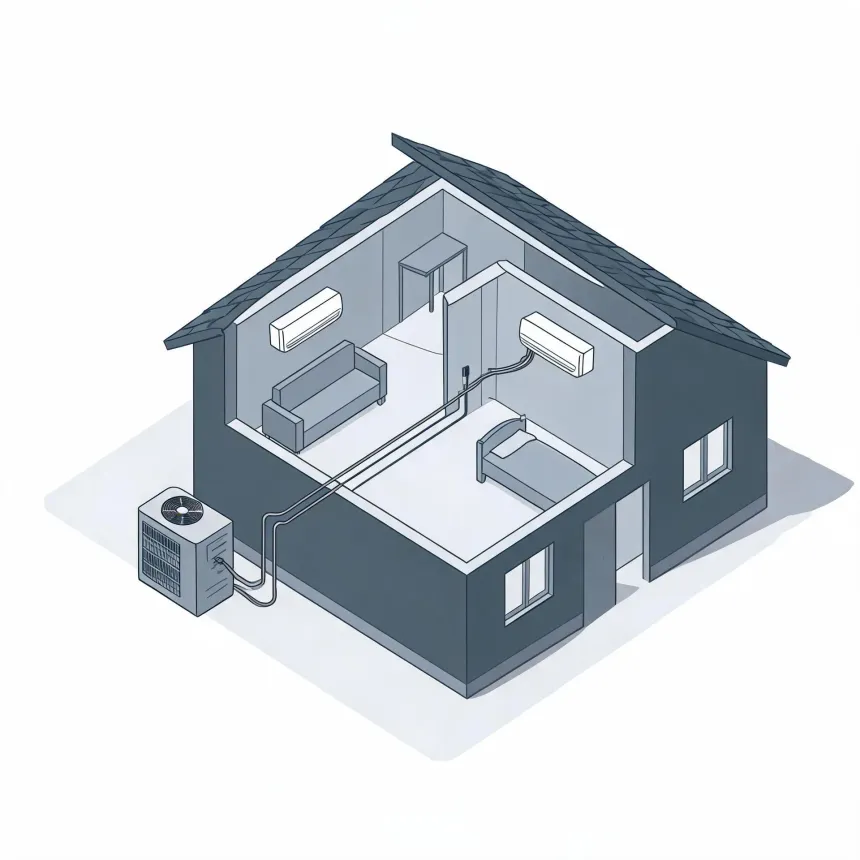
Isometric cutaway illustration of a small house showing two wall-mounted indoor air conditioning units connected by line sets to an outdoor condenser unit beside the exterior wall, with a sofa in one room and a bed in another.
Your system heats October through April and cools May through September.

NOAA nClimDiv, 1991–2020 normals

Kentucky runs 12.79 cents a kilowatt-hour, well below most of the country.

A mini split still cuts your bill, but a pricier high-efficiency model takes longer to earn that difference back here.

Most of Jefferson County heats with gas. A mini split still has a place here.

58.9% of homes heat with gas
Cooling runs May through September
Summer afternoons average 86°F

Jefferson County sits in climate zone 4A, which asks real work of a system both summer and winter. Any mini split installed here has to meet the federal minimum for that climate, 14.3 SEER2 for cooling and 7.5 HSPF2 for heating, since the standard treats a ductless system the same as any other split system. That rule narrows the field before you even start comparing brands. It also means a unit sized or rated for a milder climate won't legally go in here. On top of the equipment itself, a system that clears this bar may qualify for the federal tax credit, worth checking against what a contractor proposes.

Get it in before May

Cooling runs May through September here. April is the month to have a mini split installed, before the first warm stretch puts it to work. Installed now, there's no gap where the old system is down and the new one isn't in yet, and no rush to size the lines or pick the unit.

Find a contractor
A man in a cap, gray long-sleeve shirt and tan pants climbs concrete steps toward a dark green front door, carrying a worn canvas tool bag.
A white mini-split air conditioner outdoor condenser unit mounted on metal brackets against a beige stucco exterior wall, with a blue sky and scattered clouds in the background.

The old system has to go somewhere

If there's an old system being replaced, what happens to it depends on what it is. A window unit comes out through the window, nothing to it. A central system is a bigger job. The old condenser outside gets disconnected and hauled off, and the indoor coil or air handler comes out too, along with whatever ductwork isn't being reused. Any refrigerant left in the old lines has to be recovered, not vented, before anything gets cut apart. If the old system ran on ductwork that won't carry over to the mini split, that ductwork either gets sealed off or pulled out, depending on whether anything else in the house still depends on it. None of this is hard, but it's work, and it's worth knowing upfront whether it's included in a quote or billed as its own line.

How many rooms, how many heads

A single zone with one indoor head costs less than a multi-zone setup feeding several rooms off one outdoor condenser. Every added zone means another line set run, another indoor unit mounted and another spot picked for condensate drainage. The outdoor condenser also has to be sized to carry the total load of every head attached to it, so adding zones later isn't as simple as bolting on another unit.

The line set run decides the labor

The refrigerant lines connecting the indoor head to the outdoor condenser have to be run through a wall, often across a floor or up through a chase, and every extra foot of line and every added bend takes more time and more material. A condenser set close to the indoor head, with a clear straight path between them, goes in faster than one set far away or on the far side of the house. That distance gets decided on the walkthrough, not the sales sheet.

When you're comparing quotes, ask what the contractor is basing the sizing on. A unit picked off a chart that just matches square footage isn't the same as one sized from a load calculation that accounts for windows, insulation and how the rooms get used. Ask how many indoor heads the outdoor condenser can actually support, since not every condenser pairs with every head. Ask about the line set length built into the quote, since a longer run can call for a larger line or added refrigerant. Ask what happens to the old system, if there is one, and whether removal is part of the price. And ask what's covered if something fails after install, the compressor, the indoor coil, the labor to get to either one. Quotes that sound like the same system can mean very different jobs.

Installation day starts with the walkthrough findings already decided, not guessed at on the spot. The crew confirms where the condenser sits outside and where each indoor head mounts, then opens a path for the line set, usually a small hole drilled through the wall where the indoor unit will hang. That line set carries refrigerant lines, a condensate drain and electrical wiring together, wrapped and sealed once they're run. Outside, the condenser gets set on a pad or mounted bracket, leveled so it drains properly and doesn't vibrate loose over time. Once the lines are connected at both ends, the system gets evacuated to pull out moisture and air before refrigerant is released into the lines, and only then does the unit get powered on. The crew checks refrigerant pressures, airflow at each head and that the thermostat or remote controls the system correctly before they consider the job done.