A lit residential street at dusk featuring large two-story brick houses with glowing windows, mature trees, and a street lamp.

Mini Split Installation in Henderson, KY

Tell us about the job

Takes about a minute. No obligation.

New system or replacementMini-splitHenderson County, KY
Step 1 of 2

What ZIP code is the job in?

Weather here is hard on outdoor equipment

Henderson County saw 108 severe weather events between 2015 and 2024, including damaging wind, hail and tornadoes. A mini split's outdoor unit sits exposed to all of it, so where it gets mounted and what shields it matters as much as the unit itself.

Power cuts take the whole system down

Nearly a quarter of Kentucky households went at least 24 hours without power in 2024. A mini split runs on electricity alone, so when the power goes out, your heat or cooling goes with it until the power comes back.

7 months
October through April, your system heats
5 months
May through September, it cools
28°F
the average winter night it heats against
87°F
the average summer afternoon it cools against
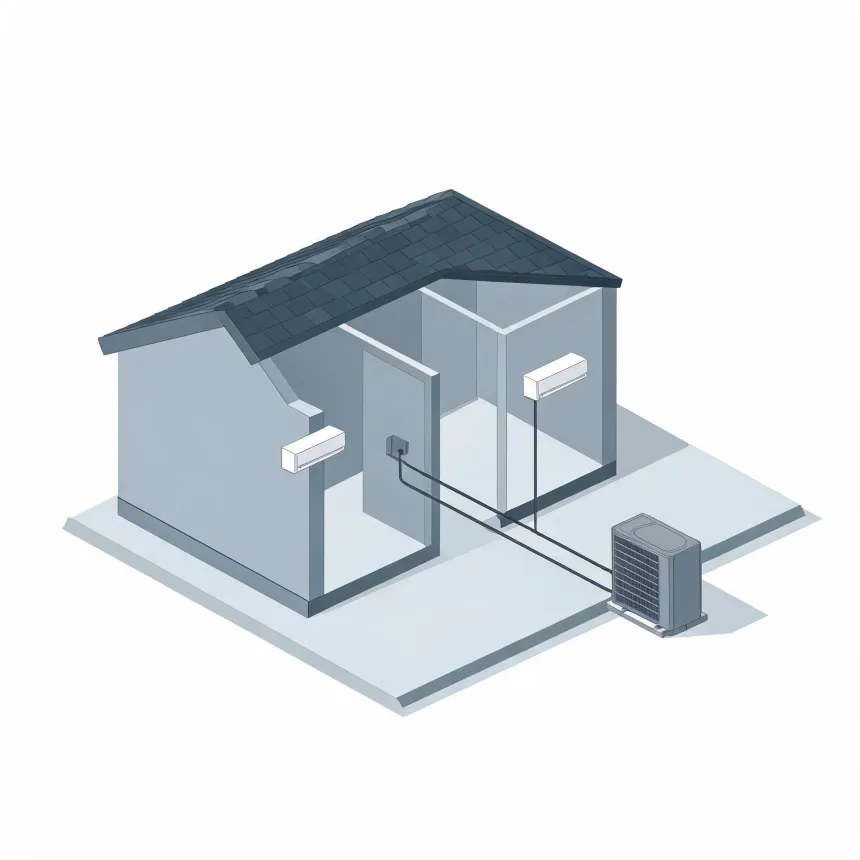
Isometric illustration of a cutaway gray house with a dark shingled roof, showing two wall-mounted indoor air handlers connected by line sets to an outdoor condenser unit on a pad outside.
Your system heats October through April and cools May through September.

NOAA nClimDiv, 1991–2020 normals

Half the homes in Henderson County were built in 1976 or earlier, half after.

A mini split here still comes down to a room by room load calculation, not the age of the house.

Five months of cooling, average summer heat, nothing to size up for

Cooling runs May through September
Summer afternoons average 87°F
82 damaging wind events from 2015 to 2024
Electricity here runs cheapKentucky homes paid 12.79 cents per kilowatthour in 2024, so fit and reliability matter more than squeezing out the top efficiency number.

Cooling starts in May here and runs through September. April is the month to get a mini split in, not the month you find out your old system quit. A install done ahead of the season means the crew can take the time a proper mount and lineset run take, instead of rushing to get cold air on in a heat wave. It also means the unit is tested and running before it has to work, so anything wrong with the charge or the wiring shows up while there's still time to fix it.

This climate sets a floor for what can go on the wall, and a tax credit is on the table while you decide

Henderson County is zone 4A, a mixed climate that puts real demand on both sides of a mini split, heating and cooling. Any split system heat pump installed here, ductless included, has to meet 14.3 SEER2 for cooling and 7.5 HSPF2 for heating under the federal standard. That is the floor, not a target to shop above. A federal tax credit is available for systems that qualify, worth knowing about while you are still comparing units.

Find a contractor
A man in a cap, dark jacket and tan work pants carries a worn canvas tool bag up concrete steps toward a dark green paneled front door of a house with horizontal siding and a potted shrub.
A beige split-system air conditioner outdoor condenser unit mounted on metal wall brackets atop a stucco wall.

What to ask before you pick one

Every mini split is a set of indoor heads tied to one outdoor compressor, and that compressor runs whenever any zone calls for heat or cooling. Ask what happens when one head is working hard and the others are idle, since not every system balances that load the same way. Ask what the compressor does on the coldest nights, because some units lose real capacity right when you need them most, and a model with a better low temperature rating will keep pulling heat long after a weaker one has to lean on backup. Ask how the manufacturer rates the warranty on the compressor versus the parts inside each head, since those often run different lengths. And ask what maintenance the system needs to hold its output over the years, because a coil that never gets cleaned loses capacity slowly, in a way you won't notice until the unit is struggling on a day it shouldn't be.

How many rooms it has to reach

Each indoor head needs its own line set, its own mounting spot, and its own wire run back to the outdoor unit. A system feeding one room is a different job than one feeding several, and the cost tracks the number of heads, not just the size of the compressor.

What the line set has to get through

The refrigerant lines run from the outdoor unit to each indoor head through a wall, sometimes up a floor or across an attic. A short, straight run is quick work. A run that has to clear framing or brick, or climb to another level, takes longer and takes more material, and that shows up in what the job costs.

If the old system is a central furnace and air conditioner, that stays put. A mini split handles specific rooms or zones, and most homes keep the ducted system running for the rest of the house unless every room is getting a head. If the old equipment being replaced is a window unit or electric baseboard, that comes out once the new head is mounted and running. A contractor can disconnect and haul away what's being replaced as part of the job, but confirm that before the work starts, since not every quote includes it. Whatever stays behind should still get its own service. A furnace or AC left in place still needs its filter changed and its coil checked, even with a mini split covering part of the house.

Installation starts with the outdoor unit and works backward from there. The crew sets the compressor on a pad or wall bracket first, somewhere it can draw air freely and drain without pooling water underneath. Then comes the line set, run through a sleeved hole in the wall to each indoor head, followed by the wiring that ties the heads back to the compressor. Once the lines are connected, the system gets evacuated with a vacuum pump to pull out moisture and air before any refrigerant moves through it. Skip that step and the system can run for a while before a compressor fails early from the moisture left behind. After charging, a tech checks static pressure, confirms each head is calling and responding correctly, and walks the homeowner through the remote or thermostat before packing up.