




A row of dark-sided single-story houses behind a tall trimmed hedge and a large tree, with a mown lawn and a paved path under an overcast sky.

Mini Split Installation in Hazard, KY

Tell us about the job

Takes about a minute. No obligation.

New system or replacementMini-splitPerry County, KY
Step 1 of 2

What ZIP code is the job in?

Most homes in Perry County heat with electricity, 74.3% of them. Bottled or LP gas and utility gas make up what's left, and neither comes close. A mini split fits into that picture without a fight, since it runs on electricity like the system it's likely replacing. There's no gas line to work around and no new fuel source to plan for. For most homeowners here, it's a straight swap in terms of what powers it, even though the equipment itself works differently from a furnace or baseboard heat.

7 months
October through April, your system heats
4 months
June through September, it cools
28°F
the average winter night it heats against
84°F
the average summer afternoon it cools against
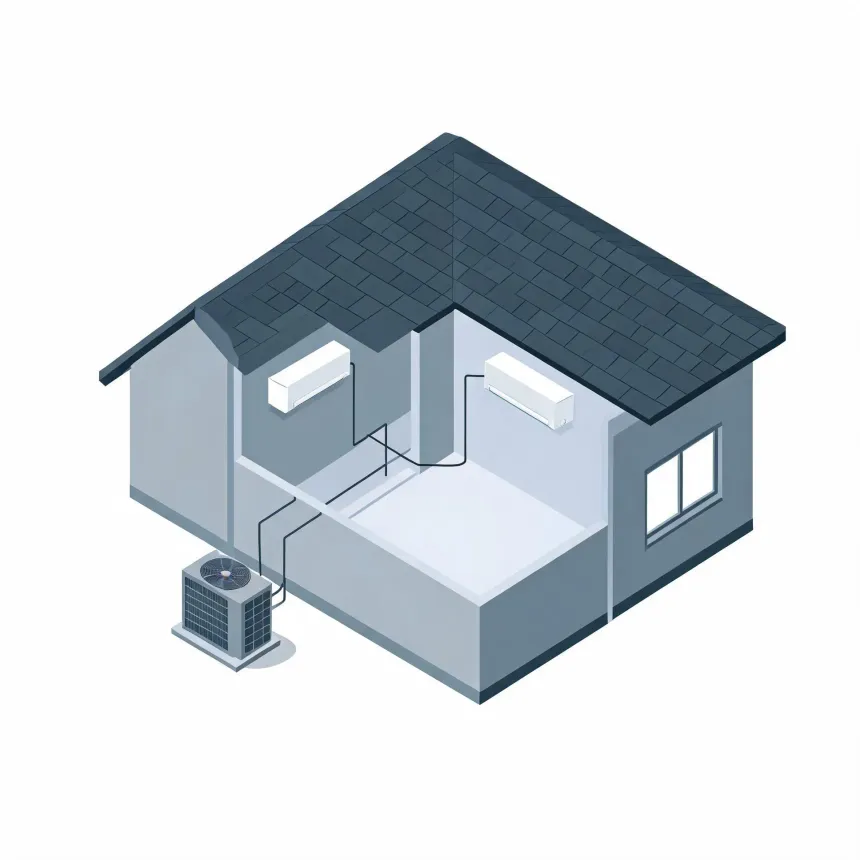
Isometric illustration of a cutaway gray house with a dark shingled roof, showing two wall-mounted indoor air conditioning units connected by lines to an outdoor condenser unit on the ground outside.
Your system heats October through April and cools June through September.

NOAA nClimDiv, 1991–2020 normals

Perry County sees damaging wind and the occasional winter storm, but nothing here calls for special equipment.

A mini split sized normally for this house will handle it fine.

May is the month to put a mini split in, before June asks it to work

Cooling runs June through September
Summer afternoons average 84°F
56 damaging wind events from 2015 to 2024

A mini split doesn't need to be sized up for anything specific to this county. Half the homes in Perry County were built in 1985 or earlier, half in 1985 or later, and that split doesn't point toward bigger equipment either way. What matters more for sizing is the house itself, its square footage and layout, not when it was built. About a third of the homes here are mobile homes, and those do call for some thought on where the indoor unit mounts and how the line set runs through the wall, but that's a question for the install, not a reason to size the system differently. A properly sized mini split, matched to the space it's heating and cooling, is the standard answer here.

Picking the right mini split matters more here than chasing efficiency

Electricity in Kentucky runs 12.79 cents per kilowatthour, cheaper than most of the country. That means a high-efficiency model takes longer to earn back the difference in cost. What matters more is getting a system sized and installed right for this house. Get a quote and see what fits.

Find a contractor
A man in a dark long-sleeve shirt, tan pants, cap and work boots carries a canvas tool bag up gray porch steps toward a dark green front door, with a potted shrub beside the entry.
A white mini-split air conditioner outdoor condenser unit mounted on metal brackets against a beige stucco exterior wall, with a blue sky and scattered clouds in the background.

Four months of real heat, nothing more

Cooling here runs about four months, June through September, with afternoon highs averaging 84°F through the summer. That's a normal mixed-climate load, zone 4A, and it asks about the same of a mini split as it does of a furnace in the winter months. A system sized to the house will cycle on and off through those four months without strain. Nothing about this stretch of weather pushes toward bigger equipment or a different kind of unit than you'd put in anywhere else in this zone.

How many zones the job needs

A single indoor head tied to one outdoor unit costs less than a setup covering several rooms from separate heads. Every added zone means another indoor unit, another line set, and another spot on a wall or ceiling to plan around. Covering one open space with one head is a simpler job than covering several rooms separately, no matter how good the equipment is.
What the line set has to get through

The outdoor unit and the indoor head connect through a refrigerant line that has to pass through a wall, and sometimes up through a floor or across an attic to reach where it's needed. A short, straight run through one wall goes quick. A run that has to work around framing, drop through tight space, or cover more distance costs more in labor and material, apart from whatever the equipment itself costs.

Ask how many BTUs each quote lands on, and what the contractor did to get there. A mini split sized by square footage alone can come out wrong, because window count, ceiling height, and how open the rooms are all change the number. Ask about the SEER2 rating too, but know it tells you how efficient the unit is, not how well it will heat or cool this particular space. If you're comparing a single zone against a multi zone setup, ask what happens if one indoor head needs service. Multi zone systems share one outdoor unit, so a problem with the outdoor compressor can take every zone down at once. Ask what the warranty covers on the compressor versus the line set and the indoor head, since those often carry different terms.

Installation day starts with the outdoor unit and the indoor head going in at the same time, since the line set connects them from the start. The installer runs that line set through the wall first, usually through a small hole no bigger around than a fist, then sets the indoor head on its mounting plate and connects the lines, the drain, and the wiring behind it. Outside, the compressor unit sits on a pad or brackets, away from the wall but close enough that the line set doesn't have to stretch. Once everything is connected, the system gets evacuated to pull moisture and air out of the lines before refrigerant is released into them. That step matters more than it sounds like it should, since trapped air or moisture in the line set is one of the more common reasons a new system underperforms. After that, the installer checks refrigerant charge, runs the system through both heating and cooling, and confirms the indoor head is reading temperature correctly before calling the job done.