



A white wall-mounted split-system air conditioner on a blue-grey wall, with a full moon visible through a curtained window at night.

Mini Split Installation in Grayson, KY

Tell us about the job

Takes about a minute. No obligation.

New system or replacementMini-splitCarter County, KY
Step 1 of 2

What ZIP code is the job in?

Most homes in Carter County heat with electricity, 62.6% by the last count. Bottled or LP gas comes in well behind that at 19.1%, and gas line service is rare here, just 9.8%. A mini split fits into that picture without a fight, since it runs on electricity like the baseboard heaters or electric furnace it's likely replacing. There's no gas line to tie into and none to work around. For a home already wired for electric heat, adding or swapping in a mini split is mostly a question of where the outdoor unit sits and how the lines run to the indoor heads.

7 months
October through April, your system heats
4 months
June through September, it cools
26°F
the average winter night it heats against
85°F
the average summer afternoon it cools against
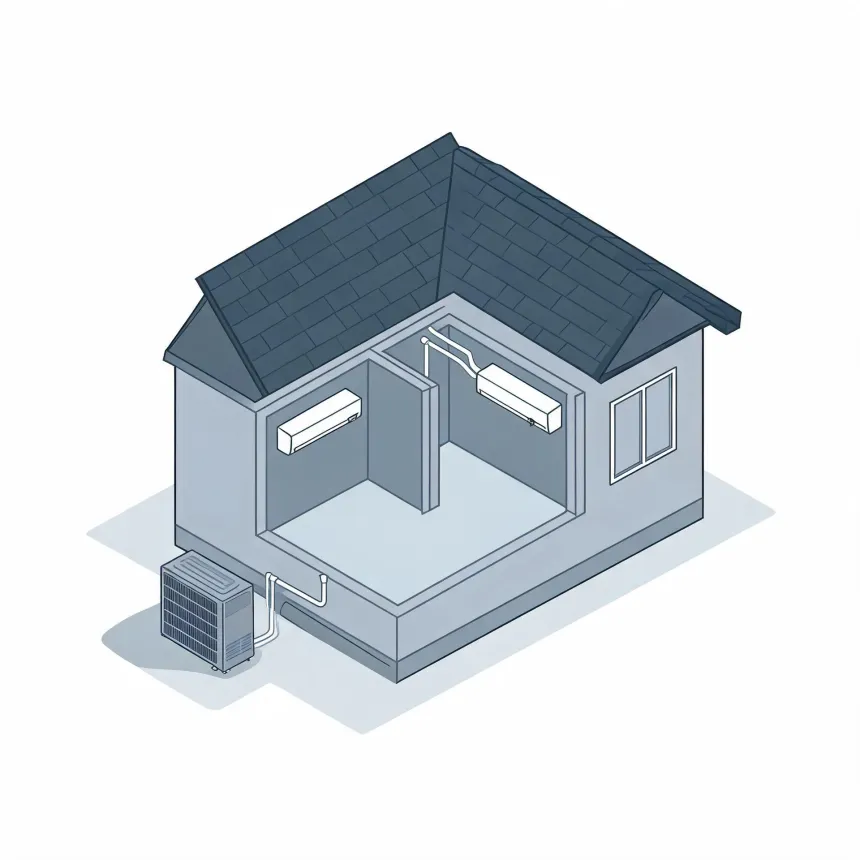
Isometric line illustration of a cutaway house with a shingled gable roof, showing two wall-mounted indoor air conditioning units connected by piping to an outdoor condenser unit on the ground outside.
Your system heats October through April and cools June through September.

NOAA nClimDiv, 1991–2020 normals

Cooling in Carter County starts in June.

A mini split put in during May is already running when the first hot days hit, not installed in the middle of them.

A standard mini split handles this county fine

Half the homes here were built by 1984
Cooling runs June through September
Summer afternoons average 85°F

Kentucky electricity ran 12.79 cents per kilowatt-hour in 2024, below what a lot of the country pays. That changes the math on which mini split to buy. The higher-efficiency models cost more up front and earn that back through lower bills, and when power is this cheap, it takes longer to see that money again. A mid-efficiency unit sized right for the space can be the more sensible buy here than the top-tier model. What matters more than the efficiency number on the label is whether the unit is sized for the rooms it's heating and cooling, and whether it's installed so it runs the way it's rated to.

A mini split installed here has to meet zone 4A's efficiency minimum

Carter County sits in climate zone 4A. Any mini split installed here has to meet the federal minimum for that category. That's 14.3 SEER2 for cooling and 7.5 HSPF2 for heating, same as any other split-system heat pump. Installing now means putting in a unit that already clears that bar, not finding out later it doesn't.

Find a contractor
A beige split-system air conditioner outdoor condenser unit mounted on metal wall brackets atop a stucco wall.

Four months of real summer, nothing more

Cooling runs four months here, June through September, with afternoon highs averaging 85°F. That's a real summer, not a mild one, but it's not extreme either. A mini split sized for the square footage it's covering will keep up through those months without needing to be oversized for some worse case that doesn't happen here. Zone 4A asks for real heating capacity too, and a standard system built to the federal minimum is built for exactly this kind of mixed climate.

What comes out depends on what's there now

Baseboard heaters usually just get disconnected and pulled off the wall, with the electrical left capped or reused for the new indoor head. An electric furnace and its ductwork can often stay in place if the mini split is supplementing it, or come out if it's a full replacement. Either way, removal is part of the job, not an extra step tacked onto it.
An old unit does not sit around for long

A contractor hauling out an electric furnace or baseboard heaters will dispose of them as part of the install, not leave them for the homeowner to deal with. Old refrigerant lines from a prior cooling system get capped or removed so they're not mistaken for live lines later. What's left behind is the new system and nothing from the old one still hanging in the walls.

The SEER2 and HSPF2 numbers on the label are efficiency ratings, not a measure of how much heat or cold the unit can put out. A mini split can carry plenty of capacity and still carry a modest rating, or the other way around, because the rating is about how much electricity it uses to deliver that capacity, not how strong it is. A higher rating means less electricity for the same comfort. It doesn't mean a bigger unit. Capacity has to match the room first. A highly rated unit sized wrong for the space will still run longer than it should and cycle on and off more than it needs to, and that wear adds up the same as it would on a unit with a lower rating. The label tells you about running cost. It doesn't tell you whether the unit fits the room, and that part has to be right first.

Installation starts with the outdoor unit. A tech sets it on a pad or mounts it to brackets on an exterior wall, somewhere with clear airflow on all sides and a short run to the indoor head. From there, a line set carrying refrigerant line, power wire and a condensate drain gets run through a hole drilled in the wall, usually behind where the indoor head will hang. The indoor unit mounts to a bracket and gets connected to those lines. Before any refrigerant goes in, the whole circuit gets sealed and pressure tested. A mini split that leaks refrigerant from a bad connection won't heat or cool right no matter how well it was sized, so that test has to hold. Once the system holds pressure, it gets charged, powered up, and run through both heating and cooling to check that it responds the way it should. Last comes sealing the wall penetration against weather and pests, so the hole that lets the lines through doesn't let anything else in behind them.