Most homes here run on electric heat
Electricity heats 56.2% of occupied homes in Barren County. Electric resistance heat is exactly what a mini split is built to beat on efficiency, so a system replacing that kind of setup has a clear case to make.
Takes about a minute. No obligation.
Electricity heats 56.2% of occupied homes in Barren County. Electric resistance heat is exactly what a mini split is built to beat on efficiency, so a system replacing that kind of setup has a clear case to make.
No gas line to work around and no furnace to coordinate with. The job centers on where the indoor heads go and where the outdoor unit sits, not on tying into fuel piping.
NOAA nClimDiv, 1991–2020 normals
The price of a mini split job comes down to how many zones you need and how far the line set has to run.
More indoor heads and longer runs between them and the outdoor unit mean more labor and more refrigerant line, and that's where the cost moves.




Kentucky electricity runs 12.79 cents per kilowatthour, cheaper than most of the country. That changes the math on a mini split. The efficiency gain still cuts your bill next to electric resistance heat, but it takes longer to earn back the cost of chasing the highest-efficiency model on the shelf. Here it makes more sense to size the system to the rooms it's heating and cooling and pick equipment that holds up, rather than stretching for a SEER2 number that pays off slowly at these rates. Ask about warranty and how the installer handles service calls. That's where the value sits when power is cheap.
Barren County sits in climate zone 4A. Any mini split installed here has to meet the federal minimum for split-system heat pumps. That means 14.3 SEER2 for cooling and 7.5 HSPF2 for heating. That floor already narrows down what can go on the wall. A federal tax credit is available on qualifying equipment, so it's worth checking before you settle on a unit.
Find a contractorIf what's coming out is a baseboard heater or a wall furnace, that old unit usually just gets shut off and left in place, or pulled out if it's in the way of the new indoor head. There's no refrigerant to recover from it and no duct to cap. If you're replacing an older heat pump or window units instead, whoever pulls the old equipment has to recover the refrigerant in it rather than letting it vent, that's a legal requirement, not a courtesy. An old outdoor condenser gets disconnected from its electrical whip and hauled off. None of that old equipment can be reused or tied into the new system. A mini split runs on its own refrigerant circuit sized for the new indoor heads, so the install is a clean break from whatever was heating and cooling the space before.
A contractor works out heat loss and heat gain for each room a head will serve. That means the wall and window area, how much insulation is there, which way the room faces, what room is next to it. That load number decides the size of the indoor head. Not the size of the room by eye, and not whatever size the old system happened to be.
A mini split that's too big chills the space fast and shuts off before it pulls the moisture out of the air. The room ends up cold and still damp. Undersized, it runs flat out and never quite catches up on the hottest afternoons. The right size runs long, steady cycles, and that's what actually keeps a room comfortable.
Comparing quotes, ask what's actually different between them before you look at the price. Bids for a mini split can still cover different jobs. Find out how many indoor heads each quote includes and what size each one is rated for, since a lower price sometimes means a smaller unit or fewer zones, not a better deal. Ask who the equipment manufacturer is and whether the indoor and outdoor units are matched as a system, since mixing brands or mismatching capacity between them can void the warranty and hurt performance. Ask what the warranty actually covers, parts or labor, and for how long, since labor coverage is what matters if something fails down the road. Ask how the line set will be run, through an interior wall, along the exterior, through the attic, since that routing affects how the finished job looks and how easy the system is to service later.
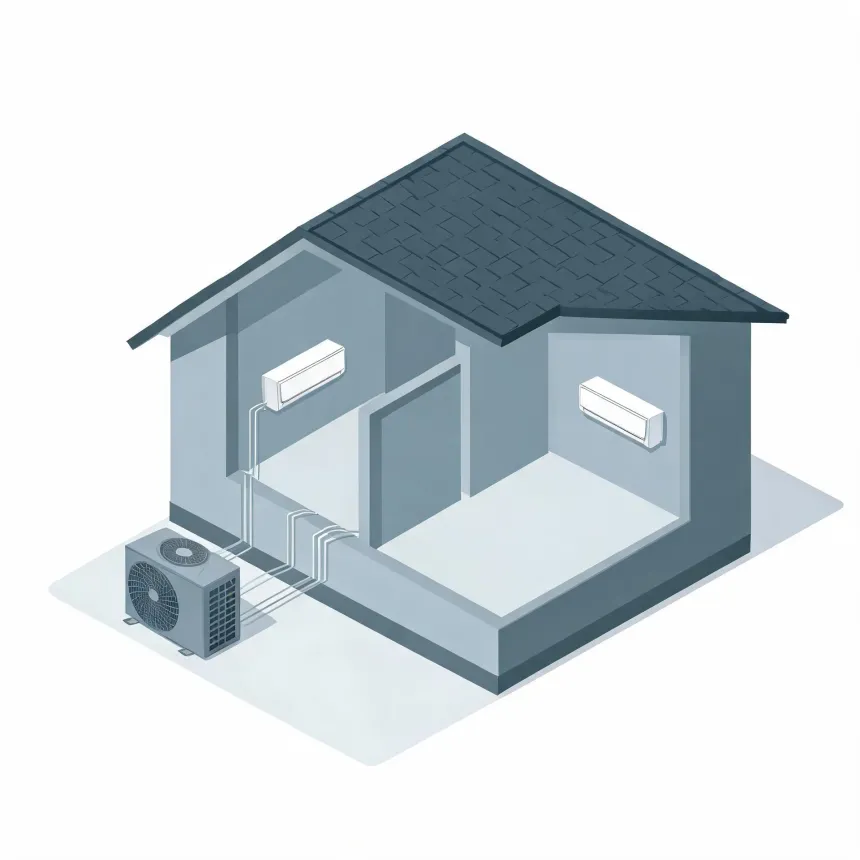
Installation day starts with the outdoor unit and where it sits. It needs clearance on all sides for airflow and a solid, level pad so it isn't sitting in standing water after a hard rain. Running the line set comes next, the copper tubing and wiring that connect each indoor head back to that outdoor unit, usually through a single small hole drilled where the wall meets the room. Once the line set is in, the tech brazes the connections, then pulls a vacuum on the whole system to clear out air and moisture before any refrigerant moves through it. That vacuum test matters more than almost anything else that happens that day. A line set with moisture or air trapped inside will damage the compressor over time, and there's no way to see that problem from outside the unit once it's sealed up. After the system holds vacuum, the refrigerant charge gets set to the manufacturer's spec, the indoor heads get mounted and leveled, and the whole system gets run on both heating and cooling before anyone calls it done.