A row of dark-sided single-story buildings with gabled shingle roofs behind a tall trimmed hedge, with lawn, leafy trees and an overcast sky.

Mini Split Installation in Florence, KY

Tell us about the job

Takes about a minute. No obligation.

New system or replacementMini-splitBoone County, KY
Step 1 of 2

What ZIP code is the job in?

Storms hit this county often

Boone County logged 121 severe weather events between 2015 and 2024, including damaging wind, hail and winter storms. Whoever mounts your outdoor unit should think about what's upwind of it and what could come off a roof in a bad storm.

Outages are common too

Nearly a quarter of Kentucky households went at least a day without power in 2024. A mini split draws far less power than a central system's outdoor unit, so a portable generator or battery that couldn't run your old AC may still keep a mini split head going through an outage.

7 months
October through April, your system heats
4 months
June through September, it cools
26°F
the average winter night it heats against
85°F
the average summer afternoon it cools against
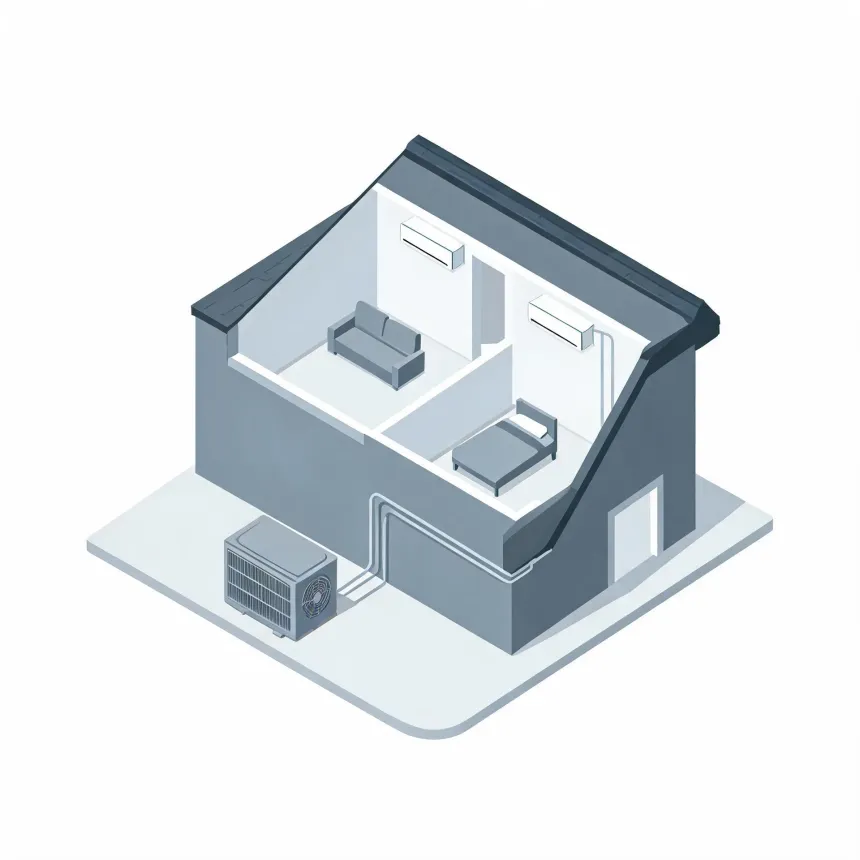
Isometric cutaway illustration of a two-room house showing two wall-mounted indoor air conditioning units connected by line sets to an outdoor condenser unit on the ground outside.
Your system heats October through April and cools June through September.

NOAA nClimDiv, 1991–2020 normals

Florence summers run four months, June through September, with afternoon highs averaging 85°F.

A mini split sized for a normal Boone County summer handles that fine. There's no reason to size up.

May is the month to get it in, before June heat and storm season arrive together

Cooling runs June through September
Summer afternoons average 85°F
86 damaging wind events from 2015 to 2024
Reliability matters more than the savings hereElectricity here runs 12.79 cents per kilowatt-hour, below the national average. A mini split earns its keep by running through outages, not by cutting the power bill.

Close to half of Boone County runs on electric heat, and gas heats most of the rest. Neither tells you much about mini splits on its own, since a mini split works alongside what's already there rather than replacing a furnace outright. What it does well here is cooling and shoulder-season heat, the weeks in spring and fall when running a full furnace or central AC is more than the house needs. If your home is electric already, adding a mini split means working with wiring that's set up for electric loads. If you're on gas, a mini split still handles cooling and can take pressure off the furnace in milder months, with the gas system carrying the coldest stretches.

Zone 4A sets the floor for what can go in

Boone County sits in zone 4A, a mixed climate that asks real work of both heating and cooling. A mini split counts as a split system under federal rules, so any one built from 2023 on has to meet 14.3 SEER2 for cooling and 7.5 HSPF2 for heating. That's the floor a contractor has to meet here, and a federal tax credit is available on top of it.

Find a contractor
A man in a backwards cap, dark long-sleeved shirt and brown work pants, seen from behind, carries a worn canvas tool bag up steps toward a dark green paneled front door beside a potted shrub.
A white outdoor air conditioner condenser unit mounted on metal wall brackets against gray horizontal siding, with a blue sky and white clouds behind it.

The label is a ceiling, not a guarantee

SEER2 tells you how much cooling a unit gets out of the power it uses, averaged over a whole season rather than one hot afternoon. HSPF2 does the same for heating. Neither number says how big a system is or how fast it cools a room, and a higher number on the label doesn't mean the unit will keep up with a harder climate. What it does mean is less waste. A mini split with a stronger rating is moving the same heat with less electricity behind it, every hour it runs. Since a mini split head runs almost any time someone's home, that rating is working in the background far more than a furnace or central AC cycling on and off. The rating also only holds if the system is sized and installed right. An oversized or undersized unit won't hit its rated efficiency no matter what the label says, and a dirty filter or a blocked outdoor coil pulls real performance below it too. The label tells you what the equipment is capable of. Everything after installation decides whether it actually runs that way, year after year.

How many zones, and what's each one rated for

A mini split system can run one indoor head or several off a single outdoor unit. If you're comparing multi-zone setups, ask what each individual head is rated to do, not just the total for the outdoor unit. A contractor who's done the room-by-room math will have an answer ready. One who hasn't will talk in generalities about the whole system.

Ask where the line set runs and how long it is

The line set carries refrigerant between the outdoor unit and each indoor head, and it has a maximum length it can run before performance suffers. A longer, twistier path means more places for a bad joint to leak down the road. Get a straight answer on the route before the work starts, not after the wall's already been drilled.

If you're adding a mini split alongside a furnace or central AC, the old system usually just stays put and keeps doing what it's always done. There's no reason to pull a working furnace out because a mini split moved in. If the mini split is replacing an old window unit or a worn-out central system, whoever does the install should disconnect it properly, not just unplug it and leave it. Refrigerant in an old system has to be recovered, not vented, and that's a legal requirement, not a courtesy. A contractor pulling permits for the new install will typically handle disposal of the old equipment as part of the job, since they're already on site with a truck. Ask who's hauling it off before work starts, so it isn't sitting in the yard after.

Installation starts with the outdoor unit, not the indoor one. Whoever's doing the work picks a spot for it first, since the line set length and route run from that decision backward. Inside, the mounting plate goes up, and the installer drills one hole through the wall for the line set, the drain line and the electrical whip to pass through together. That hole gets sealed once everything's through it, so water and air can't follow the lines back in. The line set gets connected at both ends, then the system is evacuated with a vacuum pump before any refrigerant moves, which pulls out moisture and air that would otherwise sit in the lines and cause problems later. Once that holds, the installer charges the line, mounts the indoor head, wires it in, and runs the system through its paces before calling it done.