





A row of dark-sided houses with brown shingled roofs behind trimmed hedges, lawn, and large deciduous trees under an overcast sky.

Mini Split Installation in Elizabethtown, KY

Tell us about the job

Takes about a minute. No obligation.

New system or replacementMini-splitHardin County, KY
Step 1 of 2

What ZIP code is the job in?

Hardin County logged 129 severe weather events between 2015 and 2024, including damaging wind, hail, and tornadoes. A mini split's outdoor unit sits outside through all of it, so placement matters. Keep it away from the roofline where ice or debris can fall, up on a bracket or pad clear of runoff, with room for a contractor to get to it after a storm. Winter storms have hit the county too, and nearly a quarter of Kentucky households went at least a day without power in 2024. A mini split needs electricity to run, same as a furnace's blower, so an outage takes down your heat either way. Worth asking a contractor about backup options before the system goes in, not after the first outage.

7 months
October through April, your system heats
5 months
May through September, it cools
27°F
the average winter night it heats against
86°F
the average summer afternoon it cools against
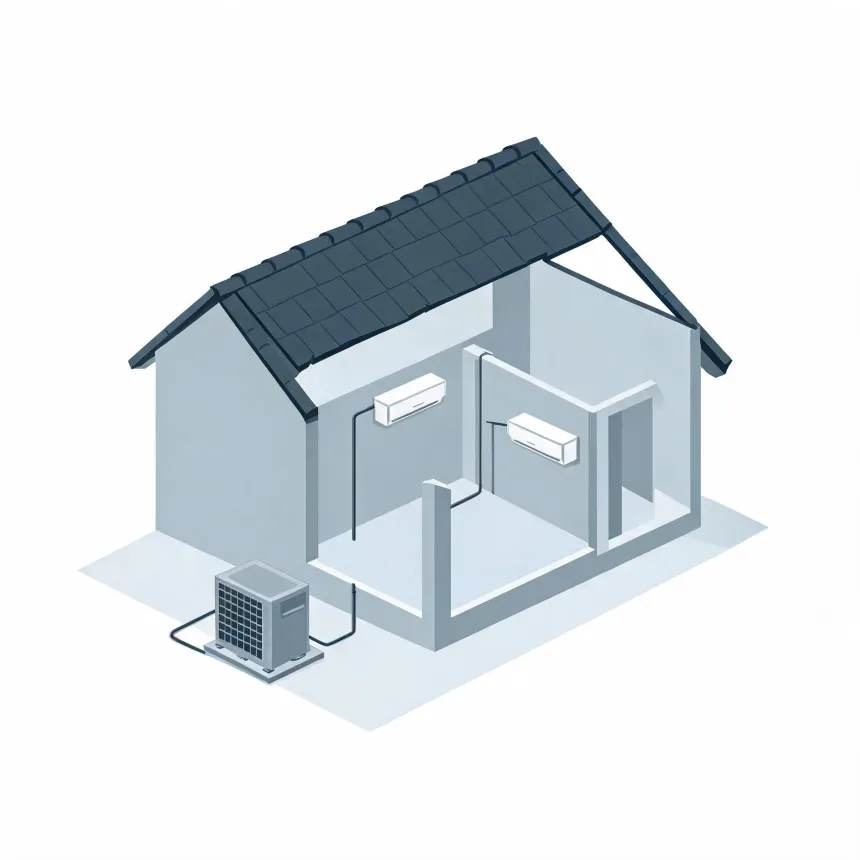
Isometric illustration of a cutaway house with a dark tiled gable roof, showing two wall-mounted indoor split air conditioning units connected by lines to an outdoor condenser unit on the ground outside.
Your system heats October through April and cools May through September.

NOAA nClimDiv, 1991–2020 normals

Cooling runs May through September here.

April is the month to get a mini split installed, before the first warm week puts it to the test.

Most homes here already run on electricity, and a mini split fits right into that

71.5% of homes heat with electricity
Cooling runs May through September
Summer afternoons average 86°F

Hardin County falls in climate zone 4A, which asks a system to handle real heat and real cold without wasting power doing it. That shapes what a contractor can install. Any ductless mini-split sold here as new equipment falls under the same federal minimum as other split-system heat pumps, so a unit manufactured from 2023 on has to hit at least 14.3 SEER2 for cooling and 7.5 HSPF2 for heating. There's no separate, looser rule for ductless systems. On top of meeting that baseline, a qualifying heat pump can also make the household eligible for a federal tax credit. Worth asking a contractor which models on their lineup qualify before deciding between them.

Power is cheap here, so fit and reliability matter more than squeezing out extra efficiency

Electricity in Kentucky runs about 12.79 cents a kilowatt-hour, well below what most of the country pays. That changes the math on which mini split to buy. A high-efficiency model still costs less to run month to month, but it takes longer to earn back the difference in price. Here, how the system holds up through a storm and whether it's sized right for the room matters more than squeezing out another SEER2 point.

Find a contractor
A man in a cap, gray long-sleeve shirt and tan work pants carries a canvas tool bag up concrete steps toward a dark green paneled front door, with a potted shrub to the right.
A white mini-split air conditioner outdoor condenser unit mounted on metal brackets against a beige stucco exterior wall, with a blue sky and scattered clouds in the background.

How it runs matters as much as how long

A compressor that cycles on and off all day doesn't wear the same as one left to run steady. Short cycling, where the unit kicks on, satisfies the thermostat fast because it's oversized, then shuts off again within minutes, stresses the compressor more than a long steady run does. The motor and moving parts see the most strain at startup, so a system doing that over and over wears faster than one sized to run longer stretches at lower output. Ask how the contractor sized the unit to the room, not just the brand or the price. A mini split built to run long and steady through a hot afternoon is doing what it's designed for. One that's short cycling, even brand new, is already working against itself.

Cooling and heating get separate scores

SEER2 covers cooling, HSPF2 covers heating, and a mini split carries both because it runs as a heat pump either direction. A unit can be strong on one and average on the other. Worth asking a contractor to walk through each number on its own instead of one blended efficiency claim.
The rating assumes your size is right

A SEER2 or HSPF2 number is measured in a lab, with the unit matched correctly to the space it's cooling or heating. Oversize the unit and it shuts off before it finishes pulling moisture out of the room, then kicks back on, burning more power than the rating promised. The number on the label only holds if the contractor sizes the unit to the room instead of rounding up for peace of mind.

What drives the price is mostly what the installer has to do to get refrigerant line from the outdoor unit to the indoor head. A short, straight run through one exterior wall costs less than a line set that has to snake up a floor or around the house to reach a second zone. Every indoor head needs its own line set and its own spot on the electrical circuit, so a multi-zone system costs more than a single head, not because the equipment is pricier but because there's more line, more mounting, more labor. Where the outdoor unit ends up matters too. A pad at ground level near an exterior wall is the easy case. A bracket mounted higher up, or a condenser that has to sit further from the house, takes more time and more hardware. The brains of the system, the size of the compressor and how many indoor heads it can run, drives part of the cost, but the labor to route everything cleanly is just as real a number on the invoice.

A mini split install starts with a walkthrough, the contractor checking where the line set will run and where the outdoor unit will sit before any tools come out. Mounting the indoor head comes first, usually high on an interior wall, with a small hole drilled through to the outside for the refrigerant lines, drain line and power wire bundled together. Those lines run to the outdoor unit, then get connected, and the system is evacuated with a vacuum pump to pull out air and moisture before refrigerant ever flows. Skip that step and moisture left in the lines can freeze or corrode the coil later. Once the system holds vacuum, the contractor opens the line valves, powers it on and checks that it's pulling the right refrigerant pressure and temperature split at the head. The last part is dialing in airflow and running it in both cooling and heating to confirm the thermostat or remote is actually talking to the unit.