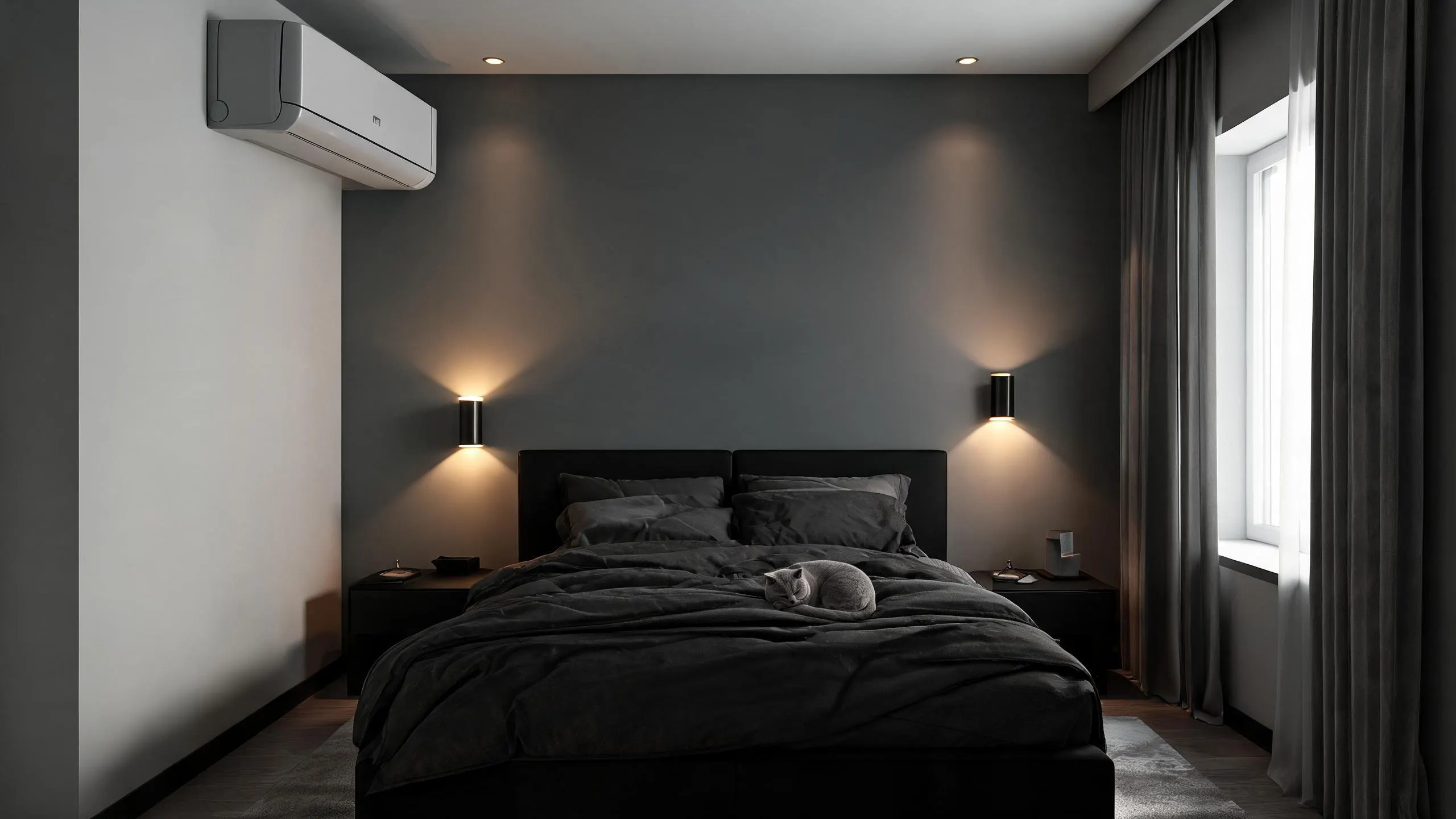





A minimalist bedroom with dark grey walls, a large bed with charcoal bedding, a sleeping cat, two warm-toned wall sconces, and a wall-mounted air conditioning unit.

Mini Split Installation in Danville, KY

Tell us about the job

Takes about a minute. No obligation.

New system or replacementMini-splitBoyle County, KY
Step 1 of 2

What ZIP code is the job in?

Most homes in Boyle County heat with electricity, close to six in ten. A mini split fits right into that picture, since it runs on electricity too and does both heating and cooling from one system. About a third of homes here use utility gas, and for those households a mini split usually goes in alongside the furnace rather than replacing it, handling a room or addition the ductwork does not reach well. Either way, the installer will size the unit to the space and check what the walls and wiring can support before running the lines.

7 months
October through April, your system heats
4 months
June through September, it cools
27°F
the average winter night it heats against
85°F
the average summer afternoon it cools against
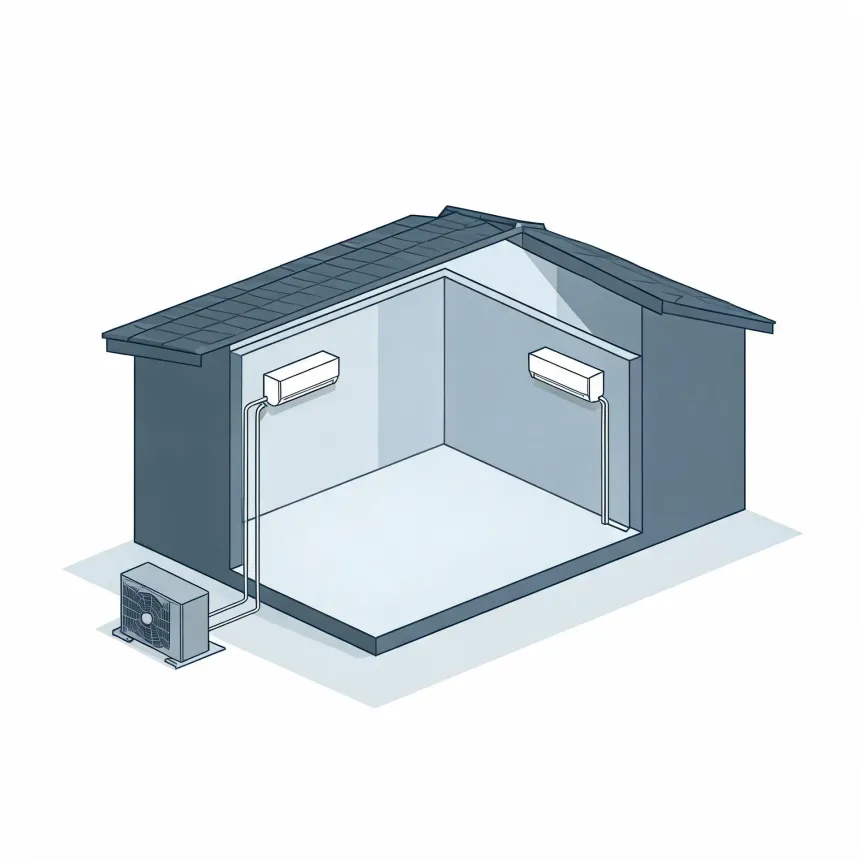
Cutaway isometric illustration of a small building interior showing two wall-mounted indoor air conditioning units connected by line sets running down to a single outdoor condenser unit on the ground outside.
Your system heats October through April and cools June through September.

NOAA nClimDiv, 1991–2020 normals

Half the homes in Boyle County were built in 1978 or earlier, half in 1978 or later.

A mini split sized for the room handles either one the same way, no special equipment needed.

Cooling starts in June here, so get it installed in May

Cooling runs June through September
Summer afternoons average 85°F
Power costs 12.79 cents a kWh statewide
Electricity runs 12.79 cents a kilowatt-hour herePower costs less than in most states, so sizing and install quality matter more than squeezing out the highest efficiency number.

Boyle County falls in climate zone 4A, which asks real work of both heating and cooling, and that shapes what can legally go in. Any mini split installed here, manufactured from 2023 on, has to meet 14.3 SEER2 for cooling and 7.5 HSPF2 for heating. That's the same minimum as any other split-system heat pump, ductless or not. The federal tax credit is worth checking too, since a qualifying unit can bring one back at tax time. The installer will know which models on the market clear the bar for this zone.

A standard mini split handles summers here

Cooling here runs four months a year, June through September, with afternoon highs averaging 85°F. That's a normal summer load, not a heavy one. A mini split sized correctly for the room will handle it without needing to be oversized or built to a higher efficiency spec than the zone already requires.

Find a contractor
A white mini-split air conditioner outdoor condenser unit mounted on metal brackets against a beige stucco exterior wall, with a blue sky and scattered clouds in the background.

The rating is a season, not a moment

That SEER2 and HSPF2 number on the label comes from measuring the unit across a full season, not one hot afternoon or one cold morning. Most of the hours it runs, it isn't working flat out. It's cycling at partial output to match whatever the room needs right then, and that's where efficiency actually gets spent. A unit left running for months at a time only gets close to that label number if it's kept clear to breathe. A dirty filter or a coil caked with dust makes the system work harder to move the same air. Leaves or anything else blocking the outdoor unit does the same thing from the other side. None of that shows up on the label. It shows up in how much power the unit pulls to do the job it was rated for.

Ask what the room needs, not what the brochure claims

A mini split sized by square footage alone can miss badly. Ceiling height, how many windows face the sun, and whether the room shares a wall with conditioned space all change the load. A contractor who does a room by room load calculation before quoting is sizing the unit to the space. One who just asks square footage is guessing.
Ask where the line set will run and how it will be hidden

The refrigerant lines, power wire and drain line all have to travel from the indoor head to the outdoor unit, usually through a hole drilled in the wall behind it. Where that line set runs, whether it's hidden in a wall chase or covered by a line hide on the exterior, changes how the finished job looks and how easy the unit is to service later. Get this settled before the work starts, not after.

A mini split that's too big for the room cycles on, hits the setpoint fast, and shuts off again before it's pulled any real moisture out of the air. That leaves the room feeling cold and damp rather than comfortable. One that's too small runs constantly and still struggles to hold the temperature steady, even on an ordinary day. Getting the size right starts with a load calculation, not a guess based on floor area. The installer measures the room, accounts for window area, ceiling height, and insulation, and works out how much heat the space gains in summer and loses in winter. That number points to a specific unit size, and going bigger isn't a safety margin, it's a different problem.

If the mini split is replacing a window unit or an older ductless system, that equipment just gets hauled off, nothing to it. Where it gets more involved is a straight swap for central air or a furnace handling the whole house. Ductwork that's no longer tied to anything either gets sealed off or pulled out, depending on whether any of it stays in service for another part of the house. A furnace or outdoor condenser coming out has refrigerant in it that has to be recovered properly, not vented, so that part of the job falls to whoever's licensed to handle it. None of this holds up the new installation. The mini split's lines run independent of whatever ductwork was there before, so the old system can come out on its own timeline.