Weather here is hard on outdoor equipment
Whitley County recorded 108 severe weather events between 2015 and 2024, most of them damaging wind. An outdoor condenser mounted where wind-blown debris or hail can reach it takes the brunt of that.
Takes about a minute. No obligation.
Whitley County recorded 108 severe weather events between 2015 and 2024, most of them damaging wind. An outdoor condenser mounted where wind-blown debris or hail can reach it takes the brunt of that.
Nearly a quarter of Kentucky households lost power for 24 hours or more in 2024. A mini split won't run without electricity, so if keeping heat or cooling during an outage matters to you, raise it before installation, not after.
NOAA nClimDiv, 1991–2020 normals
Electricity in Kentucky runs about 12.79 cents per kilowatt-hour, cheaper than most of the country.
A mini split still has to hold up through wind and outages here, so pick it for that before you pick it for the lowest operating cost.




A standard mini split, sized normally for the square footage, is the right call here. Summer runs June through September, with afternoon highs averaging 84 in June, July and August. That's real work for a system to do, but it's not extreme heat, so there's no case for oversizing the unit or paying up for a higher efficiency tier than you'd use anywhere else in a mixed climate. Winter asks something of the same system too, which is normal for zone 4A. Put the money instead into a mount and installation that can take the wind this county sees.
Whitley County sits in climate zone 4A. Any mini split installed here now has to meet the federal minimum for split-system heat pumps, 14.3 SEER2 for cooling and 7.5 HSPF2 for heating. That floor narrows down what a contractor can install. A federal tax credit is available for qualifying equipment, worth asking about before you settle on a unit.
Find a contractorA mini split runs most of the year, not just in the hardest months of summer or winter. That changes what matters in the install. The line set and wiring run inside a wall sleeve or a small core drilled through the exterior, and that opening gets sealed with a collar and proper insulation. Done poorly, it lets in air and moisture every day the system sits idle, not just when it's running. The outdoor unit needs to sit level on its pad or wall bracket, because a unit that settles or tilts over time puts strain on the compressor and the refrigerant lines. Flare fittings at the line set connections have to be torqued correctly and tested for leaks before the system is charged. A slow leak there won't show up as a dramatic failure. It shows up as a system that quietly loses capacity over a few years, running longer to do the same job. None of this is about the brand of equipment. It's about whether the person doing the install took the time to get the parts of the job nobody sees exactly right.
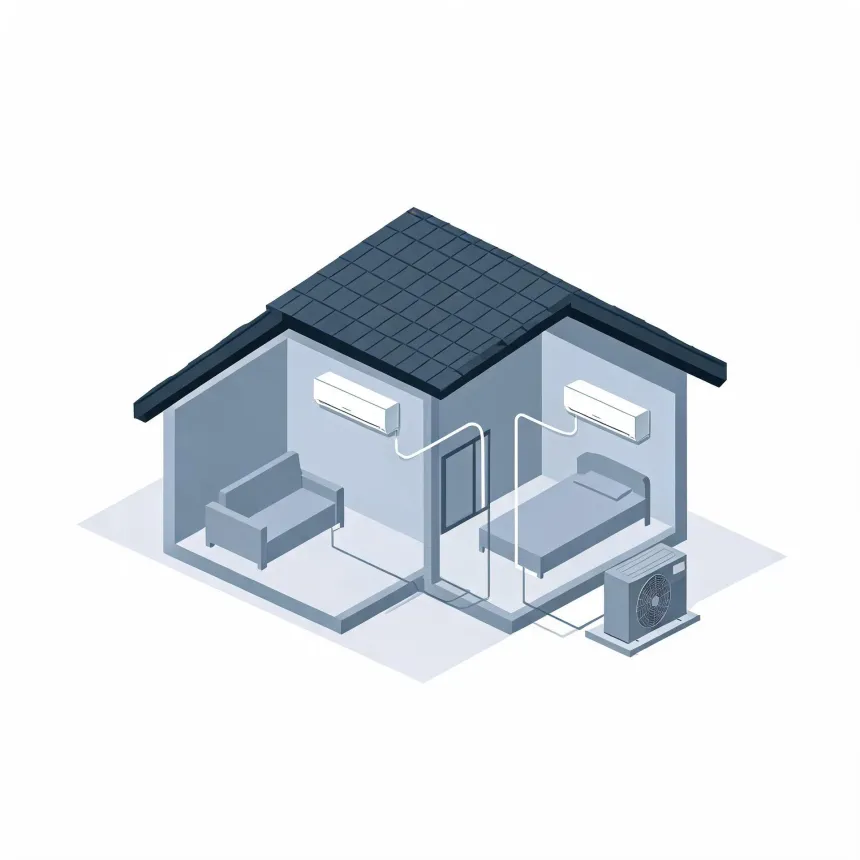
A single outdoor condenser can run one indoor head or several. If several rooms need coverage, ask whether the plan is one multi-zone system or separate single-zone units. A multi-zone system costs less to run line sets for, but if one part needs service, it can affect the other zones on the same condenser.
Capacity should come from a room-by-room load calculation, not a guess based on square footage alone. Windows, insulation and ceiling height all change how much a room needs. A contractor who skips this step is guessing at a number that affects comfort and efficiency for as long as the system runs.
Sizing a mini split is not about matching tonnage to square footage and calling it done. The calculation has to account for how many windows a room has, which way they face, how high the ceiling is, and how much insulation is behind the walls. Rooms the same size can need different amounts of capacity depending on all of that. Oversize the unit and it cools or heats the room fast, then shuts off, which leaves the air feeling damp and uneven because the system never runs long enough to pull moisture out. Undersize it and it runs constantly, straining to reach a setpoint it can't hold on the hardest days. The right size is the one that runs in long, steady cycles. That's a sign the equipment matches the room, not just the building.
Installation day starts with where the indoor head goes, not the outdoor unit. The wall needs a clear path to the outside with nothing behind it like wiring or framing that would interfere with the drill. Once that core is cut, the line set, drain line and power wiring all pass through together and get sealed before anything else happens. The outdoor unit goes on a pad or a wall bracket next, set level, because that matters for years, not just on install day. After the lines are connected and torqued, the system gets pressure tested and held there to check for leaks before any refrigerant goes in. Only once that holds does the system get charged, and only then does anyone find out if it actually runs the way it was sized to.