





A row of dark-sided cottages with brown shingled roofs behind a trimmed hedge, beside a mown lawn and large leafy trees under an overcast sky.

Mini Split Installation in Campbellsville, KY

Tell us about the job

Takes about a minute. No obligation.

New system or replacementMini-splitTaylor County, KY
Step 1 of 2

What ZIP code is the job in?

Taylor County is in climate zone 4A. That means real heating work in the winter and real cooling work in the summer, with humidity added on top. Any new mini-split here has to meet the federal minimums for a split-system heat pump. That's 14.3 SEER2 for cooling and 7.5 HSPF2 for heating, whether it's one room or a multi-zone setup for the whole house. A system built to those numbers is sized for both seasons here, not just one of them. A qualifying system can also come with a federal tax credit toward the cost.

7 months
October through April, your system heats
5 months
May through September, it cools
28°F
the average winter night it heats against
86°F
the average summer afternoon it cools against
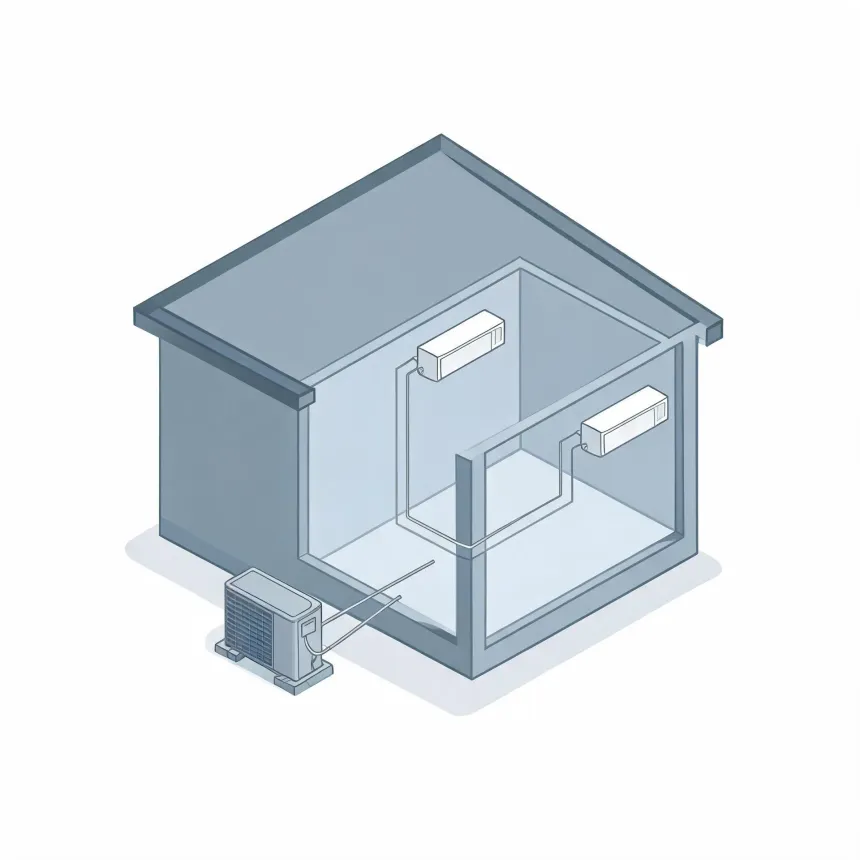
Isometric line illustration of a cutaway building interior with two wall-mounted indoor air conditioning units connected by piping to an outdoor condenser unit on the ground outside.
Your system heats October through April and cools May through September.

NOAA nClimDiv, 1991–2020 normals

Electricity in Kentucky runs about 12.79 cents per kilowatt-hour, well under what most states pay.

A high-SEER2 mini-split still costs more up front, and here it takes longer to earn that back, so pick the system that holds up through the year, not just the one with the best rating on paper.

A standard mini-split handles this county fine

Half the homes here were built by 1978
Cooling runs May through September
Summer afternoons average 86°F
Get it in before MayCooling runs May through September here. April is the month to have it done.

Summer here runs May through September, with afternoon highs averaging 86 in June, July and August. That's enough to lean on a mini-split for five months straight, but it's not extreme heat, and a standard-capacity system keeps up without strain. Zone 4A means the same unit also has to carry real heating load the rest of the year, so sizing it for cooling alone would leave winter short. There's no case here for going bigger or paying for a higher tier than the job calls for. A properly sized, standard-efficiency mini-split matches both seasons this county actually sees.

Electric heat already runs this county

Most homes in Taylor County heat with electricity already, and a mini-split is an electric system through and through. Putting one in doesn't fight the setup the house already has. That's the straightforward path here, not a switch to something the home wasn't built around.

Find a contractor
A white mini-split air conditioner outdoor condenser unit mounted on metal brackets against a beige stucco exterior wall, with a blue sky and scattered clouds in the background.

Taking out the old system is its own job

Whatever heated and cooled the house before this either gets removed or gets left in place doing nothing, and that choice matters. A central system comes with ducts, and if those ducts stay, they still leak air at every joint whether or not a furnace or air handler is pushing through them. If the old system was window units or electric baseboard, those can usually just come out, and baseboard in particular is worth disconnecting rather than leaving live. An old outdoor condenser left standing still holds refrigerant unless it's properly recovered, and that's not a job for anyone but a licensed tech. None of this is about the new mini-split. It's about making sure nothing from the old setup is quietly costing money or causing a problem after the switch.

How many zones the house needs

Every indoor head is its own run of refrigerant line and its own spot on the outdoor unit. A one-room system is a simple job. Cover a whole house and the installer is routing line sets to several rooms, which means more line, more wall penetrations, and an outdoor unit sized to drive all of them at once. The zone count drives the work more than almost anything else.
What the line set has to cross

Refrigerant line runs from the outdoor unit to each indoor head, and it has to get through a wall and often through framing, brick, or siding to do it. A straight shot through one exterior wall is quick work. A run that has to clear the attic, drop through a chase, or cross to the far side of the house takes longer and uses more line, and that shows up in the install regardless of which system is going in.

When you sit down to compare quotes, make each one name the same things so you can actually line them up. Ask what SEER2 and HSPF2 rating the quoted system carries, not just the brand name on the unit. Ask how many indoor heads it includes and whether that matches the rooms you actually want conditioned, not a guess rounded up or down. Ask where the outdoor unit goes and how long each line set run is, since a run through an attic or across the house costs more in material and labor than a straight shot through one wall. Ask what happens to whatever heated and cooled the place before, because removal or disconnection is its own line item and it should show up on paper, not get assumed. A quote that answers all of that tells you what you're paying for. One that just lists a price doesn't.

Install day starts outside, not in. The outdoor unit needs a spot with clear airflow on all sides and a solid pad underneath, usually set a few inches off the ground or wall-mounted on brackets. Indoors, each head goes up on the wall or ceiling where the installer has already marked the spot, and a small hole gets drilled through to run the line set, the drain line, and the electrical whip together. Once the lines are run and connected, the system gets evacuated with a vacuum pump to pull out moisture and air before any refrigerant moves, because trapped air or moisture in the line will wreck performance later. After that it's a pressure test to check for leaks, then the charge goes in and the installer runs the system in both heating and cooling to confirm each head is actually doing its job. The walk-through at the end covers the thermostat or remote for each zone and what the filter looks like when it needs attention.