A row of illuminated two-story brick houses with front porches and mature trees photographed at twilight.

Mini Split Installation in Bowling Green, KY

Tell us about the job

Takes about a minute. No obligation.

New system or replacementMini-splitWarren County, KY
Step 1 of 2

What ZIP code is the job in?

Weather here takes a toll on outdoor units

Warren County had 142 severe weather events between 2015 and 2024, including damaging wind and hail. A mini split's outdoor unit sits exposed to all of it, so where it goes and what shields it matters as much as the install itself.

Power cuts mean no heat or cooling either way

Nearly a quarter of Kentucky households lost power for a day or more in 2024. A mini split needs electricity to run, so an outage takes down your heating and cooling at the same time, no matter how new or efficient the system is.

7 months
October through April, your system heats
5 months
May through September, it cools
29°F
the average winter night it heats against
88°F
the average summer afternoon it cools against
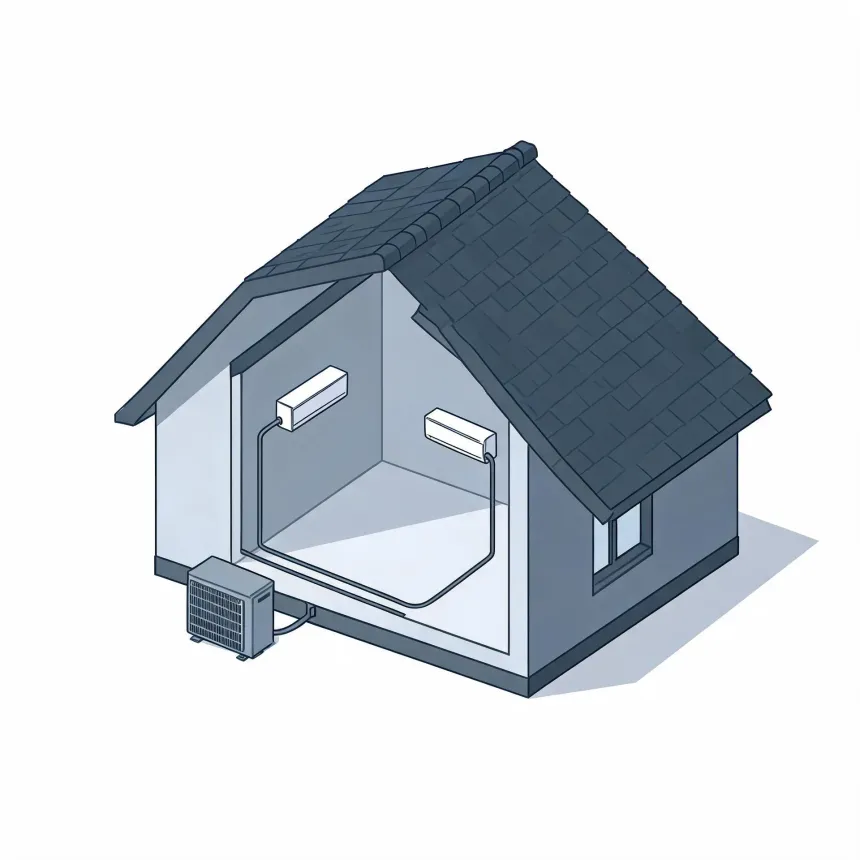
Isometric cutaway illustration of a small house with a shingled gable roof, showing two wall-mounted indoor air conditioning units connected by refrigerant lines to an outdoor condenser unit on the ground outside.
Your system heats October through April and cools May through September.

NOAA nClimDiv, 1991–2020 normals

Electricity heats 56.5% of homes in Warren County.

A mini split runs on electricity too, so it fits right into how this area already heats its homes.

April is the month to get this done, before May's heat and storms arrive

Cooling runs May through September
Summer afternoons average 88°F
98 damaging wind events from 2015 to 2024

Warren County falls under zone 4A, a mixed climate that asks real work of both heating and cooling. A mini split installed here counts as a split-system heat pump under federal rules, and any unit made from 2023 onward has to hit at least 14.3 SEER2 for cooling and 7.5 HSPF2 for heating. There's no separate, looser standard for ductless systems. That's the floor a contractor has to meet, not a target, and it narrows down which systems are even legal to install. On top of that, a mini split installed this year may qualify for a federal tax credit. Ask the contractor which models on the quote meet both the efficiency minimum and the credit.

A standard mini split handles Warren County summers fine

Cooling runs about five months here, May through September, with afternoon highs averaging 88°F. That's a normal load for a standard mini split sized and rated to the federal minimum. Nothing about this climate calls for a bigger unit or a higher tier than what's already required. The bigger question is where the outdoor unit goes, given how often wind and storms come through the county.

Find a contractor
A man in a cap and olive work shirt carries a canvas tool bag up concrete steps toward a dark green panelled front door of a house with horizontal siding and a potted shrub.
A beige split-system air conditioner outdoor condenser unit mounted on metal wall brackets atop a stucco wall.

The old system doesn't stay behind

When a mini split goes in, the old system doesn't just get unplugged and left there. If it's a central system, the indoor coil, the outdoor condenser and the line set all come out, and if the ductwork isn't being reused for anything, it may get sealed off or pulled depending on what else uses it. A window unit or an older ductless system comes out entirely, mounting plate and all, since the new lines and pad are rarely in the same spot. Whoever installs the new system should also recover the refrigerant from the old one properly rather than just cutting the lines. It's not legal to vent it into the air, and a tech who skips that step is cutting corners somewhere else too.

SEER2 and HSPF2 tell you different things

SEER2 is the cooling rating. HSPF2 is the heating rating. A mini split carries both numbers because it does both jobs, and a higher number on either one means less electricity to produce the same cooling or heating. Check both figures on a quote, not just one.

A rating comes from a lab, not your house

SEER2 and HSPF2 get measured under fixed test conditions, not inside a particular room or against a particular wall. A contractor still has to size the indoor unit to the space and set the outdoor unit somewhere air can move through it freely. Skip either step and the system won't run anywhere near its rated efficiency, no matter what the label says.

A mini split quote isn't just the price of the equipment. How many indoor heads the job needs matters, since one outdoor unit can run several zones or just one, and each added zone means another line set, another mounting job, another spot to cut through the wall. The length of that line set matters too. The farther the indoor head sits from the outdoor unit, the more refrigerant line and wiring has to run between them, and some of that run may mean opening up wall or soffit to hide it. Where the outdoor unit lands plays into it as well. A pad, a wall bracket and ground-level clearance aren't the same job, and whichever one fits the space takes different materials and different time. Electrical work can swing it further. Some systems need a dedicated circuit run back to the panel, and if the panel's already full, that's its own job before the mini split even goes in. None of this shows up on the spec sheet. It shows up when someone walks the space and figures out what the install actually asks for.

Install day starts with the walkthrough already done, so the crew shows up knowing where the lines run and where the outdoor unit sits. First the indoor head goes on its mounting plate, then a hole gets drilled through the wall for the line set, the wiring and the drain line to pass through together. That penetration gets sealed once everything's routed, so water and air can't follow the lines back inside. Outside, the condenser gets set on its pad or bracket, the lines get connected, and the whole system gets vacuumed down to pull moisture and air out of the lines before any refrigerant moves through them. Skip that step and the system can run fine for a while, then lose efficiency or wear out its compressor early. Once it's charged and powered up, a tech checks the temperature split at the indoor head and makes sure each zone actually calls for heat or cooling the way it should before calling the job done.