104 storms, one outdoor unit
Nelson County logged 104 severe weather events between 2015 and 2024, with damaging wind the most common of them. An outdoor condenser sitting against the wall or up on a mount takes that weather directly.
Takes about a minute. No obligation.
Nelson County logged 104 severe weather events between 2015 and 2024, with damaging wind the most common of them. An outdoor condenser sitting against the wall or up on a mount takes that weather directly.
Ask the installer where the outdoor unit will sit before the lines go in. A spot clear of falling branches and shielded from wind-driven hail holds up better than one picked for convenience.
NOAA nClimDiv, 1991–2020 normals
Cooling runs May through September here.
Get the mini split installed by April and it happens on your schedule, not during the first hot week.



Nelson County falls in climate zone 4A, which asks real work of both heating and cooling, and that shapes what can legally go into your home. A mini split counts as a split-system heat pump under the federal standard, so any unit built from 2023 on has to clear 14.3 SEER2 for cooling and 7.5 HSPF2 for heating. There's no separate, looser rule for ductless systems. That's a floor, not a target, so ask what SEER2 and HSPF2 the unit you're quoted actually carries. A system that clears those numbers by a wide margin may also qualify for the federal tax credit, worth asking your installer about directly.
Electricity heats 74.8% of homes in Nelson County, far more than gas or propane. A mini split is an electric heat pump, so it fits the setup most houses here already have, no gas line to run, no new fuel to plan around.
Find a contractorCooling runs about five months here, May through September, with afternoon highs averaging 86°F through June, July and August. Watch the clip run into the evening hours and the outdoor unit is still working after dark. A mini split sized to the room handles that stretch without trouble. Zone 4A asks real work of the system in both directions, but that's not a reason to size it bigger than the space calls for. A unit sized right, installed well, runs those five months year after year.
A mini split system can run one indoor head off one outdoor unit, or several heads off one larger outdoor unit, each head controlling its own room. Ask whether the quote is for a single zone or a multi-zone setup, and whether the outdoor unit has capacity left if you want to add a head later. Adding a zone after the fact means a new line set and a new indoor head, not just a software change.
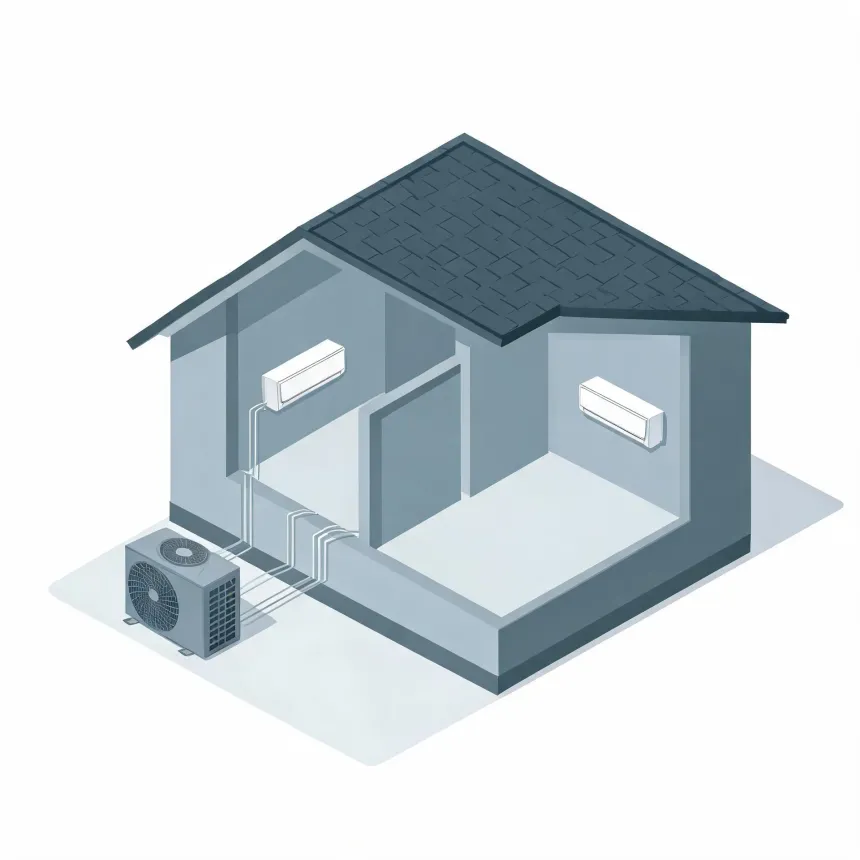
The refrigerant lines and wiring have to get from the outdoor unit to each indoor head, usually through a hole drilled in the wall behind the head. Ask the installer to walk the actual path before they commit to a spot, especially if the line has to run any distance to reach the outdoor unit. A longer line set can mean a drop in capacity, so the installer should account for that in how they size the system, not just in where they run the pipe.
SEER2 tells you how much cooling a unit produces for the power it uses, and HSPF2 does the same for heat. Both are efficiency ratings, not a measure of how much heating or cooling capacity the unit has. A mini split with a higher SEER2 moves the same amount of heat out of a room using less electricity than one with a lower rating, but a high rating on an undersized head still won't keep the room comfortable. The rating on the label is tested under set conditions, so real output moves around with the weather and how the system was installed. A unit that's sized right and set up well tends to run closer to its rated efficiency than one that's oversized or has a line set that's longer than it should be. Ask what rating the quoted unit carries and ask how the installer sized it for the room, since one number without the other doesn't tell you much.
Installation day starts with mounting the indoor head, usually high on a wall where it can throw air across the room instead of into a corner. The installer runs the line set from there to the spot picked for the outdoor unit, drilling a single hole through the wall to carry the refrigerant lines, the power wire and the condensate drain together. Those lines get connected, then the system is pressure tested before any refrigerant moves, to catch a bad joint while it's still easy to fix. Once it holds pressure, the lines are evacuated to pull out moisture and air, because either one left behind will cause problems later. The outdoor unit gets set on its pad or mount, wired in, and the whole system is charged and run through its paces, cooling and heating both, before anyone calls it done. A clean install shows almost nothing inside the house beyond the head on the wall and a thin line hidden in a cover running out to the unit.