







An outdoor heat pump unit mounted on a concrete pad in front of a two-story suburban house with a landscaped lawn.

Heat Pump Repair in Somerset, KY

Tell us about the job

Takes about a minute. No obligation.

RepairHeat PumpPulaski County, KY
Step 1 of 2

What ZIP code is the job in?

A tech starts outside at the unit, checking the refrigerant charge and the compressor before anything gets taken apart. They'll run the system in both heating and cooling to see where it stops doing its job, since a heat pump that cools fine but won't heat points to the reversing valve, not the compressor. Next comes the airflow, the coils, the filter, because weak airflow mimics a refrigerant problem and sends people chasing the wrong fix. If the outdoor unit is frosted over and not defrosting on its own, that's the defrost board or a sensor, and it gets tested on the spot rather than guessed at. By the end you should hear plainly what's wrong, what it takes to fix it, and whether it's worth repairing or replacing.

7 months
October through April, your system heats
4 months
June through September, it cools
28°F
the average winter night it heats against
84°F
the average summer afternoon it cools against
Isometric cutaway illustration of a single-story house showing interior ductwork, an air handler and rooms, with an outdoor condenser unit connected by refrigerant lines on a plain white background.
Your system heats October through April and cools June through September.

NOAA nClimDiv, 1991–2020 normals

Half the homes in Pulaski County were built in 1986 or later.

A heat pump that came with a newer house still has years left in it, and that favors repair over replacement.

October asks something of a heat pump that September never did

Cooling runs June through September
Heat runs October through April
167 damaging wind events from 2015 to 2024
A winter that doesn't push the system too hardOvernight lows here average 28°F in December, January and February, well short of what wears a heat pump down.

There's a few things worth checking before you pick up the phone. Look at the thermostat first and make sure it's set to heat, not cool, and the fan is set to auto. Check the breaker box, since a tripped breaker on the outdoor unit will shut the whole system down and looks exactly like a bigger failure. Pull the filter and hold it up to a light. If you can't see through it, air isn't getting past it either, and that alone can cause weak heat or a frozen coil. Walk outside and look at the unit itself. Snow or leaves packed against the fins will choke it off the same way a dirty filter does, and that's something you can clear by hand. If the outdoor coil is coated in ice and the system isn't melting it off on its own after a while, that's not something to chip at or hose down. That's a defrost problem, and it's a call, not a fix.

This winter wasn't what broke your heat pump

A mild winter like this one doesn't beat up a heat pump the way a harder climate would. So if yours is struggling, the cause is more likely age or a specific part than years of strain, and that usually makes it worth fixing.

Find a contractor
A man in a cap, gray long-sleeve shirt and tan work pants carries a canvas tool bag up concrete steps toward a dark green paneled front door, with a potted shrub to the right.
A gray air-source heat pump mounted on a concrete pad next to a house with gray vinyl siding, surrounded by gravel and flanked by green shrubs and white hydrangea flowers.

A newer system points you toward repair

If your heat pump came in when the house was built, and the house is one of the newer ones here, age probably isn't what's wrong with it. A compressor or a reversing valve can fail on a system with plenty of years left, and that's a part to replace, not a reason to replace the whole unit. Check the paperwork or ask the tech what year the system went in before you decide which way to go.

What you'll notice first

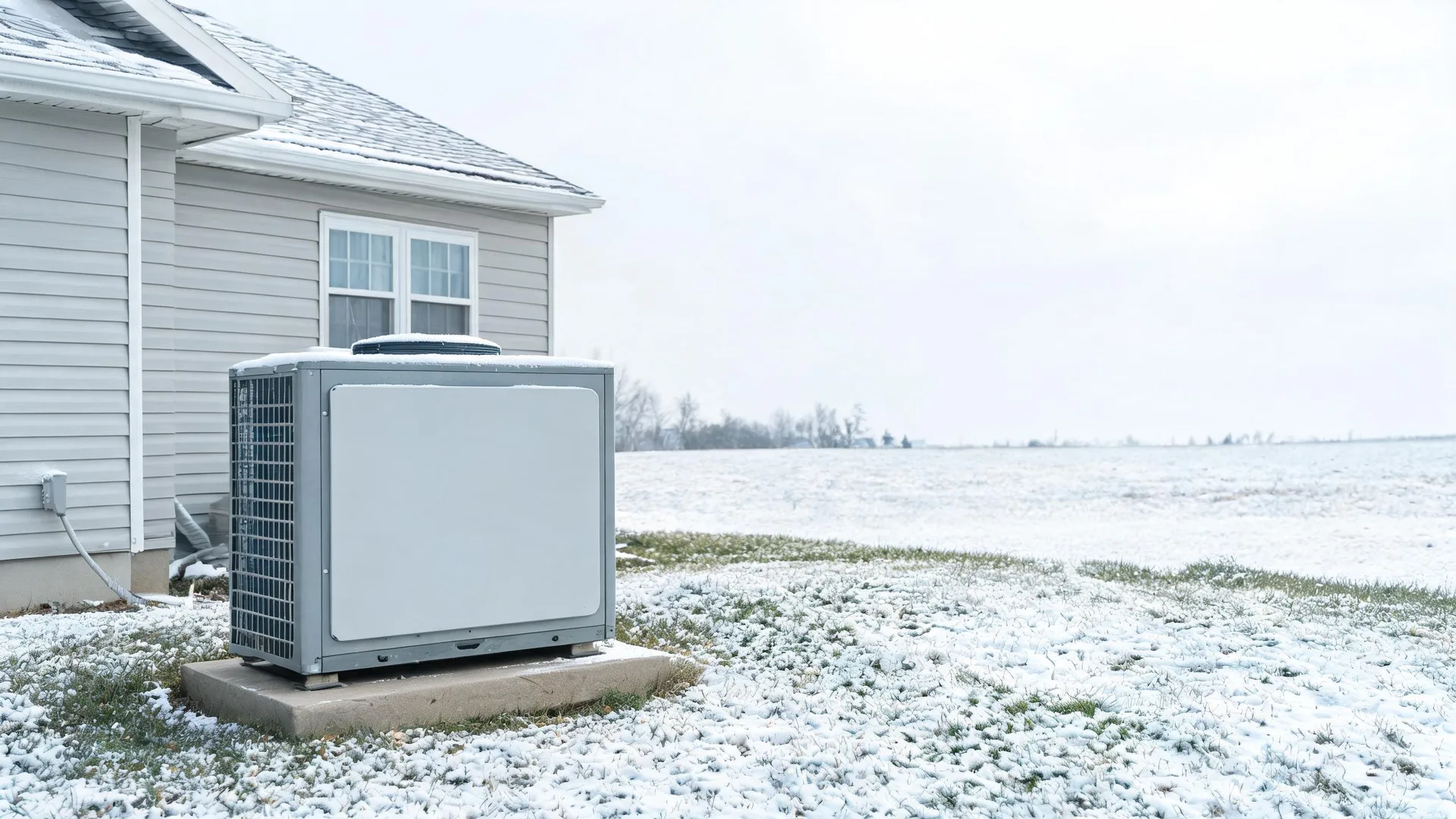
A failing heat pump usually gives some warning before it quits. The air coming out of the vents feels cool instead of warm. The outdoor unit runs long stretches without shutting off, or it short cycles, kicking on and off every few minutes. Frost builds up on the outdoor coil and stays there instead of clearing on its own. Sometimes the system leans hard on backup heat strips and won't come off them, even though the house stays warm.
What those signs point to

Weak heat with no frost on the coil usually points to the reversing valve or a refrigerant leak. Short cycling often traces back to a dirty filter or a bad sensor, not the compressor. A system stuck running backup heat means the heat pump itself has stopped carrying the load on its own. Each of these is a different repair, so it's worth having a tech confirm which one is happening before deciding how serious it is.

Most heat pump failures trace back to a handful of parts. The reversing valve is a common one. It's what switches the system between heating and cooling, and when it sticks, the unit keeps running but blows the wrong temperature air. Capacitors wear out too, usually showing up as a fan that hums but won't spin or a compressor that struggles to start. Low refrigerant almost always means a leak somewhere in the lines or coil, not the system just running low over time, since these are sealed systems. The defrost board and its sensor fail often enough to be a usual suspect when ice builds up outside and never clears. Contactors pit and stick from years of cycling on and off, which can leave the outdoor unit running nonstop or not starting at all. None of these mean the whole system is done. They're individual parts, and most of them get replaced on their own.

Age is the first thing to weigh, but it isn't the only thing. A heat pump works harder than a furnace or an AC alone, since it runs most of the year carrying both heating and cooling, so its parts wear on a different schedule than either one. A compressor failure late in a system's life is usually the point where replacement starts making more sense than repair, because the compressor is the most expensive part to replace and the rest of the unit has logged the same years it has. A reversing valve, a capacitor, a contactor or a defrost board failing doesn't say anything about the rest of the system. Those parts fail on their own timeline, sometimes early, and swapping one out on an otherwise sound heat pump is a normal repair, not a stopgap. The question worth asking isn't just how old the system is, but which part failed and whether it's been back for repairs recently. A first repair on a unit with no other history reads differently than one that keeps coming back.