






Three illuminated two-story brick houses on a tree-lined residential street photographed at twilight, with warm window light and landscape uplighting visible against a deep blue evening sky.

Heat Pump Repair in Paducah, KY

Tell us about the job

Takes about a minute. No obligation.

RepairHeat PumpMcCracken County, KY
Step 1 of 2

What ZIP code is the job in?

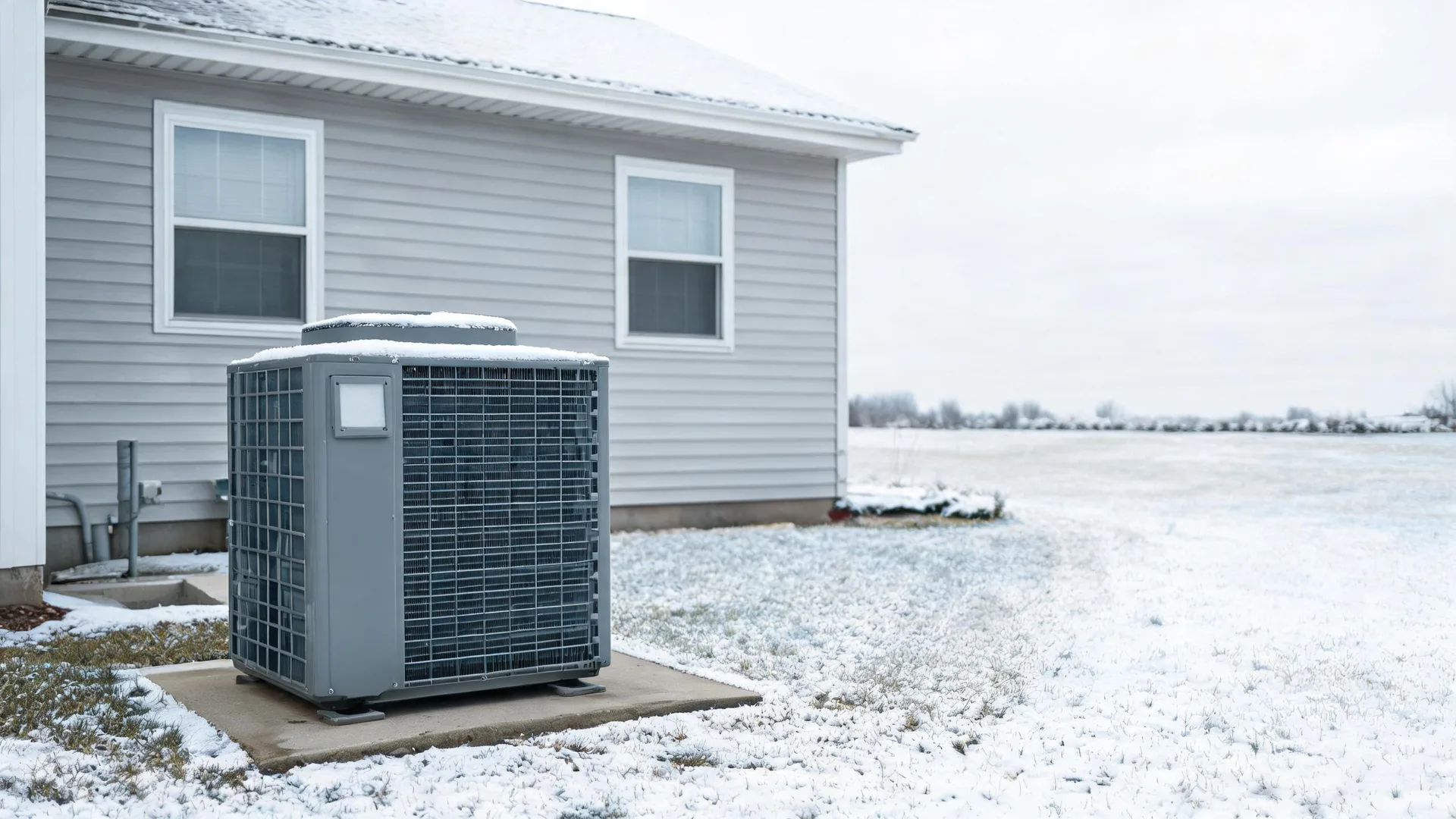
McCracken County saw 134 severe weather events between 2015 and 2024, most of it wind. Your heat pump's outdoor unit sits outside through all of it, exposed to whatever blows through. Wind-driven debris can bend the fins on the coil or crack a fan blade, and hail dents the cabinet and the coil underneath it. A unit that took a hit like that can keep running for weeks before it struggles, so it still working today doesn't mean it came through fine.

7 months
October through April, your system heats
5 months
May through September, it cools
29°F
the average winter night it heats against
88°F
the average summer afternoon it cools against
Isometric grayscale illustration of a cutaway house showing interior rooms, ceiling ductwork and an air handler, connected by lines to an outdoor condenser unit on a pad outside.
Your system heats October through April and cools May through September.

NOAA nClimDiv, 1991–2020 normals

A heat pump that's low on charge or losing a capacitor can usually be repaired.

One that's cracked a heat exchanger or lost the compressor is done, and the rest of the system is old enough to go with it.

October asks your heat pump to switch over and start heating. Weak parts fail right there.

Cooling runs May through September
Heat runs October through April
96 damaging wind events from 2015 to 2024
An older heat pump isn't the problem hereHalf the homes in McCracken County were built in 1978 or earlier, half later.

If your outdoor unit came through a bad storm, get a contractor to look at the coil fins and the fan blade before you assume it's fine. Bent fins choke airflow across the coil, and a cracked blade can throw the fan out of balance until it finally gives out. McCracken County recorded 15 hail events between 2015 and 2024, enough that a dented cabinet shouldn't surprise anyone. A unit that still runs after a hit isn't the same as one that was checked after a hit.

Get it checked after a storm

Storms hit hard here. If the outdoor unit took hail or debris, have it checked even if it still runs.

Find a contractor
A white mini-split heat pump outdoor unit mounted on a concrete pad beside a gray-sided house, surrounded by gravel and green shrubs.

What to listen for before it quits

A heat pump runs most of the year, heating and cooling both, so its parts wear on both ends of the system at once. Listen for what changes. A click when it switches between heating and cooling that wasn't there before. Air coming out the vents that's noticeably cooler than usual during a heating cycle, which often means the reversing valve is stuck partway. Ice building up on the outdoor coil and not melting off during the defrost cycle. Short cycling, where it kicks on and off every few minutes instead of running a full cycle. The outdoor fan running but moving less air than it used to, which points to a motor on its way out rather than a dirty coil. None of these mean the unit is done. They mean a part is failing, and a part that fails slowly now fails completely later, usually on the day you need the system most.

The reversing valve is the part unique to a heat pump

Everything else inside it, the compressor, the capacitor, the contactor, fails the same way it would in a straight air conditioner. The reversing valve is the one part doing a job an AC never asks of it, switching the flow of refrigerant so the system can heat instead of cool. A valve that sticks or wears out shows up as a system stuck in one mode, or heating that suddenly feels like cooling.
The compressor rarely fails on its own

By the time a compressor quits, something usually pushed it there first. A low charge makes it run hotter than it should. A failing capacitor makes it strain to start. A dirty outdoor coil makes it work against bad airflow. Catching the capacitor or the charge early is what keeps the compressor from being the next thing to go.

There's a few things worth checking before a service call. Check the thermostat is set to heat and the setpoint is actually above room temperature, since a setting bumped by accident looks exactly like a dead system. Go to the outdoor unit and clear away any leaves, grass clippings or ice packed around the base, since blocked airflow across that coil can bring on a lot of the same symptoms as a real failure. Check the air filter inside, because a clogged one starves the whole system of airflow and can trip it into shutting down to protect itself. Look at the breaker panel for a tripped breaker before assuming a part failed. None of this fixes a stuck reversing valve or a weak capacitor, but it rules out the simple stuff fast, and there's no harm in checking it yourself first.

A diagnostic visit starts outside at the unit itself. The tech checks the refrigerant charge and the pressures on both the high and low side. From there it moves to the electrical parts. The capacitor gets tested under load, not just looked at, since a capacitor can read fine sitting still and still fail the moment it has to start the compressor. The contactor gets checked for pitting. Then comes airflow on both sides, the outdoor coil and the indoor filter and blower, because a part can test fine and still fail to heat the house if air isn't moving through it. Only after that does the reversing valve get tested, usually by watching whether it actually switches when it's told to. A good diagnosis finds what caused the failure, not just the part that finally gave out.