A lit brick residential street at dusk showing a row of two-story homes with covered porches and mature trees.

Heat Pump Repair in Nicholasville, KY

Tell us about the job

Takes about a minute. No obligation.

RepairHeat PumpJessamine County, KY
Step 1 of 2

What ZIP code is the job in?

Age and history matter more than the symptom

A heat pump that trips its breaker or stops switching between heating and cooling can usually be repaired if it hasn't needed much work before now. But a unit that keeps coming back for the same compressor or coil trouble has already told you where this is headed. The repair in front of you matters less than how many came before it.

What a failing compressor changes

Most parts on a heat pump, the capacitor, the fan motor, the reversing valve, can be swapped without touching the rest of the system. A compressor is different. It sits at the center of the refrigerant circuit, and replacing it alone often costs close to a new outdoor unit. When a contractor tells you the compressor is going, that's the point to ask about replacing the whole system instead of just that part.

7 months
October through April, your system heats
5 months
May through September, it cools
27°F
the average winter night it heats against
85°F
the average summer afternoon it cools against
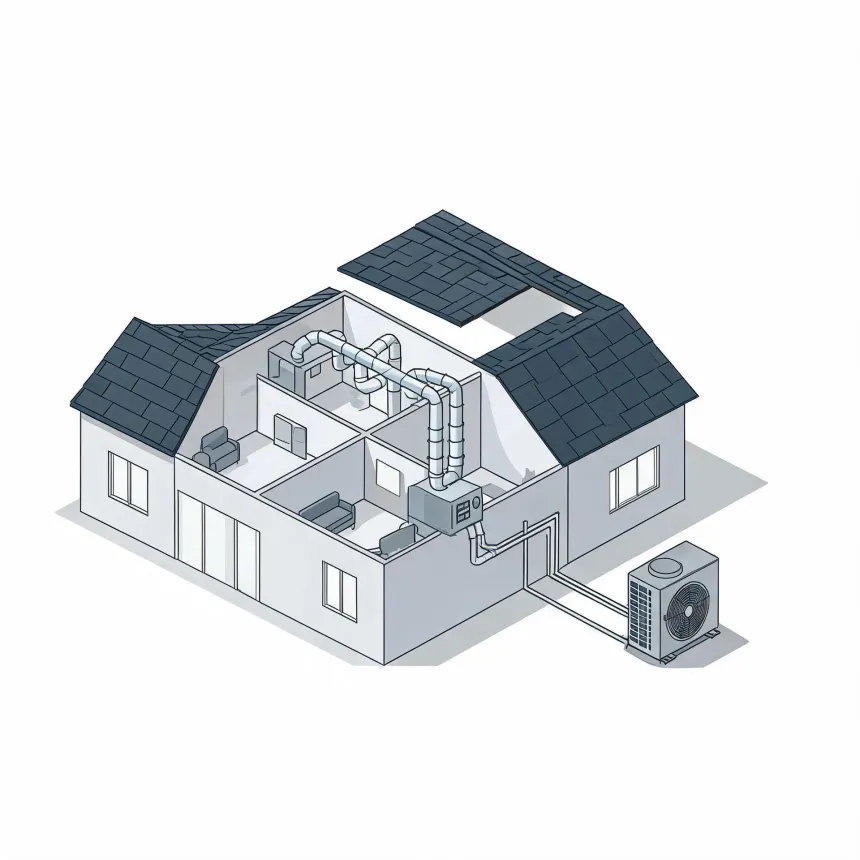
Isometric line illustration of a cutaway single-story house showing interior rooms, ceiling ductwork connected to an indoor air handler, and refrigerant lines running to an outdoor condenser unit on a pad.
Your system heats October through April and cools May through September.

NOAA nClimDiv, 1991–2020 normals

Jessamine County asks real work of a heat pump, with winter lows averaging 27°F and summers humid enough to earn a 4A rating.

Still, that's a mixed climate, not an extreme one, so a heat pump here is rarely run into the ground before its time.

October asks the most of a heat pump that coasted through summer

Cooling runs May through September
Heat runs October through April
37 damaging wind events from 2015 to 2024

A heat pump here rarely wears out before its time

That mixed climate is exactly why a heat pump acting up here is usually still worth fixing, not replacing. Get the cause checked and go from there.

Find a contractor
A man in a cap, gray shirt and tan pants steps up a concrete porch stair toward a dark green front door, carrying a canvas tool bag filled with hand tools, beside a potted shrub.
A gray heat pump outdoor unit mounted on a concrete pad next to the stone-accented exterior wall of a house.

Running it while something's wrong rarely buys you time

A heat pump that's struggling doesn't fix itself by staying on. If it's low on refrigerant, the compressor keeps working against a charge it can't move properly, and that strain is what wears a compressor out early. If a breaker trips and someone resets it without finding out why, the short or overload that caused it is still sitting there. Ice on the outdoor coil works the same way. A unit that can't defrost properly keeps building ice instead of shedding it. The ice blocks airflow across the coil, so the system works harder to move less heat. None of that gets better with the system running. It gets worse, and it often takes another part down with it.

What you can check before you call

Start at the thermostat. Make sure it's set to the mode you want and the temperature is actually past the point where the system should kick on. Then check the breaker panel for the outdoor unit and the air handler. A tripped breaker tells you something, even if you don't reset it. Look at the outdoor unit itself. If the coil is coated in ice, that's worth knowing before anyone shows up. Walk around inside and check that air is actually coming out of the vents. No airflow at all points somewhere different than weak airflow.

What's not worth touching yourself

Don't pull the outdoor unit's access panel or touch anything near the refrigerant lines. Those lines run at pressures that can cause real injury, and the compressor inside isn't something to poke at. If you see ice on the coil, leave it. Chipping at it or hosing it off can damage the fins behind it. The same goes for the reversing valve, the part that switches a heat pump between heating and cooling. If the system is stuck in one mode, that's a diagnosis for someone with gauges, not a thing to force by hand.

Most people notice a heat pump problem through comfort, not noise. Rooms that used to feel even now run warm in one spot and cold in another, or the air coming out of the vents doesn't feel like it's doing much either way. Short cycling is another sign worth paying attention to. The system kicks on, runs for a little while, then shuts off before it's caught up, and starts again soon after. That puts wear on the compressor with every restart. Listen for anything new too. A hum with no airflow usually points to the fan motor or a capacitor that can't get it spinning. A unit that runs constantly without ever satisfying the thermostat is telling you it's lost its ability to keep up, and that's worth a call before it stops working altogether.

A diagnostic visit starts with questions, not tools. What's it doing, when did it start, does it happen in heating mode, cooling mode, or both. Then comes the thermostat, checked and ruled out before anything else gets touched. From there a tech reads pressures off the refrigerant lines and checks the temperature split between the air going into the system and the air coming out. That split says a lot. Too small and the system isn't moving heat the way it should. Electrical readings come next, the capacitor, the contactor, the windings in the compressor itself, checked against what they're supposed to read rather than guessed at. Outside, the coil gets a look for ice or dirt, and the reversing valve gets tested by watching whether it actually switches when it's told to. None of this is exploratory. Each reading either clears a part or points to it, and by the end there's a specific answer, not a guess.