A lit residential street at dusk featuring large two-story brick houses with glowing windows, mature trees, and a street lamp.

Heat Pump Repair in Madisonville, KY

Tell us about the job

Takes about a minute. No obligation.

RepairHeat PumpHopkins County, KY
Step 1 of 2

What ZIP code is the job in?

What the repair tells you

A failed capacitor, a bad contactor or a clogged defrost sensor is a routine repair, worth doing on a heat pump of any age. A compressor or a reversing valve is a different matter. Those are the most expensive parts in the system, and replacing one on a unit already near the end of its life usually just delays the bigger decision.


What keeps happening after the repair

If the breaker keeps tripping, or the system keeps freezing up after it's been serviced, that points to something the last repair didn't catch, like a refrigerant leak or a failing motor. A heat pump that needs a service call every season is costing more than the repair bills show, in comfort lost and in strain on the parts still working.

7 months
October through April, your system heats
5 months
May through September, it cools
29°F
the average winter night it heats against
87°F
the average summer afternoon it cools against
Isometric cutaway illustration of a small house showing ducted air distribution, an indoor air handler, and an outdoor condenser unit connected by lines, with a sofa and bed in the rooms.
Your system heats October through April and cools May through September.

NOAA nClimDiv, 1991–2020 normals

Heat pump repairs in Madisonville tend to turn up right when the system switches over, in May for cooling and October for heat.

A weak part can coast through the mild weeks and then fail the first time the system has to work hard.

Old house or new, the usual parts fail the same way

Half the homes here were built by 1976
68 damaging wind events from 2015 to 2024
Power costs 12.79 cents a kWh statewide

Get it looked at early

Problems tend to show up in the first weeks of the season, when the load hits a part that was already weak.

Find a contractor
A man in a cap and olive work shirt carries a canvas tool bag up concrete steps toward a dark green panelled front door of a house with horizontal siding and a potted shrub.
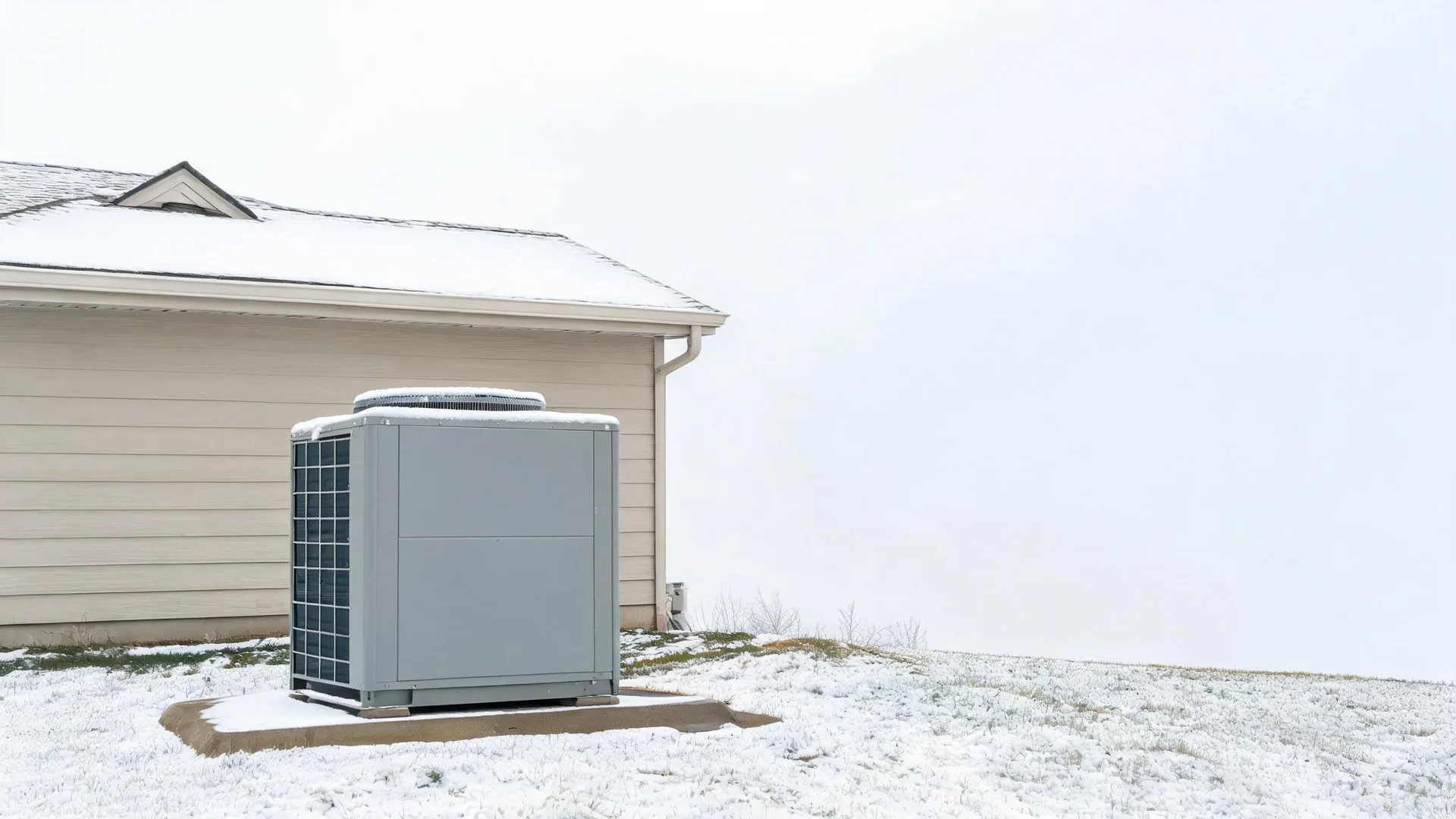
A gray heat pump condenser unit mounted on a concrete pad against the gray lap-siding exterior wall of a house.

What to check before you pick up the phone

Before you call anyone, check the thermostat batteries and make sure it's set to heat or cool, not just fan. Go outside and look at the outdoor unit. Clear away leaves, grass clippings or snow piled against it, and make sure nothing is blocking airflow on any side. Check the air filter. A filter clogged with dust chokes the system and can cause it to ice up or shut down on its own. Look at the outdoor coil for a heavy coat of ice. Some frost in defrost mode is normal, but a solid sheet that doesn't clear is not. Check the breaker panel. A tripped breaker might just need to be reset once, but if it trips again right away, leave it off and call someone. Listen for anything unusual when the system starts up, a hard clunk or a loud buzz, and note it so you can describe it. None of this fixes a bad compressor or a refrigerant leak, but it rules out the simple stuff first.

It won't switch between heat and cool

A heat pump stuck heating when the thermostat calls for cool, or the other way around, usually means the reversing valve isn't shifting. Sometimes it's just stuck and a technician can get it moving again. Sometimes the valve itself has failed and needs replacing.

It's blowing air that isn't warm or cold enough

Air still moving from the vents but barely warm in winter or barely cool in summer often points to low refrigerant or a compressor that's struggling. The airflow working while the temperature doesn't is the tell. A fan can run fine even when the part that actually heats or cools the air is failing.

A heat pump that's icing up or short cycling will keep doing that job badly instead of stopping. Ice on the outdoor coil blocks airflow across it, so the system pulls harder to move the same heat, and that strain lands on the compressor. Short cycling wears the start components faster each time it happens, since the compressor draws the most current right when it kicks on. A reversing valve stuck halfway can run the system in a confused state, heating and cooling at once, which wastes the compressor's effort for no comfort at all. None of these fix themselves by running longer. The part that's struggling stays struggling, and everything downstream of it works harder to make up the difference.

A diagnostic visit starts outside, at the unit itself. A technician checks the refrigerant pressure, since that one reading points toward a leak, a weak compressor or a restriction before anything gets taken apart. They'll check the electrical side too, testing the capacitor and contactor under load rather than just looking at them, because a capacitor can look fine and still fail to hold a charge. Inside, they check the air handler, the static pressure in the ducts, and the temperature split between the air going in and the air coming out. That split tells them whether the system is actually moving heat the way it should, not just running. Only once those readings are in does the real cause separate from the symptom the thermostat was showing.