





A quiet suburban street at twilight featuring two-story brick homes with illuminated windows and large trees lining the sidewalk.

Heat Pump Repair in Lexington-Fayette urban county, KY

Tell us about the job

Takes about a minute. No obligation.

RepairHeat PumpFayette County, KY
Step 1 of 2

What ZIP code is the job in?

Fayette County logged 143 severe weather events between 2015 and 2024, and most of those were damaging wind. Hail showed up too, and both can leave a mark on a heat pump's outdoor unit. Hail dents the fins on the coil, and wind throws branches and debris into the cabinet, sometimes without stopping the unit from running. A heat pump can keep moving air after a storm and still be hiding a bent coil or a damaged fan blade. If your system sat through weather like that, it's worth having someone look at what the storm left behind, even if nothing seems wrong yet.

7 months
October through April, your system heats
4 months
June through September, it cools
27°F
the average winter night it heats against
85°F
the average summer afternoon it cools against
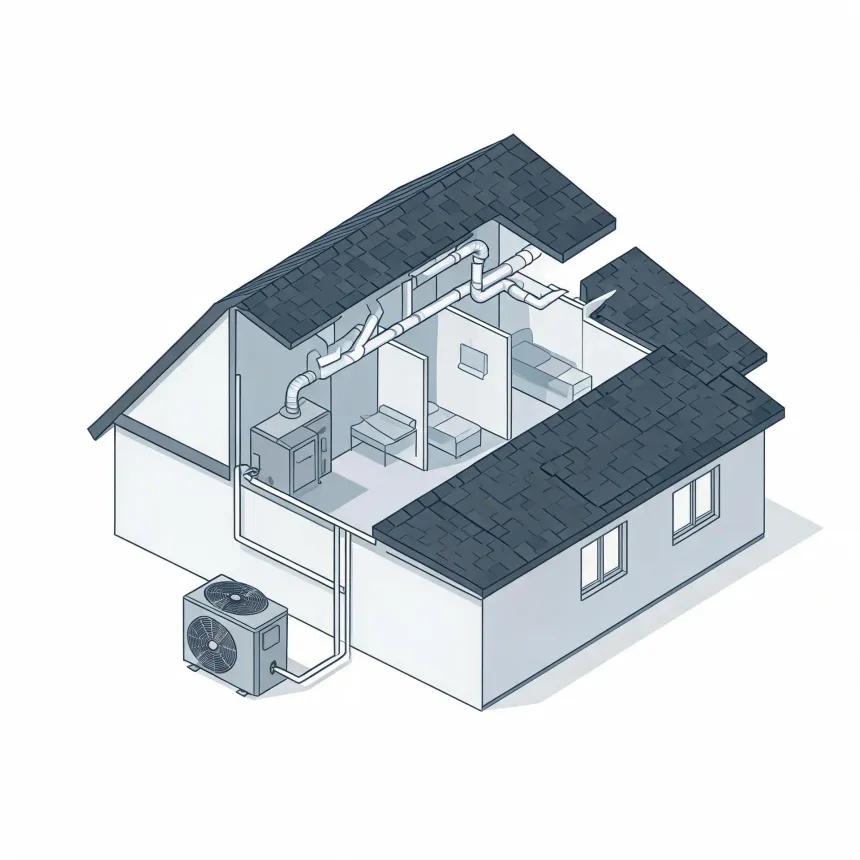
Isometric line illustration of a cutaway single-story house showing interior ductwork, an indoor air handler unit, and an outdoor condenser connected by refrigerant lines, with a dark shingled roof.
Your system heats October through April and cools June through September.

NOAA nClimDiv, 1991–2020 normals

Heat pumps here run heat from October through April, about seven months straight.

September is when a weak part gets found, not October, so get it looked at before the first cold week.

The weather here is the hard part, not the workload

108 damaging wind events from 2015 to 2024
15 hail events from 2015 to 2024
14 winter storms from 2015 to 2024

Half the homes in Fayette County were built in 1984 or later. If yours is one of them, the heat pump may still be within its working life, especially if it came with the house. A repair makes more sense on a system with years left in it than one already past where most of its kind start failing for good. Worn parts like a contactor or a capacitor can be replaced on their own without touching the rest of the unit. Before deciding it's time to replace anything, it's worth finding out which kind of problem you actually have.

Had storm damage checked yet?

After weather like that, a unit can still blow air and still be hiding a bent coil or a cracked fan blade. Get the outdoor unit checked for storm damage before you rule out a simple repair.

Find a contractor
A man in a gray work shirt and tan pants carries a canvas tool bag up wooden porch steps toward a dark green front door, with a potted shrub to the right.
A gray heat pump outdoor unit mounted on a concrete pad next to the stone-accented exterior wall of a house.

Most failures are one worn part, not the whole system

Most heat pump failures trace back to a handful of parts, and they rarely fail without warning. A capacitor weakens slowly, so the system struggles to start before it quits starting at all. A contactor's contacts pit and burn from years of opening and closing, until one day they don't close. The reversing valve, the part that switches the system between heat and cooling, can stick from a buildup inside it, leaving the unit stuck running one mode no matter what the thermostat asks for. Outdoors, a fan motor's bearings wear out the way any motor's do, and you'll hear it before it quits, usually as a grinding or a squeal. None of these parts fail because a heat pump runs backward part of the year instead of just cooling. They fail the way any mechanical or electrical part fails, from years of cycling on and off, carrying current, holding pressure.

What you can check from inside

Look at the thermostat first. If the screen is blank, check the breaker before anything else. Check your air filter too. A clogged filter starves the system of airflow and can make a heat pump run constantly without warming or cooling the house. If the filter is gray and stiff, swap it before you assume the unit itself is failing.

What to look at outside

Walk out to the outdoor unit and look at the coil, the metal fins around the cabinet. Bent or crushed fins block airflow and make the whole system work harder. Clear away any leaves, grass clippings or branches sitting against the cabinet. Don't take the cover off or reach inside. If the fan isn't spinning or you hear grinding or rattling, that's a sign for a technician, not a fix you do yourself.

A heat pump in trouble doesn't always shut off. It can keep running while doing a worse job, which is why the signs are usually about comfort, not silence. Air coming from the vents that feels barely warm, or barely cool, often points to a problem before the system ever quits outright. Short cycling, where it kicks on and off every few minutes instead of running a full stretch, wears on the compressor and usually gets worse the longer it goes unchecked. Ice on the outdoor unit in the dead of a heating run is normal for a few minutes during defrost, but a coil that stays frozen is not. A hissing sound near the lines can mean refrigerant escaping, and that's one to get looked at soon rather than wait on, since the system can't make up for what's leaking out.

A diagnostic starts outside at the unit itself, not with guesses based on what the thermostat says. A technician checks refrigerant pressure with gauges, since that number tells them whether the system has a leak long before a coil ices over or a hissing sound gives it away. They'll pull the access panel and test the capacitor and contactor with a meter rather than eyeballing them, because a capacitor can look fine and still be weak. Airflow gets checked at the vents and back at the unit, since a problem can sit in restricted airflow as easily as in a failing part. They'll also run the system through a full cycle, heat and defrost, to see whether it reverses and recovers the way it should. The point of all this is to find which part is actually failing, not to replace parts until something works.