A quiet residential street at dusk lined with illuminated two-story brick houses and mature trees.

Heat Pump Repair in Danville, KY

Tell us about the job

Takes about a minute. No obligation.

RepairHeat PumpBoyle County, KY
Step 1 of 2

What ZIP code is the job in?

Both seasons ask something of it, neither asks too much

Danville sits in zone 4A, a mixed climate where winter lows average 27°F and summers call for real cooling too. A heat pump here runs both directions, but it never grinds through months of extreme heat the way systems further south do.


So age explains more than wear

A heat pump struggling in Danville usually got there through age or a worn part, not years of punishing load. That's worth knowing before deciding whether a repair makes sense.

7 months
October through April, your system heats
4 months
June through September, it cools
27°F
the average winter night it heats against
85°F
the average summer afternoon it cools against
Isometric line illustration of a cutaway house showing interior rooms, an air handler with ductwork in the attic space, and an outdoor condenser unit beside the exterior wall.
Your system heats October through April and cools June through September.

NOAA nClimDiv, 1991–2020 normals

September is the last month before heat season starts in October.

Whatever was wrong with your heat pump in the cold months will still be wrong when it has to switch over and start holding heat again.

Nothing here runs this system hard, so a breakdown points to the unit, not the weather

Half the homes here were built by 1978
32 damaging wind events from 2015 to 2024
9 hail events from 2015 to 2024

A heat pump in trouble tends to say so in plain ways. It blows air that isn't warm enough to feel right, even though the system is running. It cycles on and off more than it used to, never settling into a steady stretch. Ice builds up on the outdoor unit and doesn't clear during the defrost cycle like it should. You hear it straining, a clanking or a hum that wasn't there before, or it runs long stretches without actually bringing the house up to temperature. Any of these is worth a call before the part that's struggling takes another one down with it.

A heat pump with an easy job that's still acting up is worth repairing

A heat pump that's held up fine against Danville's winters and summers for years isn't likely to be failing from wear now. Get the actual cause checked and in most cases the fix is worth it.

Find a contractor
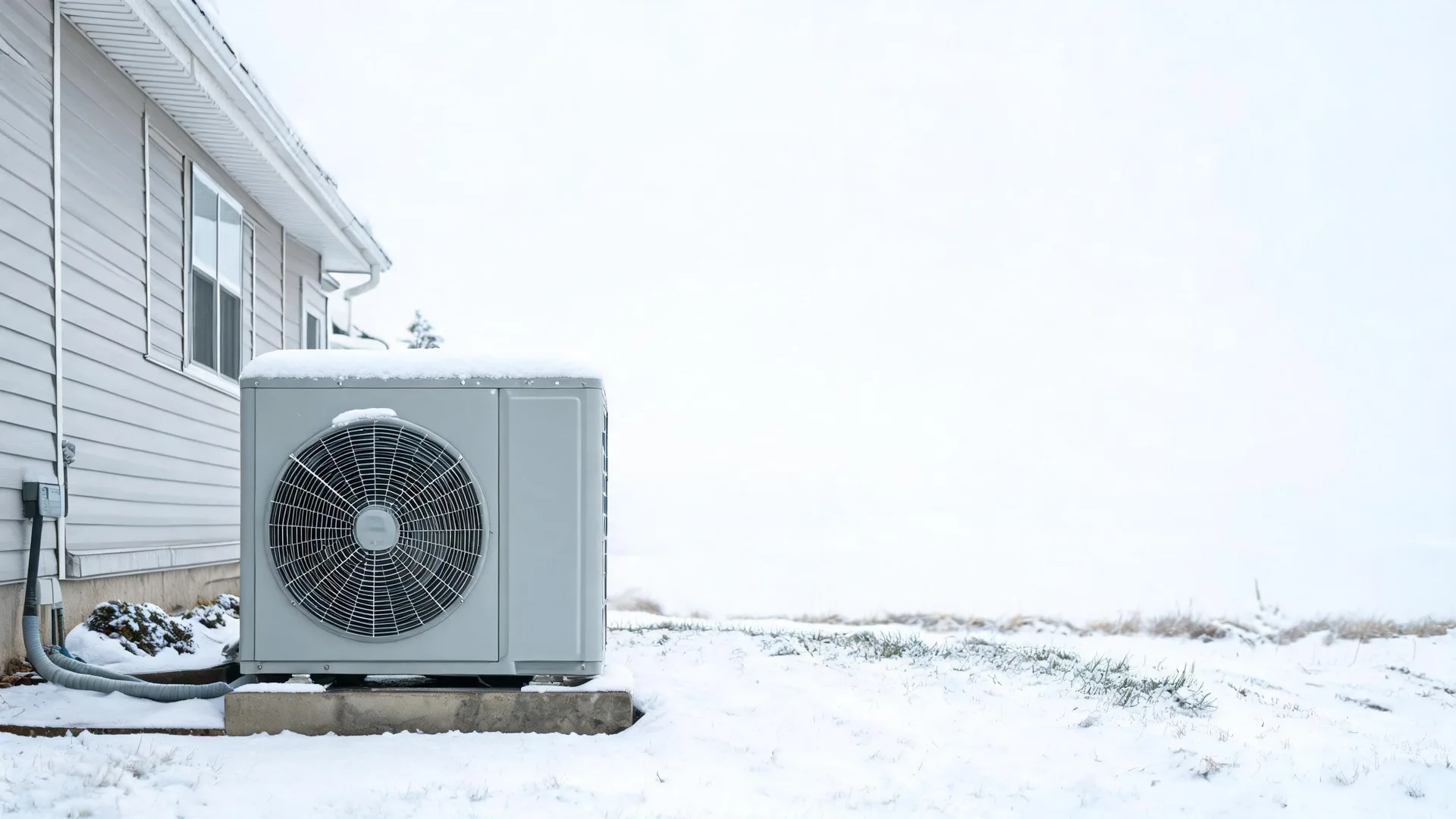
A gray heat pump outdoor unit mounted on a concrete pad next to a residential house with lap siding and stone accents.

What to check yourself first

Before anyone comes out, make sure the thermostat is set to heat and the setpoint is actually above room temperature. Walk over to a vent and feel for airflow. A heat pump puts out air that feels cooler than a furnace would, so don't judge it on warmth alone, but no airflow at all is a different problem than weak airflow. Go look at the outdoor unit. A thin coat of frost in cold weather is normal, but a thick layer of ice or snow packed against the coil is not. Clear away anything blocking it, leaves, a drift, a cover left on from last season. Back inside, pull the filter and hold it up to a light. If you can't see through it, that alone can cause weak airflow, poor heating, and a system that runs long without catching up. Check the breaker panel too. If the outdoor unit isn't running at all, a tripped breaker is worth ruling out first. None of this tells you exactly what's failing, but it tells the tech what's already been ruled out, and that's a useful place to start.

The reversing valve carries the wear the furnace never sees

A heat pump pushes refrigerant one way to cool and the other way to heat, and the reversing valve is what switches it. That valve moves every time the system changes direction, year round, in a way no part of a furnace has to. When it sticks or wears out, the system can get stuck cooling when you've called for heat, or stop switching into defrost. That's a failure point specific to heat pumps, not something a furnace or straight AC system deals with at all.

The defrost cycle is where small problems turn into breakdowns

Frost on the outdoor coil is normal in cold weather, so the system runs a defrost cycle to clear it, briefly reversing and running the outdoor fan to melt it off. That cycle depends on a sensor reading coil temperature and a control board timing it correctly. If the sensor drifts or the board fails to trigger defrost, ice keeps building instead of clearing, and a thickening layer of ice on the coil is usually the first sign something in that cycle isn't working.

A heat pump that keeps running with a problem doesn't just struggle, it adds damage on top of the damage. Ice left to build on the outdoor coil blocks airflow across it, so the system pulls harder to move heat through ice that's getting thicker by the hour. A failing reversing valve under continued strain can stick in one position permanently instead of just sticking occasionally. Weak airflow from a clogged filter forces the system into longer run times, and those long cycles wear on the compressor. A refrigerant leak behaves the same way. Left alone, a system low on charge keeps running anyway, and a compressor isn't built to run that way for long. The part that's struggling rarely fails alone if the system keeps being asked to work around it.

A diagnostic visit starts with questions, not tools. A tech wants to know what the system is doing, when it started, and whether it happens in heat mode, defrost, or both. After that, it's gauges on the refrigerant lines and a meter on the electrical components, checking charge, checking the reversing valve actually shifts when it's told to, checking the defrost board is timing the cycle and reading the coil sensor correctly. Airflow gets checked too, across the filter, across the coil, because a system can have a perfectly good compressor and still run badly if air isn't moving through it. None of this is guesswork. Each reading either matches what a healthy system should show or it doesn't, and that's what points to the actual failed part instead of just the symptom it's causing.