






A quiet residential street at dusk lined with illuminated two-story brick houses and mature trees.

Heat Pump Repair in Campbellsville, KY

Tell us about the job

Takes about a minute. No obligation.

RepairHeat PumpTaylor County, KY
Step 1 of 2

What ZIP code is the job in?

Taylor County saw 106 severe weather events between 2015 and 2024. Most of it was wind, with hail and a few tornadoes mixed in. A heat pump's outdoor unit sits outside year round, so it takes whatever comes through. It can keep running afterward and still have a bent fin, a dented fan guard, or a coil that's taking in less air than it should. None of that announces itself right away. If your unit has been through a storm, it's worth having someone look it over even if you haven't noticed a problem yet.

7 months
October through April, your system heats
5 months
May through September, it cools
28°F
the average winter night it heats against
86°F
the average summer afternoon it cools against
Isometric line illustration of a cutaway single-story house showing interior rooms with furniture and attic ductwork connected to an outdoor condenser unit beside the building.
Your system heats October through April and cools May through September.

NOAA nClimDiv, 1991–2020 normals

Half the homes in Taylor County were built in 1978 or earlier, half after.

A heat pump doesn't care which. It fails the same way whether the house around it is old or new.

September is when a weak heat pump runs out of road

Cooling runs May through September
Heat runs October through April
69 damaging wind events from 2015 to 2024
The climate here doesn't push a heat pump that hardWinter lows here average 28°F, not deep cold, so a heat pump isn't running flat out to keep up

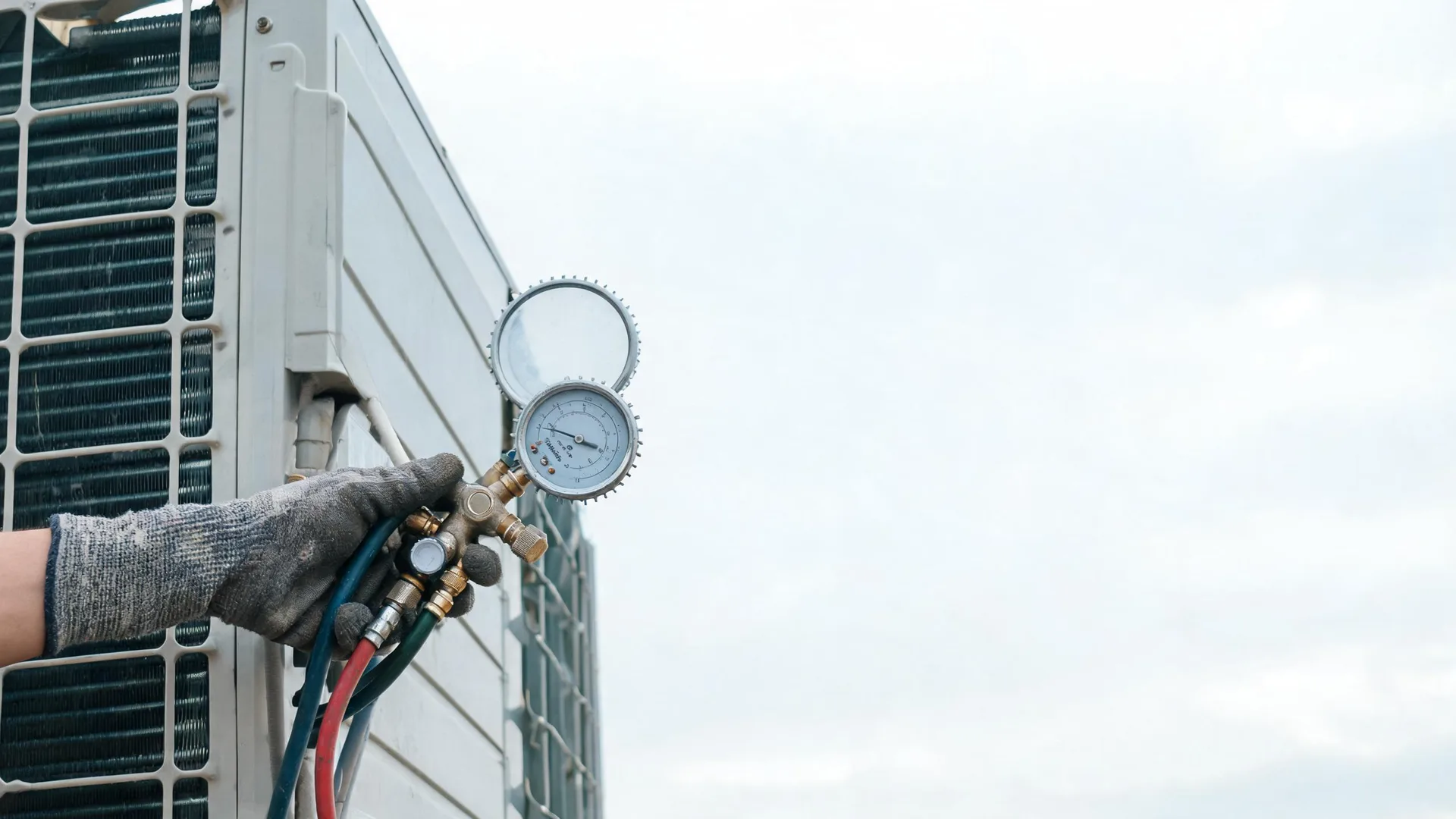
A tech starts outside, at the unit itself. They'll check the refrigerant charge, look at the reversing valve, and see how the outdoor coil is drawing air. If the fins are packed with debris or bent flat in patches, the unit has to work harder to move heat either direction, and that shows up as a system that runs long and still doesn't keep up. Inside, they'll check airflow at the vents and look at the indoor coil for ice, which points to a charge problem or a blocked filter rather than anything electrical. They'll also run the system in both heating and cooling, since a heat pump that cools fine but won't heat usually has a reversing valve stuck in one position. By the end they can tell you whether it's a part failing or just wear catching up with the system.

This heat pump has had an easier life than most, so repair is usually the right call

A heat pump here isn't working against deep cold most winters, so the parts inside it tend to wear at a normal pace rather than get driven into the ground. That means a unit acting up is more likely dealing with one failed part than a system worn out all over. Worth getting it looked at before deciding it's done.

Find a contractor
A gray heat pump outdoor unit mounted on a concrete pad next to a residential house with lap siding and stone accents.

What a failing heat pump sounds and feels like before it quits

A failing heat pump rarely just stops. It tells you first. Weak heat is the most common sign, air coming out of the vents that's warm but not hot enough to catch up on a cold day. Short cycling is another, where the unit kicks on, runs a few minutes, and shuts off before it's done anything useful. Ice on the outdoor coil that doesn't melt off on its own means the defrost cycle isn't doing its job. A hum with no start, or a fan that spins slower than it should, points to a weak capacitor. And if the system blows cold air when it's set to heat, that's a reversing valve stuck in the wrong position, not a thermostat problem. Any one of these is worth a call. Ignoring them just means the part that's struggling keeps struggling until it fails outright.

A small problem doesn't stay small while the unit runs

A reversing valve that's just starting to stick, or a defrost sensor giving a bad reading, doesn't fix itself by the system continuing to run. The unit keeps cycling the same way it always has, on the same bad information, and whatever is wearing keeps wearing. A part that's partly failed under load usually finishes failing under load.
Running on ice is what turns into a compressor job

If frost builds on the outdoor coil and the unit never defrosts it off, the coil can't pull in air anymore. The compressor doesn't know that. It keeps trying to move refrigerant through a system that can't shed heat properly, and that's the kind of strain that takes out a compressor rather than a fan motor or a sensor.

Before anyone comes out, a few things are worth a look. Check the thermostat is set to heat and the temperature is actually above room temperature, since a setting bumped by accident gets mistaken for a broken system all the time. Go outside and look at the unit itself. If the outdoor coil is caked in ice, that's worth noting but don't chip it off or hose it down, just leave it for the tech. Check that nothing is blocking airflow around the unit, no leaves packed against the fins, no branches or debris sitting on top. Inside, pull the filter and hold it up to light. If you can't see through it, that's restricting airflow to the point where it can cause real problems. Check your breaker panel too, since a tripped breaker will shut the whole system down and look like a bigger failure than it is. None of this tells you exactly what's wrong, but it rules out the simple stuff before someone drives out to look at the complicated stuff.

A heat pump that needs a part is almost always worth fixing. The compressor is the expensive piece, and most repairs never touch it. A bad capacitor, a stuck reversing valve, a failed defrost sensor, these get swapped out and the unit runs like normal again. What changes the math is when the compressor itself is the problem, especially if it's been straining for a while under a bad charge or an iced-over coil. A compressor job can cost close to a new system, and at that point you're paying to keep the oldest, least efficient part around. If a tech tells you the compressor is going and the rest of the unit is getting old alongside it, that's usually when replacing the whole system makes more sense than chasing one repair after another.