AC smells like burning in Owensboro, KY

RepairCentral ACDaviess County, KY
Step 1 of 2

What ZIP code is the job in?

Why does my AC smell like something is burning?

A burning smell from your AC is one of those things you don't ignore, and you're right not to. It usually means something is overheating, and the longer the system keeps running, the more likely it is to turn a small electrical problem into a bigger repair. With how long cooling season runs around Owensboro, most people notice this smell at the worst possible time, mid-July, system working hard, and want to know if it's safe to just keep it running.

It's almost always an electrical part overheating, not a fire risk by itself

A burning smell usually points to a motor or electrical part under strain, like a blower motor bearing or a wire connection that's come loose and started to arc. Dust burning off a coil that's been sitting unused can also cause a short, sharp smell the first time you run the system. Either way, the smell means something inside the cabinet is hotter than it should be. Shut the system off at the thermostat and the breaker, and don't run it again until someone's looked at it. With how many hours an AC runs through a Daviess County summer, a part that's already overheating usually doesn't hold up for long once it starts.

An outdoor air conditioner condenser unit on a concrete pad beside a house with light horizontal siding, with a small electrical disconnect box on the wall, mulch and shrubs at left, and a plain white wall and concrete slab at right.

What a hot motor smells like

A burning smell that's sharp, almost like hot dust or scorched plastic, often points to the blower motor or the fan motor in the outdoor unit. These motors run for hours at a stretch during a Daviess County summer, and if the bearings are going or the motor windings are breaking down, the heat has nowhere to go. You'll sometimes notice the air coming out warmer than usual at the same time.

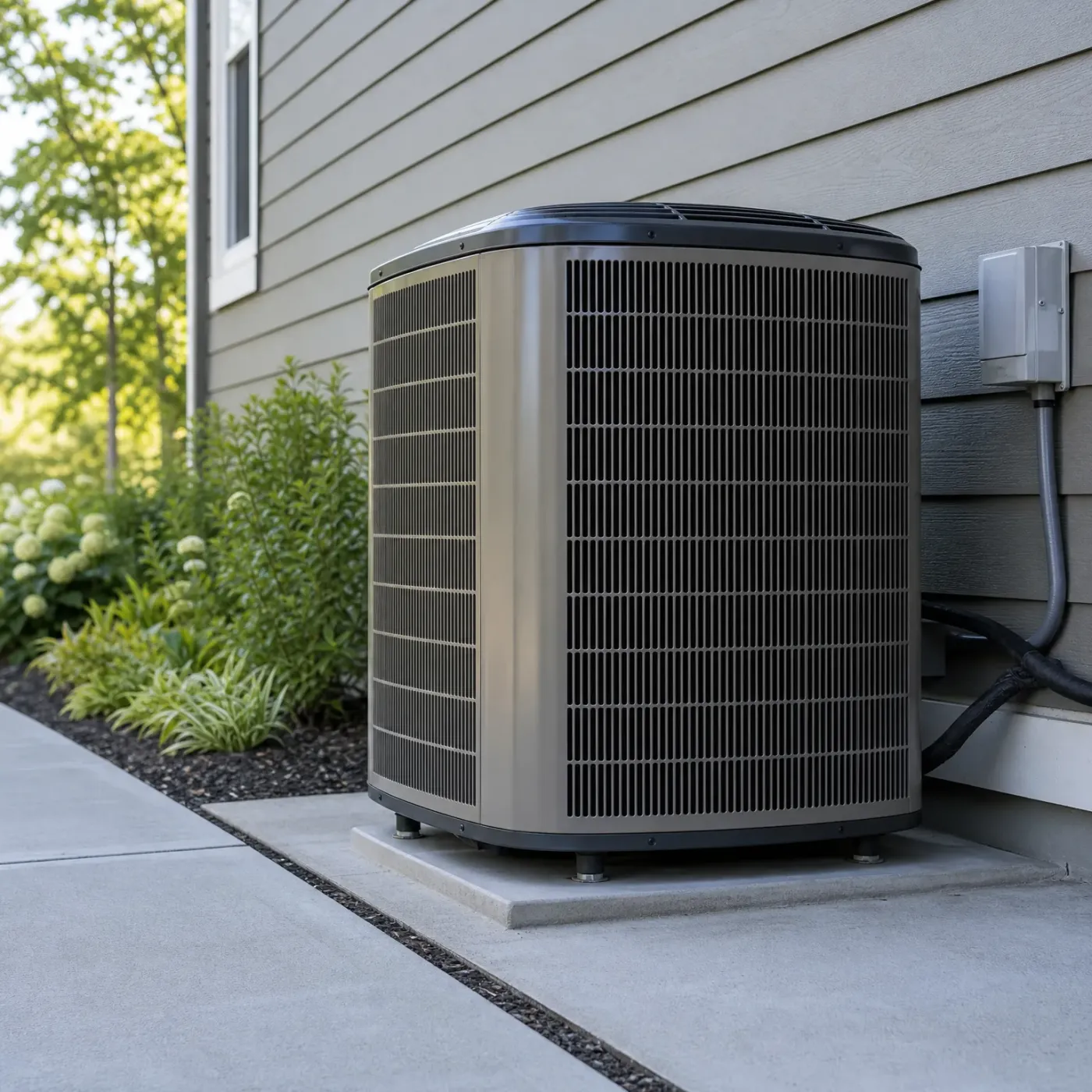
A dark gray outdoor air conditioner condenser unit on a concrete pad beside a house with horizontal siding and a plain light wall, with mulch and grass in the foreground and a conduit and electrical box on the wall.

What a wiring smell means

A smell closer to burning rubber usually comes from electrical wiring or a failing capacitor, not the airflow itself. Wire insulation gives off that smell when it gets too hot, often from a loose connection at the breaker, the disconnect box, or inside the unit. This is the kind of smell that shows up fast and doesn't fade on its own, since the wiring stays energized as long as the system calls for power.

A woman in a long cream cardigan and jeans stands at an open wooden front door of a gray shingled house with stone-based porch columns, with a second person visible inside, and potted flowers and shrubs beside the entry.

What that smell means for your house

If your system is still running, that burning smell is moving through your ducts into every room it feeds. You'll notice it near the vents first, then in the hallway, then everywhere. A smell that strong usually means whatever's overheating has been at it for a while, not just the last few minutes.

Left alone, an overheating motor or a failing part can trip the breaker, or it can keep pushing past that point until something actually burns through. Either way you're looking at a system that stops cooling in the middle of a Daviess County summer, which is its own kind of bad. Rather than start calling around and explaining the smell to one shop after another, you can get matched with a contractor who takes it from here, asks the right questions, and calls you back to set up a time to look at it.

A large weathered ceramic vase and a shallow wooden bowl sit on a rustic wooden table beside a window with linen curtains, with a blurred sofa with cushions and a hanging fabric panel in the background.
An outdoor air conditioner condenser unit on a concrete pad beside a house with beige horizontal siding and a stone-veneer base, with refrigerant lines running to a gray wall-mounted electrical box, surrounded by dark mulch, a flowering shrub and an evergreen on the left.

Running the way it should

This is a condenser doing its job: no smell, no odd sound, just steady operation on the pad outside. Refrigerant and air move through it the whole time it runs, and nothing inside gets hot enough to give off an odor. That's what normal looks like.

An outdoor air conditioning condenser unit on a concrete pad beside a house with light vinyl siding, an electrical disconnect box and conduit on the wall, bare shrubs and mulch to the right, and a concrete walkway in the foreground.

Something inside is overheating

Nothing about this unit looks different from the outside, and that's the problem. The smell is coming from a part overheating inside the cabinet, maybe a motor, maybe a wire, and there's no way to tell which one just by looking at the condenser sitting there.

A woman in a cream cowl-neck sweater sits by a window with snow outside, in a dimly lit living room with a sofa, lit lamp, mirror, candles and a fireplace.
A woman in a gray turtleneck sweater sits beside a large window looking out at snow-covered evergreen trees, in a dimly lit living room with a lit fireplace, lamps, couch and houseplant.
A woman in a cream turtleneck sweater stands beside a large window with snow-covered ground and bare trees outside, in a dimly lit living room with lamps, a sofa and framed art.
A woman in a grey cowl-neck sweater stands indoors near a window, looking out at falling snow, with a lamp, framed picture and couch in the warmly lit room behind her.
An outdoor air conditioning condenser unit on a concrete pad beside a house with horizontal lap siding, with a gray electrical disconnect box and conduit on the wall and green shrubs and trees to the left.

Find an air conditioner repair pro in Daviess County

Skip calling shops to ask who repairs air conditioners in Daviess County.

Get matched with a pro who fixes air conditioners in Daviess County.

Answer a few questions

Sending the form costs nothing.

Shut it off, or let it run

Shut it off now

  • A dead unit is an inconvenience, but a burning smell left running can turn into a fire if a wire or board actually ignites.
  • You lose the cooling for however long it takes to get someone out, which matters once a Daviess County afternoon gets into the 90s.
  • Shutting it down stops the smell from spreading further through the ducts into bedrooms and closets that haven't gotten it yet.
  • Whatever caused the smell, a seized motor or a cracked wire, stays exactly as it is until a contractor can look at it.
  • If the smell was faint and came from dust burning off a coil that just kicked on, you may have shut down a unit that was fine.

Keep it running

  • If the smell fades within a few minutes, it may just be dust burning off a coil or motor that sat unused, and the system is likely fine.
  • Letting it run means you keep cooling through the heat instead of waiting on a repair visit.
  • If the smell doesn't fade and gets stronger, you're running a system with an electrical or motor problem under load, which is how small failures become bigger ones.
  • A motor or component already overheating gets hotter the longer it's asked to keep working, not cooler.
  • You won't know which case you're in, faint and fading or sharp and growing, until you've already let it run for a few minutes.
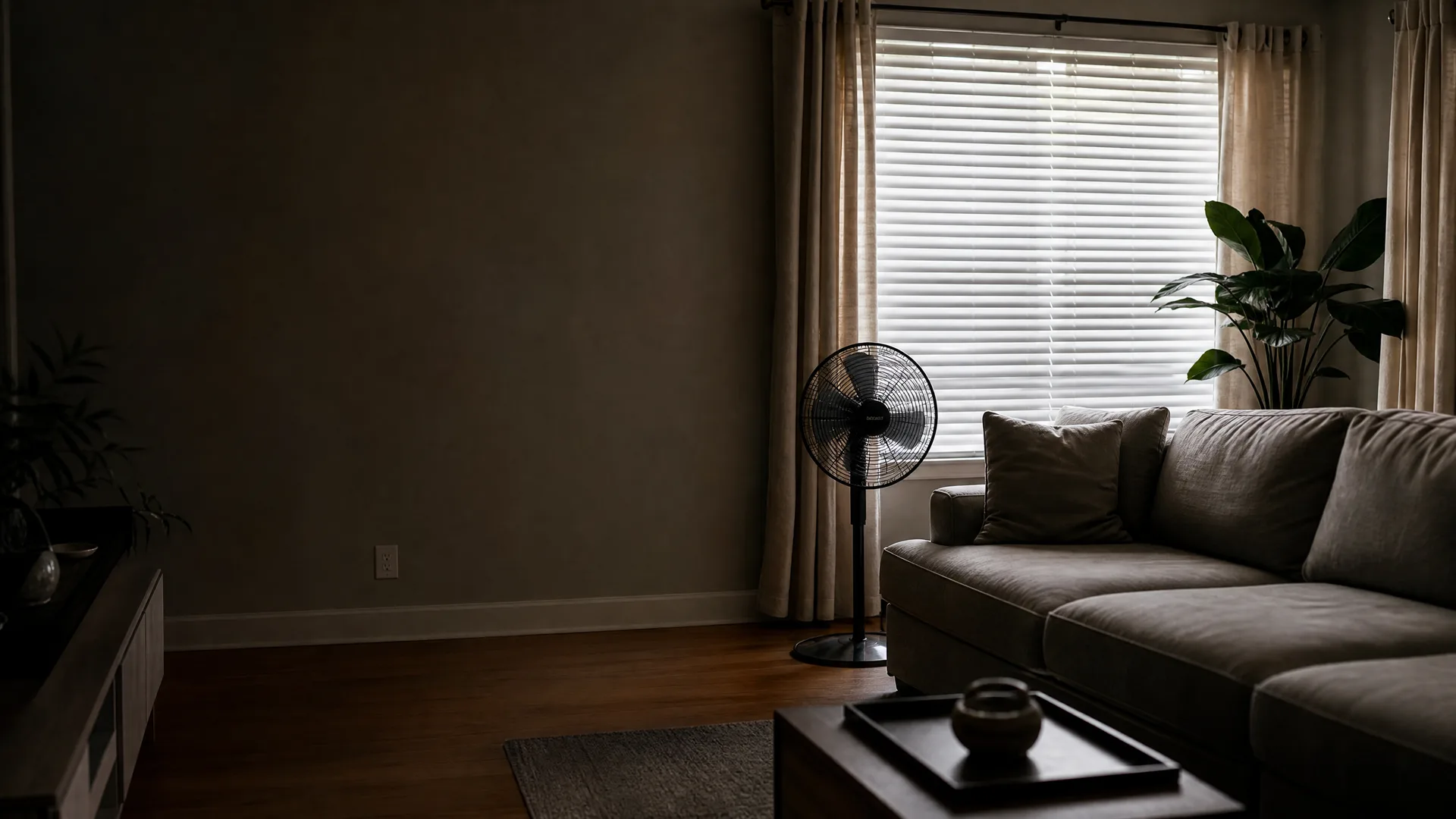
A dimly lit living room with a gray sectional sofa, a standing pedestal fan, a curtained window with blinds, a potted broad-leaved plant, a wooden coffee table with a tray and lidded jar, and a rug on dark wood flooring.

The blinds are drawn against the sun, but the living room is still warm enough that the floor fan's been running beside the couch since noon. It's the middle of July, the kind of Daviess County afternoon where the air outside doesn't move. You've had the AC on all day. Then it comes through the vent nearest the couch, faint at first, a hot dusty smell that wasn't there an hour ago. You turn the fan up, thinking it'll clear, but a few minutes later it's stronger, reaching the hallway now too. The couch cushion still holds the cool from this morning. The smell doesn't.


Should you even be smelling this right now

You're probably noticing it right at the thermostat or standing near a vent, a hot, electrical smell that wasn't there yesterday. Maybe the air coming out feels weaker than usual, or the outdoor unit is making a sound it didn't make before. Some households catch a haze near the supply registers before they catch the smell. None of that is normal for a system that's working right, and once you notice it, it tends to get your attention every time the AC cycles on. Left alone, whatever's overheating usually doesn't fix itself, and running the system while it smells like this raises the chance of real damage to the unit, not just an odd smell in the house.

  1. Power to the unit shuts off at your breaker or the outdoor disconnect

  2. A technician checks the capacitor, wiring and board for burn marks

  3. The blower motor and fan motor get tested for heat and resistance

  4. The burned part gets replaced and the system is run to confirm the smell is gone

Cooling runs May through September

That five months of steady running is five months where a strained motor or a failing part has time to overheat. Your AC doesn't get a break from May through September, so a burning smell that shows up now is likely to keep showing up until the part causing it gets replaced.

NOAA nClimDiv 1991-2020

A burning smell from your AC means something inside it is overheating, and shutting it off is the right call until someone can look at the capacitor, the wiring, or the motor itself. That part is simple. What's harder is everything that comes after: finding a contractor in Daviess County who can actually get out to you soon, explaining what you smelled and when, maybe explaining it again to a second or third company while you compare who can come sooner and what they'll charge. You don't have to do that part. Once you're matched with a contractor who handles this kind of repair, they'll reach out to you directly, and the back and forth of calling around stops. The smell isn't going to fix itself, and running the unit while you sort through quotes only gives the problem more time to do damage. The fix is still a repair, with whatever that takes. But you won't be the one tracking down who can do it.

Interior room corner with sunlight from a window, showing peeling paint and damaged plaster on the wall above a white baseboard, a wooden cabinet with a pale bowl on top, hardwood floor and a patterned rug.
Interior corner of a room with tan walls, white profiled baseboard and window trim, a wood-plank floor in sunlight, and green foliage visible through the window.
An empty room corner with cream walls, white baseboard, two windows with deep sills showing green foliage outside, and a wood plank floor lit by sunlight.
Empty room corner with beige walls, white beadboard wainscoting, chair rail and baseboard, a window with green foliage outside, and sunlight casting leaf shadows on the wall above a wood floor.
Sunlit room corner with a multi-pane window, beige walls, white baseboard, wood floor with a woven rug, and a dark wooden cabinet holding a ceramic table lamp below a framed picture.

The right pro for this job

Answer a few questions instead of calling shop after shop.

Describe it once

You're not committing to anything by asking.