Three illuminated two-story brick houses on a tree-lined residential street photographed at twilight, with warm window light and landscape uplighting visible against a deep blue evening sky.

AC Installation in Winchester, KY

Tell us about the job

Takes about a minute. No obligation.

New system or replacementCentral ACClark County, KY
Step 1 of 2

What ZIP code is the job in?

Bigger isn't better

An oversized air conditioner cools the air fast and shuts off before it pulls the moisture out of the room. The house ends up cold and clammy at the same time. It also cycles on and off more often, and every start wears the compressor a little more than a full, steady run would.


It comes from a load calculation

A contractor works out the right size by measuring the house. Square footage, window area and direction, ceiling height, insulation all go into it. That math is called a load calculation, and it's the only honest way to size a system. Walking in and matching the old unit's size skips the part where that unit might have been wrong too.

4 months
June through September, your air conditioner is on duty
85°F
the average summer afternoon it cools against
7 hail events
in ten years, and hail bends the fins on outdoor coils
13.4 SEER2
the federal minimum any new unit must meet
Isometric line illustration of a cutaway house showing interior rooms, ceiling ductwork, an indoor air handler unit, and an outdoor condenser connected by lines along the exterior wall.
Your air conditioner works hardest from June through August.

NOAA nClimDiv, 1991–2020 normals

Clark County sees damaging wind, hail or a winter storm most years, and the grid feels it.

A standard system sized to this house is the safer bet than one picked to impress.

Four months of summer, 85 degrees average. A standard system covers it.

Cooling runs June through September
Summer afternoons average 85°F
Power costs 12.79 cents a kWh statewide
Time it before JuneCooling runs June through September here, so May is the month to get it done.

Electricity in Kentucky runs about 12.79 cents a kilowatt-hour, well under what a lot of the country pays. That changes the math on a new system. A high-efficiency air conditioner costs more up front, and here it takes longer for the lower power bills to make up that difference. For a lot of homes in Winchester, a standard-efficiency unit sized right for the house is the better value. Put the extra money toward correct sizing and a clean installation instead. That's what keeps the system running well for years, not the efficiency number on the sticker.

Any new system here has to meet 14.3 SEER2

Clark County falls in the Southeast region for federal efficiency rules, not just the national minimum. A split-system air conditioner installed here has to hit at least 14.3 SEER2 under 45,000 Btu/h, higher than what's required in a lot of the country. A federal tax credit is available on top of that for units that qualify. That rule plus zone 4A's mix of heat and humidity narrows down what actually makes sense to install.

Find a contractor
A man in a cap, gray work shirt and brown pants, seen from behind, steps up porch stairs toward a dark green front door while carrying a canvas tool bag, with a potted shrub beside the entry.
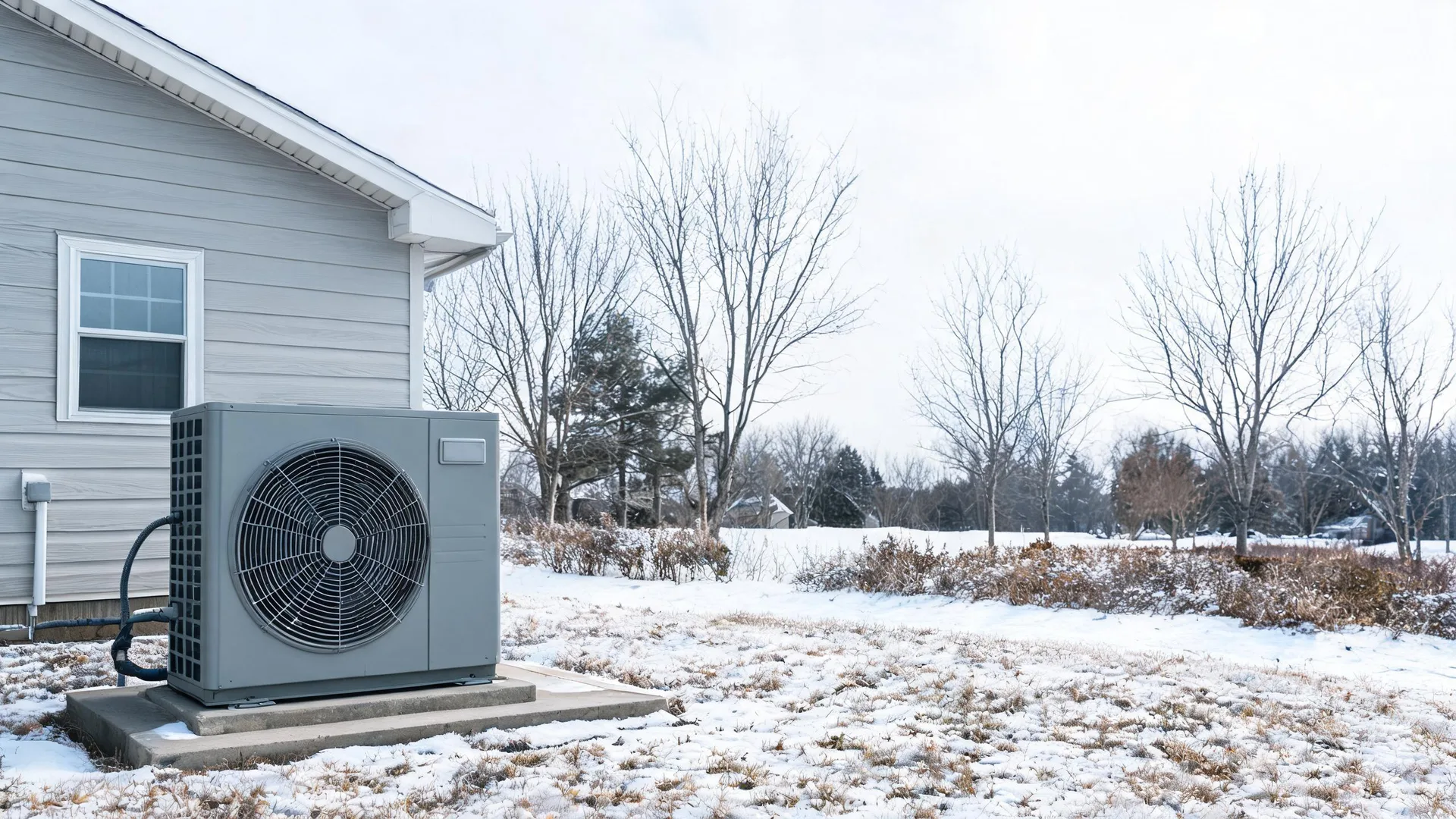
A gray residential air conditioner condenser unit mounted on a concrete pad in an open grass field.

Questions worth asking before you sign

When you're comparing systems, ask what the warranty actually covers and who has to register it. A lot of manufacturer warranties on parts go unclaimed because nobody filed the registration within the window after install, and the homeowner finds out years later when a compressor fails and they're stuck paying for a part that should've been covered. Ask separately about the labor warranty, since that's usually the contractor's own and runs for a different length than the manufacturer's parts coverage. Ask what refrigerant the system uses, since older and newer systems run on different ones, and a repair down the road is simpler when the refrigerant is still in common use. Ask how the outdoor unit and indoor coil are matched. They're rated as a pair, and mismatching them, say reusing an old coil with a new condenser, can quietly cut efficiency and shorten the life of the compressor even if both pieces run fine on their own. Ask what happens to the ductwork during install. A new system moving air through old, leaky or undersized ducts won't perform the way the brochure says it will, no matter how good the equipment is.

The rating only counts the equipment

SEER2 measures how efficiently the condenser and coil turn electricity into cooling, tested as a matched pair. It says nothing about the ducts carrying that air through the house, or a return that's too small, or a coil installed with the wrong airflow across it. A high rating on the sticker doesn't fix any of that.

It's a lab number, not a promise

The rating comes from testing under set conditions, not from the particular house it ends up in. A unit sized wrong for the space it's cooling, or installed with a refrigerant charge that's off, will run worse than its rating no matter what the label says. The number tells you about the machine. Correct sizing and a clean installation tell you how it actually performs.

An outdoor air conditioning condenser unit installed beside the exterior wall of a blue vinyl-sided house at sunset.

Going above the federal minimum saves little here, about $10 a year.

  • A higher-efficiency unit$220 a year
  • A new unit at the federal minimum, 14.3 SEER2$230 a year

Estimates for a typical Clark County home, from EIA household energy data, Kentucky fuel prices and NOAA climate normals. Your home will differ.

Equipment is only part of the bill. The bigger cost is usually the install itself. A straight line set run costs less than one that has to snake through tight framing. Ducts that can already handle the new system's airflow cost less than ducts that need rework. A breaker and disconnect that already match the new unit's draw cost less than ones that have to be upgraded. A straightforward swap in the same location, with the same ductwork and the same electrical, costs less because there's less to touch. Add a bigger coil that needs a modified plenum, or a return that has to be enlarged, and the labor grows even though the price of the unit didn't change. The brand on the condenser matters less than how much of the house around it has to be adapted to fit it.