







Aerial view of a square outdoor air conditioning condenser unit on a concrete pad beside a house wall with a sliding glass door.

AC Installation in Somerset, KY

Tell us about the job

Takes about a minute. No obligation.

New system or replacementCentral ACPulaski County, KY
Step 1 of 2

What ZIP code is the job in?

Ask what size unit they're proposing and how they got that number. It should come from a load calculation on the house, not just a match to the old equipment. A unit that's too big cools the air fast and shuts off before it pulls the moisture out, so rooms feel clammy. Ask what SEER2 rating the system carries and what that means for how it runs, not just the sticker number. Ask about the condenser pad, the line set, and whether the ductwork gets inspected or just hooked up as is. A contractor who walks the attic or crawlspace before quoting is telling you something. One who quotes over the phone is telling you something too.

4 months
June through September, your air conditioner is on duty
84°F
the average summer afternoon it cools against
26 hail events
in ten years, and hail bends the fins on outdoor coils
13.4 SEER2
the federal minimum any new unit must meet
Isometric cutaway illustration of a house interior showing ducted HVAC piping, an indoor air handler unit, and an outdoor condenser with fan connected by a line, rendered in grey tones on a white background.
Your air conditioner works hardest from June through August.

NOAA nClimDiv, 1991–2020 normals

The size of the unit is only part of the cost. The ductwork it connects to matters just as much.

If the supply and return ducts are too small for the new system, fixing that adds to the job before the condenser ever gets set on its pad.

At 12.79 cents a kWh, a high SEER2 rating pays back slower here

Power costs 12.79 cents a kWh statewide
Cooling runs June through September
Summer afternoons average 84°F
A standard system does the job hereSummer here runs June through September, with afternoon highs averaging 84°F.

Pulaski County sits in zone 4A, a mixed climate that asks real work of both heating and cooling, with humidity in the mix too. A new split system installed here has to meet the Southeast's regional minimum, 14.3 SEER2, which runs higher than the national floor manufacturers can build to elsewhere. That rules out the lowest-end units sold in other parts of the country. Larger systems carry their own regional minimum, a notch below that number. Ask where the system you're quoted falls against 14.3, and whether it's rated for the Southeast or just built to the national minimum.

Most homes here run on electric heat, and your AC should match what's already in place

Electricity heats 82.1% of homes in Pulaski County. A central AC system pairs with that setup without any rewiring or new fuel line to plan around. Replacing what's already there is the straightforward route for most homeowners here.

Find a contractor
A man in a dark long-sleeved shirt, tan work pants and boots, seen from behind, carries a worn canvas tool bag as he steps up onto a porch toward a green paneled door, with a small potted evergreen beside him.
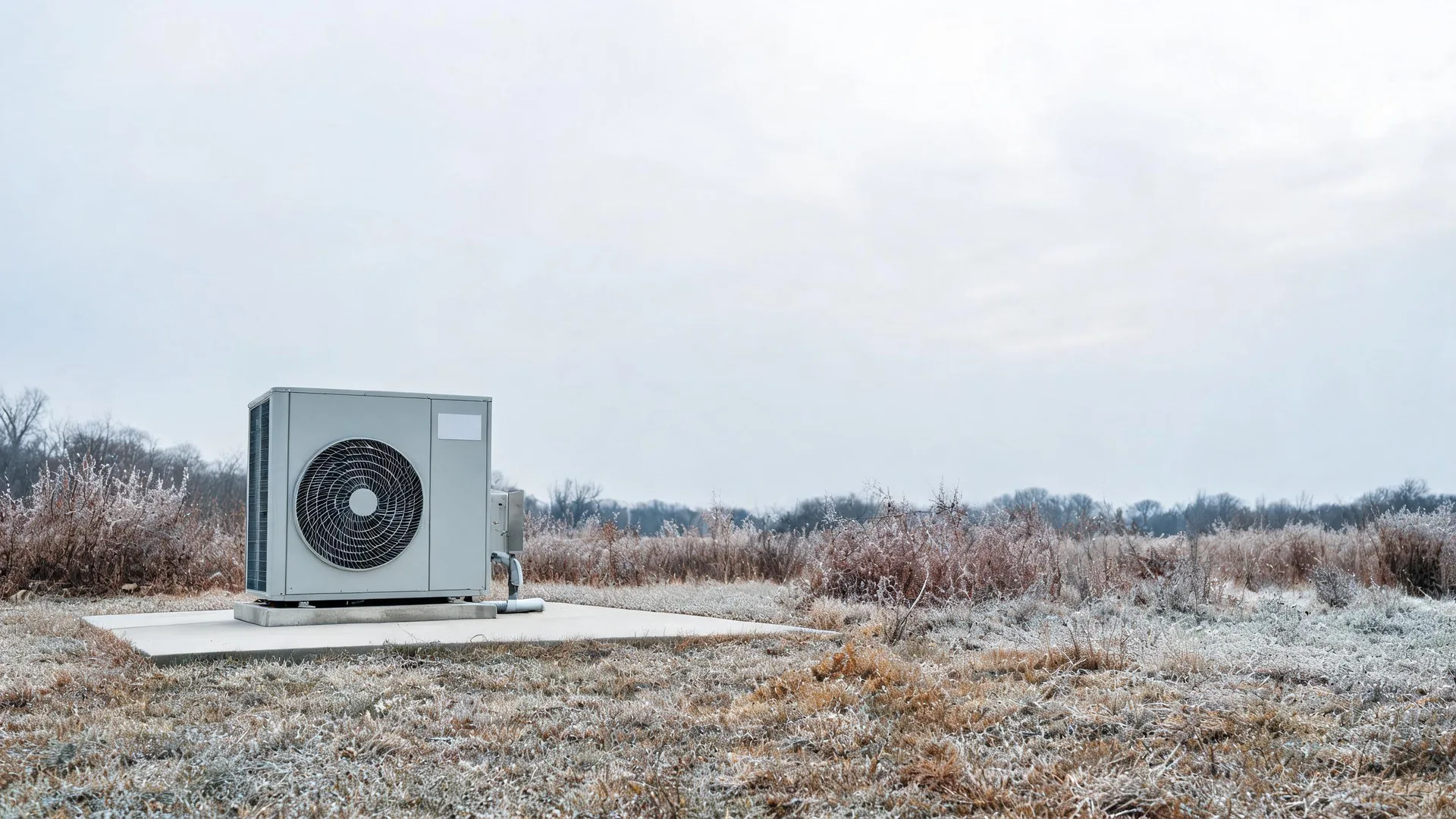
A gray residential air conditioner condenser unit mounted on a concrete pad in an open grass field.

The old unit doesn't get a slow retirement

The old condenser doesn't get hauled off still running. Once the new system is set, the refrigerant lines get cut, and whatever charge is left in the old unit has to be recovered before anything comes apart. That's the law, not a courtesy. After that the old condenser, the old coil, and the old line set if it's being swapped too, go out the door with the install crew. If the ductwork is staying, it gets tied into the new equipment rather than replaced. A system rarely fails all at once. Usually the compressor is what finally gives out, after the capacitor, the contactor, and the fan motor have already been replaced piecemeal to keep it running. By the time a homeowner is ready to replace the whole system, most of the easy repairs have already been tried.

The size comes from the house, not a chart

A load calculation looks at floor area, window placement, insulation, and how many walls face the sun before it gives a number. Houses that look alike on the outside can call for different tonnage depending on how they were built. Matching the new unit to whatever size was there before skips that work entirely.

Oversized cools fast but runs wrong

A unit that's too big chills the air quickly and shuts off before it has time to pull humidity out of the house. Starting and stopping that often also wears on the compressor more than steady running would. Sized right, the system runs longer cycles and actually dries the air while it cools it.

Overhead view of a gray residential air conditioning condenser unit mounted on a concrete pad beside a house with asphalt shingle roofing.

Going above the federal minimum saves little here, about $20 a year.

  • A higher-efficiency unit$210 a year
  • A new unit at the federal minimum, 14.3 SEER2$230 a year

Estimates for a typical Pulaski County home, from EIA household energy data, Kentucky fuel prices and NOAA climate normals. Your home will differ.

Installation day starts before anyone touches the old unit. The crew sets up outside, lays down drop cloths and runs a pump to pull the refrigerant charge out of the system that's coming out. Only after that charge is confirmed empty do the lines get cut. Inside, the air handler or coil gets swapped, and the new condenser goes on its pad outside, leveled before it's bolted down. The line set gets connected, pressure tested, then pulled into a vacuum to clear out any air and moisture before refrigerant ever goes in. Once the new charge is weighed in, the system gets run through its paces, checking airflow at the vents, cycling it on and off, and confirming the temperature split between the air going in and the air coming out.