






Overhead view of a gray residential air conditioning condenser unit mounted on a concrete pad beside a house with asphalt shingle roofing.

AC Installation in Brandenburg, KY

Tell us about the job

Takes about a minute. No obligation.

New system or replacementCentral ACMeade County, KY
Step 1 of 2

What ZIP code is the job in?

Most houses in Meade County run on electric heat, about 65 percent of them. Bottled or LP gas covers another 17.8 percent, and utility gas just 12.6 percent. If your home is one of the electric ones, a new AC usually means a straightforward swap, matched to a furnace or air handler that's already set up for it. Central air paired with electric heat is the common setup around here, so a contractor sizing your system has plenty to go on.

5 months
May through September, your air conditioner is on duty
86°F
the average summer afternoon it cools against
11 hail events
in ten years, and hail bends the fins on outdoor coils
13.4 SEER2
the federal minimum any new unit must meet
Isometric cutaway illustration of a single-story house showing interior rooms with furniture, overhead ductwork, an indoor air handler unit, and an outdoor condenser unit connected by lines at the side of the building.
Your air conditioner works hardest from June through August.

NOAA nClimDiv, 1991–2020 normals

Meade County has logged 76 severe weather events between 2015 and 2024, mostly wind and hail.

None of that changes what an AC install here needs. Standard sizing and standard equipment are enough.

Five months of summer here don't call for anything beyond standard equipment

Cooling runs May through September
Summer afternoons average 86°F
Power costs 12.79 cents a kWh statewide
Get it done before MayCooling runs May through September here, so April is the month to get it installed.

Kentucky electricity runs 12.79 cents a kilowatt-hour, cheaper than most of the country. That changes the math on a new AC. A high-efficiency model costs more up front, and the lower power rate stretches out the time it takes to earn that back. Here, a mid-range unit sized right for your house will keep bills reasonable without the extra cost of top-tier efficiency. Put the money into getting the size and installation right instead. A properly matched system installed well will cost less to run than an oversized or poorly fitted one, no matter what efficiency rating is on the label.

Your new AC has to meet 14.3 SEER2 here

Any new AC installed in Meade County has to meet 14.3 SEER2, the regional minimum for the Southeast. That's higher than the national floor of 13.4 SEER2, so not every unit on the market qualifies for installation here. A system that meets it may also qualify for a federal tax credit, worth checking into before you settle on equipment.

Find a contractor
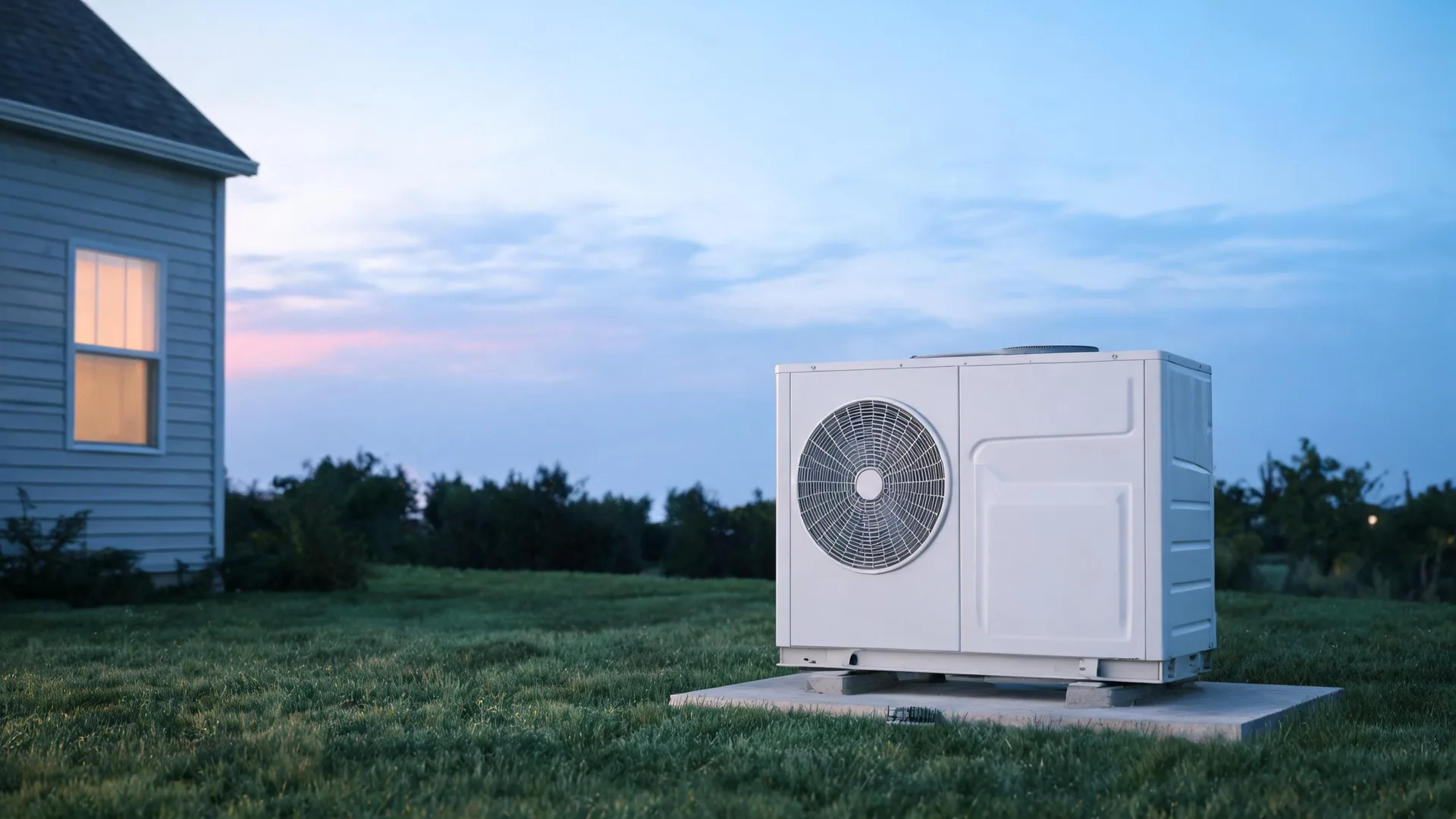
An outdoor air conditioning condenser unit mounted on a concrete pad surrounded by gravel, photographed against a partly cloudy blue sky.

Sized for the house, not the old unit

Size comes from a load calculation, not from matching the number on the old unit or guessing by square footage. A contractor works out how much heat your house gains on a hot day, counting the windows, the insulation, the walls, even which way the house faces. Too big and the system cools the air fast but shuts off before it pulls the moisture out, so the house feels clammy even at the right temperature. It also cycles on and off more, and every start puts more wear on the compressor than running steady does. Too small and it runs flat out on the hottest days and still can't keep up. The right size runs long, steady cycles that hold a even temperature and pull humidity out along the way. That calculation also has to account for the ductwork already in the house, since even the right size unit will struggle if the ducts can't move enough air to match it.

Ask what the warranty actually covers

A compressor warranty is worthless if the contractor charges labor to replace it. Ask what parts are covered, for how long, and whether labor is included or billed separately. Get the registration done at install, since some manufacturers shorten the warranty if it's not filed within a set window.

Ask who is pulling the permit

A permitted install means an inspector checks the refrigerant lines, the electrical disconnect, and the condensate drain before it's signed off. A contractor who skips the permit is skipping that check too. If something fails later, a permitted job has a record of what was done and by whom.

Overhead view of an outdoor AC condenser unit on a concrete pad next to a house with a dark shingle roof.

Going above the federal minimum saves little here, about $10 a year.

  • A higher-efficiency unit$240 a year
  • A new unit at the federal minimum, 14.3 SEER2$250 a year

Estimates for a typical Meade County home, from EIA household energy data, Kentucky fuel prices and NOAA climate normals. Your home will differ.

Install day starts with the old unit coming out, the outdoor condenser and the indoor coil both. If the new system uses a different refrigerant, the line set usually has to come out too, since old lines can carry traces that contaminate new equipment. The condenser goes on a pad outside, leveled so oil stays circulating properly in the compressor. Inside, the coil sits in the plenum above or beside the furnace, and that's where a lot of the real work happens, since the coil has to seal tight against the ductwork or the system pulls in air it never conditioned. Then it's the electrical hookup, the disconnect box, the condensate line, and a vacuum pulled on the refrigerant lines to clear out moisture and air before anything gets charged. The system doesn't run right until that vacuum holds and the charge is set to what the equipment calls for, checked against the actual temperature and airflow that day.